GEO for Local Businesses: How to Win Near Me AI Queries
TL;DR: Local GEO makes a business's location, reputation, and service data verifiable enough for AI systems to cite it in "near me" answers. Success depends on a complete Google Business Profile, fresh reviews, precise LocalBusiness schema, and consistent NAP data, not sheer citation volume.
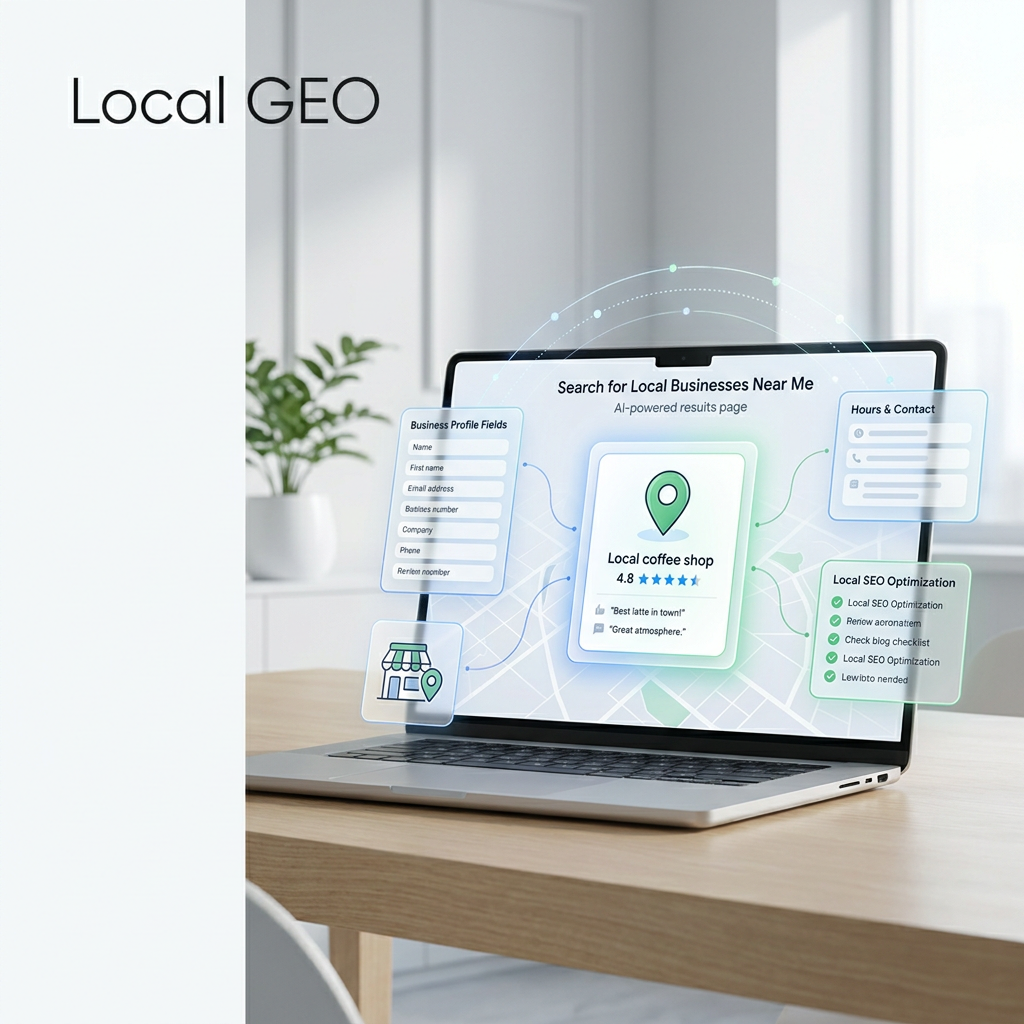
Local GEO is the practice of optimizing a local business so AI systems like Google AI Overviews, ChatGPT, and Gemini can confidently retrieve and cite it when answering "near me" queries. It depends on Google Business Profile completeness, recent reviews, LocalBusiness schema, and NAP consistency, not citation volume alone.
How AI Systems Handle "Near Me" Queries Differently From Regular Searches
When a query carries local intent, AI retrieval shifts from a general relevance model to one that weights proximity signals, entity data, and reputation. Three factors decide who gets named in the answer: category relevance, service specificity, and freshness. The AI is not just matching keywords; it resolves a real-world business entity to the searcher's location.
Industry analysis shows Google AI Overviews appear above organic results for roughly 14% of local queries. On those searches, the answer typically resolves to one or a handful of businesses, not a list of ten blue links. Any business not named in that block becomes invisible to the user, regardless of its map-pack or organic rank.
This changes the goal from "rank in the top three" to "be the entity the AI can retrieve and verify as the best fit." The retrieval process leans on structured entity data, not just on-page signals. For a deeper look at how AI systems retrieve and cite answers, see What Is AI Mode in Google? Complete Guide for 2026.
What Makes a Google Business Profile "AI-Eligible" (Not Just SEO-Complete)
Filling out every field on a Google Business Profile is table stakes. AI systems go further, using specific GBP elements as structured data points that determine whether a listing is retrievable and trustworthy for a service query.
Primary and secondary category accuracy is the strongest relevance signal. A profile listed as "Dentist" with a secondary category of "Cosmetic Dentist" matches "best dentist near me" more precisely than a generic "Dental Clinic."
Attributes and a complete service list act as a machine-readable menu. When a user asks for "teeth whitening near me," the AI cross-references the query against the profile's services and attributes. The Q&A section is an underused direct-answer source; answers to common questions become extractable text the AI can lift and cite.
Photo freshness signals activity. Uploading recent images shows the business is actively maintained, which AI systems weigh when choosing which entity to cite, especially for time-sensitive queries like "emergency dentist open now." Regular posts of updates, offers, and events reinforce this signal.
Do Review Volume and Recency Actually Influence AI Recommendations?
The review signals that move AI-generated local answers are narrower than many practitioners assume. AI systems retrieve directly from Google reviews and, for specific verticals, from category-specific platforms. A dental practice might be cited based on Healthgrades reviews alongside its Google reviews.
Review recency within the last 60 to 90 days appears to matter more to AI freshness signals than raw total count. A business with 40 recent, detailed reviews that mention specific services and outcomes can outperform a competitor with 400 stale, one-line reviews. AI models treat a cluster of fresh reviews as evidence of current, consistent performance.
Sentiment, not just star rating, is what the AI synthesizes. Phrases such as "gentle with kids" or "explained the procedure clearly" across multiple platforms influence citation decisions. Track where that sentiment appears and make sure recent reviews contain the language people use when asking for recommendations. Learn more about closing AI citation gaps.
Does LocalBusiness Schema Help AI Extract Your Business Data? A Dental Practice Example
Structured data does not create rankings; it creates extractability. For a dental practice, LocalBusiness schema in JSON-LD gives AI systems a machine-readable summary of the business, which becomes the foundation for answering "near me" queries that require specific location, hours, and services.
Take the fictional Bright Smile Dental. The JSON-LD fields that matter most for AI extraction are:
- @type: Dentist (or LocalBusiness with a more specific sub-type)
- name: "Bright Smile Dental"
- address: full street address, city, state, postal code
- geo: latitude and longitude coordinates
- openingHoursSpecification: structured day-by-day hours, including special hours for holidays
- aggregateRating: numeric rating value and review count
- hasOfferCatalog: a list of services such as "Teeth Whitening," "Dental Implants," "Emergency Dental Care"
AI systems favor pages where structured data and visible content match exactly. If the schema lists "Dental Implants" but the page text only mentions "implant dentistry," the AI hits a trust-signal failure. Aligning schema terminology with on-page copy fixes this. Validate your implementation with Google's Rich Results Test or the Schema Markup Validator to confirm extractability.
Does NAP Consistency Still Matter for AI Local Visibility?
Citation volume across dozens of directories, a pillar of local SEO in 2015, has a materially weaker influence on AI answers than it once had on map-pack rankings. In a generative-engine world, NAP consistency serves entity resolution rather than acting as a ranking lever.
The most efficient setup for AI verifiability is a Google Business Profile, the business's own website, and one or two major directories the AI regularly indexes, such as Yelp and Healthgrades for dental practices. If the name, address, and phone number match exactly across those sources, the AI resolves the entity with high confidence. Adding dozens of low-tier directories brings no measurable benefit and can introduce inconsistencies that degrade resolution.
Near Me Queries: Google AI Overviews vs. ChatGPT
Google AI Overviews pull from Google's index, Maps data, and Google Business Profile in real time, so proximity to the searcher is a hard input. When someone searches "best dentist near me," Google resolves the searcher's location and matches it against Bright Smile Dental's GBP coordinates and hours, then delivers a direct, map-grounded recommendation.
ChatGPT, without live location access, leans on aggregated reputation signals, review sentiment across the web, and named recommendations from articles and directories it has indexed. For Bright Smile Dental, a strong presence in city-specific listicles ("Top Dentists in Austin") and a steady flow of detailed reviews on Healthgrades and Google become the main signals ChatGPT can pull from. Proximity is replaced by textual prominence.
Perplexity and Gemini sit in between. Perplexity often cites sources directly, drawing from a mix of web results and structured data, while Gemini can access Google's knowledge graph but may not always apply hard location filtering without explicit permission. The practical implication: a business can be the top answer in Google AI Overviews and invisible in ChatGPT, or vice versa. Data from Why ChatGPT, Gemini & Perplexity Cite Different Brands shows that winning on one AI surface does not guarantee winning on another.
How to Test Whether Your Local Business Shows Up in AI Recommendations
Start by running the same 5 to 10 query variations across platforms on a recurring basis, not just once. Use a VPN or incognito window with location overrides to simulate searches from different cities, and record the results in a dated log for each platform.
Manual checking breaks down fast for multi-location businesses. Ongoing citation tracking and competitive benchmarking replace guesswork, giving teams a clear before-and-after picture of what changed. Ongoing citation tracking turns sporadic spot checks into a systematic audit that flags when a business drops out of an AI answer.
After Bright Smile Dental implemented the changes above (precise LocalBusiness schema, refined GBP categories, a populated Q&A section, fresh photos, and recent detailed reviews) the results shifted. Before the work, the practice appeared in 1 of 10 test queries across platforms. After, it appeared in 7 of 10. The improvement came from making the entity verifiable and extractable across every surface the AI systems query.
Key Takeaways:
- AI Overviews appear above organic results for a notable share of local "near me" searches, resolving to a short named list instead of ten links.
- Review recency (last 60 to 90 days) influences AI citation more than total review count.
- LocalBusiness schema does not create rankings; it creates extractability, and it only helps when it matches visible page content exactly.
- Citation volume across generic directories has a weaker effect on AI visibility than it did on traditional map-pack rankings. Consistent NAP across a few authoritative sources is enough.
- A business can appear in Google AI Overviews and be absent from ChatGPT's answers because the two systems retrieve from different sources.
FAQ
What is local GEO and how is it different from local SEO?
Local GEO optimizes a business so AI systems like Google AI Overviews, ChatGPT, and Gemini can retrieve and cite it in "near me" answers. Traditional local SEO aims to rank in map packs and organic results, while local GEO targets the AI's single recommendation block, where proximity, entity data, and reputation determine who gets named.
How do I get my local business recommended by AI tools like ChatGPT or Google's AI Overviews?
Complete your Google Business Profile with accurate categories, services, and recent photos. Generate fresh, detailed reviews on Google and a few major directories. Implement LocalBusiness schema that matches your visible page content exactly, and keep NAP consistent across your website, GBP, and those directories.
What role do reviews play in local GEO?
Review recency and sentiment matter more than raw volume. AI systems pull from Google reviews and from category-specific platforms such as Healthgrades for dentists. A steady stream of recent reviews with specific service language gives the AI the fresh, trustable text it needs to cite a business.
How do I optimize my Google Business Profile specifically for AI-generated answers?
Focus on precise primary and secondary categories, a complete service list, and a Q&A section filled with direct answers to common customer questions. Post regularly and upload new photos to signal activity. Each element provides extractable, structured data points that increase the AI's confidence in naming the business.
What are some real examples of "near me" AI queries?
Examples include "best dentist near me," "emergency plumber near me," "teeth whitening near me," "criminal defense attorney near me," and "urgent care open now." These queries trigger AI answers that resolve to a named business or a short list, pulling from location data, reviews, and structured entity information.
How do I track whether my business shows up in AI local recommendations?
Run the same set of 5 to 10 query variations across ChatGPT, Google AI Overviews, Perplexity, and Gemini on a recurring schedule, and log the results each time. For multi-location businesses, use a citation tracking tool that records mentions over time so you can monitor and compare visibility.
Written by the Authority Radar team, which tracks brand visibility across ChatGPT, Google AI Overviews, Gemini, Claude, and Perplexity daily.