Why ChatGPT, Gemini, and Perplexity Cite Different Brands (And What It Means for Your SEO Strategy)

A Brand Can Rank #1 — And Still Be Invisible in AI Answers
We ran a simple test across AI platforms.
Same brand.
Same queries.
Same competitors.
And yet—
In one platform, the brand appeared as a cited source
In another, it was mentioned but never cited
In another, third-party websites dominated almost entirely
This wasn’t a hypothesis.
It came directly from campaign data.
A Quick Note on This Analysis
AI platforms do not publicly disclose how they select or prioritize sources.
So instead of making assumptions, this analysis is based on:
A real campaign for HubSpot (CRM)
Identical query sets across platforms
Observed outputs from tools tracking:
Mentions
Citations
Source distribution
Share of voice
👉 These are observed patterns, not fixed rules.
The Campaign Setup
We analyzed a CRM-focused campaign tracking queries such as:
Best CRM with marketing automation
Best CRM with WhatsApp integration
Best CRM with email automation
Across platforms including:
Perplexity
Grok (xAI)
Each platform was evaluated on:
Brand mentions
Brand citations
Source distribution
Competitor visibility
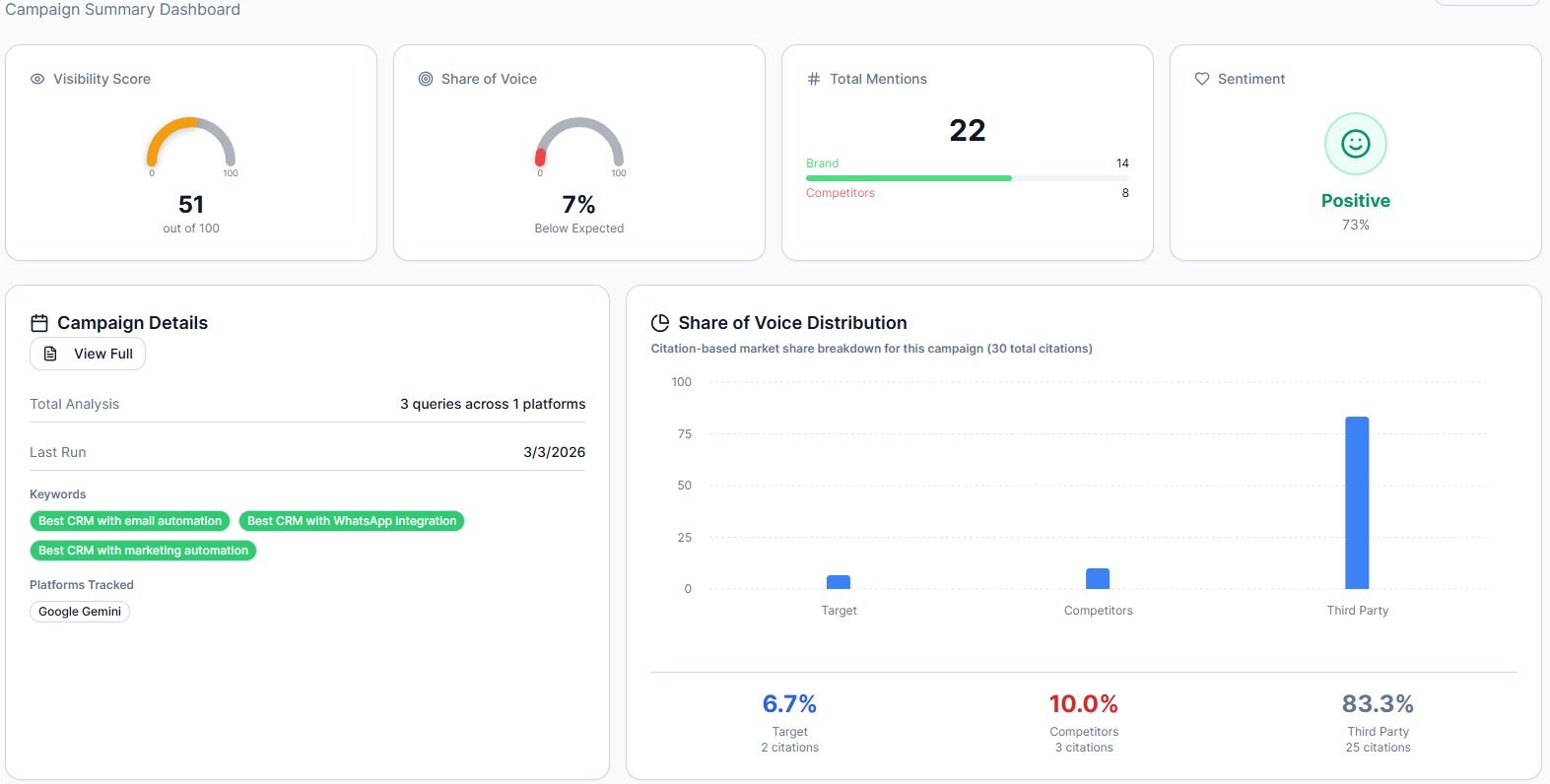
Caption: Campaign overview showing citation distribution and visibility for CRM queries on Perplexity
What We Observed Across Platforms
1. Same Queries, Different Citation Outcomes
For the same set of CRM queries:
In Perplexity:
The target brand (HubSpot) appeared as a cited source
Citations included a mix of:
Brand-owned content
Third-party comparison sites
Visibility was distributed across multiple sources
In Grok (xAI):
The same brand (HubSpot) received:
15 mentions
0 citations
Approximately 95% of citations came from third-party sources
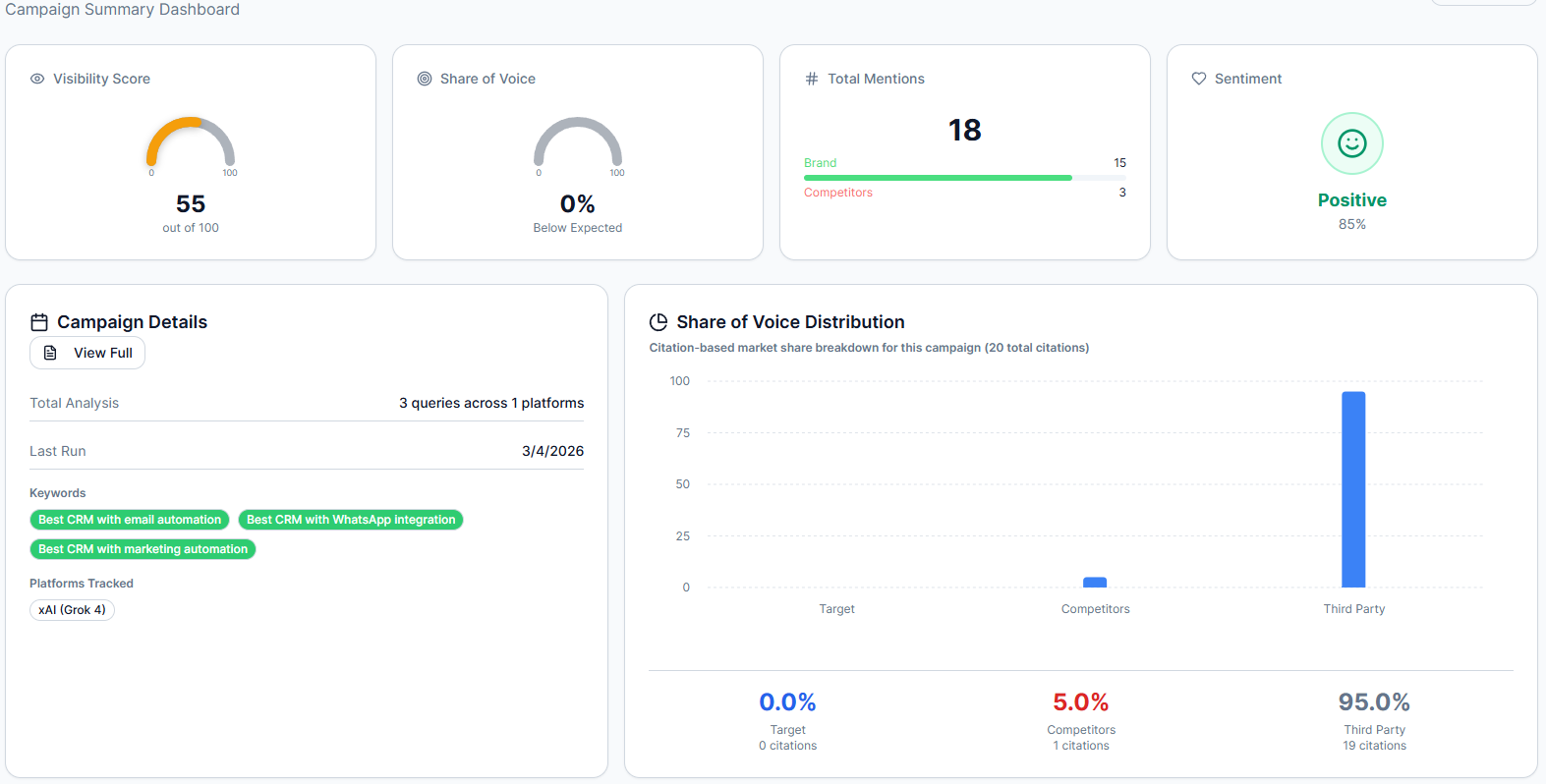
Caption: Same queries on Grok (xAI): brand mentioned but not cited; third-party sources dominate
What this suggests
For identical queries, the brand contributed to the response in one platform—but not to the source layer in another.
2. Mentions vs Citations: A Critical Gap
In the Grok dataset:
Brand mentions: 15
Brand citations: 0
Why this matters
This highlights a key distinction:
A brand can be part of the generated answer, but not part of the sources used to support it.
In practical terms:
Mentions → awareness
Citations → authority, attribution, and likely traffic
3. Third-Party Sources Can Dominate Visibility
In the Grok campaign:
~95% of citations came from third-party sources
These included:
Review platforms
Comparison blogs
Industry content sites
What this suggests
In some AI-generated responses, visibility may depend heavily on:
👉 External ecosystem coverage—not just your own website
4. Platform Behavior Is Not Consistent
Comparing the same campaign across platforms:
Perplexity included the brand within cited sources
Grok relied heavily on third-party citations
The same queries produced different attribution patterns
What this suggests
Different platforms may construct answers differently—leading to variation in:
Which sources are cited
How brands are represented
How much weight is given to third-party content
Interpreting These Differences (Carefully)
We are not claiming that any platform follows a fixed rule.
However, based on repeated observations, differences in citation behavior may relate to:
How easily content can be summarized
How structured or comprehensive it is
Whether external references support content
The role of third-party validation in the answer
A Closer Look: Same Brand, Same Queries — Different Outcomes
For the CRM campaign:
Queries analyzed:
Best CRM with marketing automation
Best CRM with WhatsApp integration
Best CRM with email automation
Observed outcome:
In Perplexity:
HubSpot was included in cited sources
Appeared alongside comparison content
Contributed directly to the answer’s references
In Grok:
HubSpot appeared in generated text (15 mentions)
But did not appear in citations
Third-party sources dominated the reference layer
Interpretation
The difference was not in:
Query intent
Brand relevance
Topic coverage
It was in:
👉 How each platform selected and displayed sources
What This Means for SEO Teams
1. Ranking Does Not Guarantee Inclusion
A page can perform well in traditional search and still:
Not be cited
Not be attributed
Not influence AI-generated answers
2. AI Visibility Is Multi-Layered
From the campaign data, visibility operates across layers:
Mention layer → brand appears in text
Citation layer → brand is used as a source
Source ecosystem → third-party influence
3. Your Content Is Only Part of the Equation
With third-party citations dominating in some cases:
👉 Visibility may depend on:
Review coverage
Listicles
Industry mentions
External validation
4. Multi-Model Gaps Create Opportunity
Most brands are likely to be:
Strong in one platform
Underrepresented in another
Without tracking this, these gaps remain invisible.
A Practical Framework (Based on Observations)
Step 1: Audit Across Platforms
Track:
Mentions
Citations
Source distribution
Across multiple AI systems.
Step 2: Identify Gaps
Look for patterns like:
High mentions, low citations
Strong presence in one platform, weak in another
Third-party dominance replacing your brand
Step 3: Adjust Content Strategy
Based on observed patterns:
Improve clarity and extractability
Strengthen structure and depth
Increase presence in third-party ecosystems
Build stronger evidence and credibility
Step 4: Monitor Continuously
These patterns are not static.
They evolve with:
Model updates
Content ecosystem changes
Query trends
Why This Matters Commercially
If your brand:
Is not cited
Is replaced by competitors
Or is overshadowed by third-party sources
Then:
👉 You lose visibility before users even visit a website
The Bigger Shift: From Rankings to Representation
Traditional SEO:
Where do we rank?
AI-driven discovery:
How are we represented—and cited—across platforms?
Final Takeaway
From this campaign, we observed:
Identical queries producing different citation outcomes
Mentions without citations
Strong third-party dominance in some platforms
Clear variation across AI systems
We are not defining rules.
But we are seeing a pattern:
AI visibility is fragmented—and model-dependent.
Want to See Your Own Data?
Most teams track rankings.
Few track:
Citations
Mentions
Platform-level visibility
Source distribution
Authority Radar helps you:
Track performance across AI platforms
Identify where you’re cited (and where you’re not)
Analyze competitor presence
Act on real data
👉 Start your first campaign and understand your true AI visibility.