What Is Google AI Mode? How It Works, and What It Means for Your Brand (2026)


If you've been Googling things lately and getting full conversational answers instead of a list of blue links, that's AI Mode. It rolled out broadly in May 2025, hit 75 million users by December, and now reaches over 100 million people every month across the US and India. It is, by every honest measure, the biggest shift in how Google works since universal search.
This guide covers what AI Mode actually is, how it works under the hood, the data you should know, and what changes for SEO and brand visibility — without the marketing gloss.
What Is Google AI Mode?
Google AI Mode is an AI-powered search experience that uses a custom version of Gemini to interpret your question, run multiple searches behind the scenes, and synthesize the results into a conversational answer with citations. You can keep asking follow-ups in the same thread, the way you would with ChatGPT or Perplexity.
It launched as a Search Labs experiment in early 2025 and rolled out widely in the US starting May 2025 at Google I/O. Since then it's expanded to over 200 countries and 35+ languages, picked up Gemini 3 Pro reasoning in late 2025, and added agentic, multimodal, and personalization features that keep arriving roughly every quarter.
A few things worth getting straight up front:
AI Mode is not the same as AI Overviews. AI Overviews are short summaries that appear above traditional results. AI Mode is a separate tab — and increasingly, a separate experience — that replaces the SERP entirely with a generated answer.
AI Mode is not the Gemini app. Gemini is Google's standalone assistant. AI Mode is Gemini-powered, but it lives inside Search and is grounded in Google's web index, Knowledge Graph, Shopping Graph, and Maps data.
It is where Google has said search is going. Sundar Pichai and Robby Stein have both been clear that AI Mode is the future-state of Google Search, not a side experiment.
AI Mode by the Numbers (2026)
The data below comes from Google's earnings calls, Semrush, SE Ranking, BrightEdge, and a Digital Third Coast consumer survey. I've cited each so you can verify or reuse them.
75 million users by December 2025, up roughly 4x from May 2025
100M+ monthly active users in the US and India (Sundar Pichai, Q2 2025 earnings)
AI Mode share of Google searches went from 0.25% in early May 2025 to over 1% by early July 2025 (Semrush)
Average AI Mode query is 7.22 words long, almost double the 4.0-word average for traditional search (Semrush)
Average AI Mode session lasts ~11 minutes vs 2–3 minutes for traditional search
Zero-click rate inside AI Mode is roughly 93%, compared to ~34% in standard Google Search without an AI Overview (Semrush)
Only 32% of URLs in AI Mode sidebars match the top 10 organic results; domain overlap is around 51% (SE Ranking)
Same query tested three times in AI Mode shows just 9.2% URL overlap with itself — meaning citations are highly volatile
Average AI Mode answer contains 12.6 links, vs 13.3 for AI Overviews
Reddit appears in 68%+ of AI Mode answers, alongside YouTube, Wikipedia, and Google's own properties
AI Overviews now appear on ~48% of all queries and reduce organic CTR by 15–61%, with position #1 seeing the sharpest drop at ~34.5% (BrightEdge, via DigitalApplied)
68% of users fact-check the AI-generated information they receive (Digital Third Coast survey of 1,001 Americans)
If you only remember three things from that block: AI Mode citations don't track traditional rankings, the same query gives different answers each time, and most users never click through.
How Google AI Mode Works (Under the Hood)
Most explainers stop at "it uses AI." That's not useful. Here's what's actually happening when you type a question.
Query fan-out
This is the core mechanism. Instead of treating your question as one query, AI Mode breaks it into multiple sub-queries and runs them in parallel. A search like "best project management tool for a remote design team of 12" gets decomposed into things like "project management tools for design teams," "PM tools with strong remote collaboration features," "project management pricing tiers under 15 users," and so on.
Robby Stein, Google's VP of Search, has described AI Mode running up to 16 simultaneous sub-queries for a typical complex prompt. For Deep Search, that number goes into the hundreds. The system uses Google Search itself as a backend tool — it's the same index and ranking signals you've always optimized for, just executed at fan-out scale.

This is why a page that doesn't rank top 10 for your head term can still get cited. It might rank well for a sub-query you didn't even know was being run.
Retrieval-Augmented Generation (RAG)
Once the sub-queries return results, the model doesn't just summarize from training data. It pulls passages from real, current web pages and uses them as the source material for its answer. That's RAG: the model is grounded in retrieved documents rather than just guessing from what it remembers.
The practical implication: AI Mode is selecting passages, not pages. A single well-structured paragraph from a mid-ranking page can beat a comprehensive guide if that paragraph more directly answers a sub-query. This is why content chunking, clear headings, and self-contained sections matter more in 2026 than they did in 2023.
Gemini 3 Pro and the model selector
In late 2025 Google added a model dropdown inside AI Mode. The default "Fast" model handles most queries. "Thinking with 3 Pro" — Gemini 3 Pro — kicks in for harder reasoning tasks and is gated behind Google AI Pro and Ultra subscriptions. Gemini 3 brought a major upgrade to query fan-out by understanding intent more precisely and discovering content the previous model missed.
There's also a developer-facing detail worth knowing: in the Gemini API, you can configure when the model triggers web grounding using a dynamicThreshold parameter on dynamic_retrieval_config. That threshold determines whether a query is answered from training data or routed through retrieval. It's one of the few peeks under the hood into how Google decides when to invoke RAG.
Deep Search
Deep Search is an opt-in mode for AI Pro/Ultra subscribers. It runs the same fan-out technique but at much greater scale — hundreds of sub-queries, multiple minutes of processing — and produces a fully cited research report. Stein has described using it for things like comparing home safes by fire-resistance rating and insurance compatibility. It's not what most users will trigger, but it's a sign of where the experience is headed.
AI Mode vs AI Overviews vs Gemini vs ChatGPT Search vs Perplexity
This is the disambiguation question I get asked most often. Here's the cleanest comparison I can offer:
Product | Where it lives | What it does | Powered by | Free? |
|---|---|---|---|---|
Google AI Mode | Inside Google Search (tab + google.com/ai) | Replaces SERP with conversational answer; follow-ups; citations | Custom Gemini + Gemini 3 Pro | Yes (with Pro features gated) |
Google AI Overviews | Top of standard Google SERP | Short AI summary above traditional results | Gemini family | Yes |
Gemini app | gemini.google.com & mobile app | Standalone AI assistant; productivity, code, images, video | Gemini 3 family | Yes (with Pro/Ultra tiers) |
ChatGPT Search | inside ChatGPT | AI chat with web grounding | GPT-5.x | Yes |
Perplexity | Answer engine, citation-first design | Mix of frontier models | Yes |
The simple version: AI Overviews are the appetizer, AI Mode is the full meal, Gemini is the standalone restaurant, and ChatGPT/Perplexity are competing chains.
How to Access Google AI Mode
Three ways to get there:
Visit google.com/ai directly.
Type a query into google.com and tap the AI Mode tab.
On the Google app, tap the AI Mode icon on the home screen.
Countries: Available in 200+ countries and territories as of early 2026, with 35+ languages added in the latest expansion. Initial markets were the US and India.
Account type: Personal Google accounts only at the consumer level. Workspace accounts have limited access depending on admin settings.
Age: Most features require 18+. Personalization features (Gmail and Photos integration) are gated to US-only users 18+.
Subscriptions: AI Mode itself is free. Gemini 3 Pro ("Thinking") inside AI Mode, Deep Search, and Nano Banana Pro image generation require Google AI Pro or Ultra.
Search history: Recommended to enable Web & App Activity. Without it, AI Mode works but won't let you pick up where you left off.
AI Mode vs Traditional Google Search
Traditional Google Search | Google AI Mode | |
|---|---|---|
Output | Ranked list of links | Synthesized answer with optional sidebar citations |
Query length (avg) | 4.0 words | 7.22 words |
Session length (avg) | 2–3 minutes | ~11 minutes |
Zero-click rate | ~34% (no AIO) / ~43% (with AIO) | ~93% |
Sources surfaced | 10 organic results per page | ~7 unique sidebar domains, 12.6 links per answer |
Result stability | Mostly stable for the same query | ~9.2% overlap when the same query is run 3 times |
What "winning" looks like | Ranking high enough to earn a click | Being cited, mentioned, or recommended in the answer |
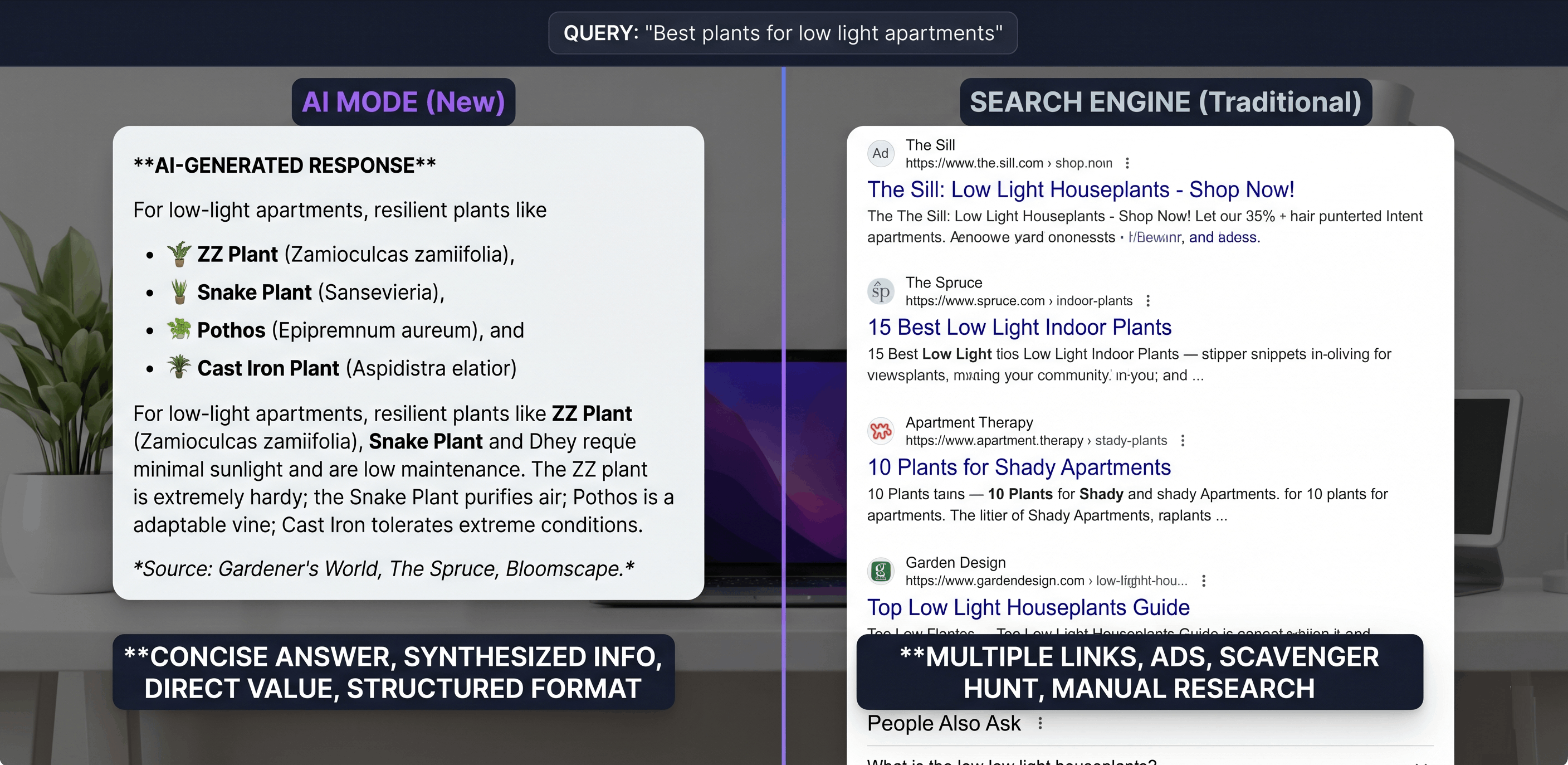
The pattern is clear once you see it: a page can rank #2 organically and contribute nothing to the AI answer. Another page that doesn't crack the top 20 can be cited because it directly answered a sub-query.
Industry CTR Impact: Where AI Mode Hits Hardest
Not every industry is feeling this equally. BrightEdge data tracked from February 2025 to February 2026 shows AI Overview prevalence varies sharply by sector. Roughly:
B2B Tech and SaaS: very high AI Overview/AI Mode coverage on informational queries
Healthcare and Insurance: high coverage, particularly on definitional and comparison queries
Education: high coverage on "how does X work" queries
Legal: rising coverage on procedural and definitional questions
Local services: lowest exposure — AI Overviews show on roughly 7% of local queries
Ecommerce: ~16% of ecommerce queries trigger AI Overviews; transactional queries are increasingly affected
If you're in a heavily AI-affected vertical and you're still measuring success purely by keyword rank, you're optimizing for a smaller and smaller slice of the actual demand. The CTR drops on top-of-funnel informational queries — which is where most SaaS and content-led businesses build awareness — are real. Position #1 in particular is taking a hit because AI Overviews now sit above it.
Why AI Mode Matters for SEO and Brand Visibility
Four shifts that matter, each backed by what the data is actually showing:
Rankings no longer equal visibility. With only 32% URL overlap between AI Mode citations and the top 10 organic results, "ranking #1" and "being in the answer" are increasingly different outcomes. Optimizing for one doesn't guarantee the other.
Citation has become a new SEO currency. When AI Mode names your brand or pulls a passage from your page, that's a form of visibility traditional rank tracking can't see. It builds familiarity and trust before a click ever happens — Barry Schwartz has called it billboard SEO, and the analogy holds.
Competitive comparison happens inside the answer. AI Mode actively compares brands, tools, and products in its responses. If three competitors get named and you don't, that's not a ranking issue — it's an authority and representability issue, and it compounds.
Framing matters as much as presence. A brand mentioned as "the recommended option" gets a different downstream outcome than one mentioned as "an older alternative." Sentiment and stance inside AI answers are now part of brand positioning, whether you measure it or not.
How to Optimize for Google AI Mode
The honest version: there's no shortcut, and anyone selling you one is either confused or lying. What works is consistent application of a few practices that signal relevance and authority to retrieval-based systems.
Answer specific questions specifically. Lead with the answer. Define the term in the first sentence. AI Mode disproportionately pulls from the first 30% of a page's text — about 44% of all LLM citations come from there, so your intro is doing more work than ever.
Build topical depth, not just page-level optimization. Cover the cluster, not just the head term. Fan-out runs sub-queries you haven't optimized for individually; topical authority increases your odds of being relevant to one of them.
Structure content for chunk extraction. Self-contained paragraphs, clear H2/H3 hierarchy, schema where it fits. The model is selecting passages, not pages.
Earn citations from sources AI systems trust. Original research, attributed data, and expert-led perspectives travel further than aggregated content.
How to Tell If Your Brand Appears in AI Mode
This is where most teams have a measurement gap. Traditional rank trackers don't track AI answers. To know whether your brand appears in AI Mode, you need to know which prompts trigger AI answers in your category, whether your brand is mentioned or cited, how it's framed, which competitors share the same answers, and how that's trending over time.
There's a longer companion piece on how to track your brand in Google AI Mode that walks through the methodology in detail.
Common Misunderstandings About Google AI Mode
"If I rank #1 I'll be in the AI answer automatically." Not how it works. With ~32% URL overlap between top-10 organic results and AI Mode citations, ranking and being cited operate on different signals.
"AI Mode is replacing SEO." It's expanding what SEO has to cover. Rankings still matter — they're a signal AI Mode uses. But citation, mention, and framing are now separate measurable outcomes.
"Only big brands get cited." False. Reddit threads get cited heavily. So do small specialist sites with strong topical depth. Specificity often beats domain size in retrieval-based systems.
"This is a technical SEO issue." It's a content, authority, and brand issue. Technical SEO is the floor, not the ceiling.
What's Next for AI Mode
A few things to watch over the next few quarters:
Agentic features. Project Mariner is bringing agentic capabilities into AI Mode — the ability to take action on your behalf, like booking, ordering, or comparing across providers.
Personal Intelligence. AI Mode is starting to use connected Gmail, Photos, and Workspace data to personalize answers. This will fragment the SERP further: same query, different answers per user.
Generative UI. Gemini 3 in AI Mode now generates dynamic interactive simulations and tools on the fly for the query. That's a different game from "AI summarizes a page."
Ad expansion. Ads are appearing in roughly 25.5% of AI-generated results, up sharply year-over-year. Monetization is moving inside the answer.
The direction of travel is consistent: more answers, fewer clicks, more decisions made before a user ever lands on your site.
A Quick Note on How Authority Radar Helps
Authority Radar is built specifically for measuring brand visibility inside AI search experiences, including Google AI Mode. We track which prompts trigger AI answers in your category, whether your brand is mentioned or cited, how it's framed, and how competitors are positioned in the same answers — at a query-by-query level. If the data in this guide is making your dashboard feel incomplete, that's the gap we close. See how it works.
Frequently Asked Questions
What is Google AI Mode in plain English?
It's an AI-powered version of Google Search that gives you a full conversational answer instead of a list of links, and lets you ask follow-ups in the same thread.
Is Google AI Mode free?
The base experience is free. Gemini 3 Pro inside AI Mode ("Thinking"), Deep Search, and Nano Banana Pro image generation require a Google AI Pro or Ultra subscription.
Is Google AI Mode replacing traditional Google Search?
Not yet, but it's the direction Google has publicly committed to. Traditional results still exist and still matter — AI Mode is currently a separate tab and an opt-in experience for most queries.
How is AI Mode different from AI Overviews?
AI Overviews are short AI summaries above traditional search results. AI Mode is a separate experience that replaces the search results page with a generated answer and supports conversational follow-ups. They share underlying tech but only ~10.7% of URLs overlap between them.
How is AI Mode different from Gemini?
Gemini is Google's standalone AI assistant (gemini.google.com). AI Mode is Gemini-powered but lives inside Search and is specifically grounded in Google's web index and structured data sources.
Which countries is AI Mode available in?
Over 200 countries and territories as of early 2026, in 35+ languages. Some advanced features (like Personal Intelligence and Project Mariner agentic features) are US-only at launch.
How do I turn on AI Mode?
Visit google.com/ai, or tap the AI Mode tab in Google Search, or use the AI Mode icon in the Google app. You'll need to be signed into a personal Google account.
Does AI Mode hallucinate?
Less than a pure LLM chatbot would, because it grounds answers in retrieved web content via RAG. But it still makes mistakes. Google labels AI Mode answers as experimental, and 68% of users say they fact-check AI-generated information regardless.
Will my website still get traffic with AI Mode in the picture?
Yes, but the math is changing. Zero-click rates inside AI Mode hit ~93%, and only 6–8% of AI Mode sessions click out to an external site. Traffic from AI Mode is real but comes through a narrower door.
Can my brand appear in AI Mode answers?
Yes. Pages with clear, well-structured, authoritative content on specific topics regularly get cited. Domain authority helps but doesn't decide it — passage-level relevance to a sub-query often matters more.
How do I track my brand inside AI Mode?
Standard rank trackers don't show AI answers. You need a platform that monitors prompts, captures AI-generated answers over time, and detects brand mentions, citations, sentiment, and competitor presence inside those answers. Authority Radar is built for this.
How often does AI Mode change its answers?
Frequently. The same query run three times in AI Mode shows just ~9.2% URL overlap with itself. Volatility is part of the model — which is why measuring visibility over time, not at a single point, is the right approach.
Sources and Further Reading
Have questions about how your brand is showing up in AI-powered search? Start a free Authority Radar trial and see your visibility inside AI Mode at the prompt level.