Content Recovery. Only on Authority Radar.

Every Tool Tells You Traffic Dropped. We Tell You If You Can Get It Back.

Content Recovery scores every declining page on whether recovery is realistic, sorts each one into fix now, rebuild, abandon, or ignore, and then measures whether your fix actually worked. Stop pouring weeks into pages that were never coming back.

Start Free TrialBook a 15-Minute Demo

7-day free trial. No credit card. Connect Search Console in one click.
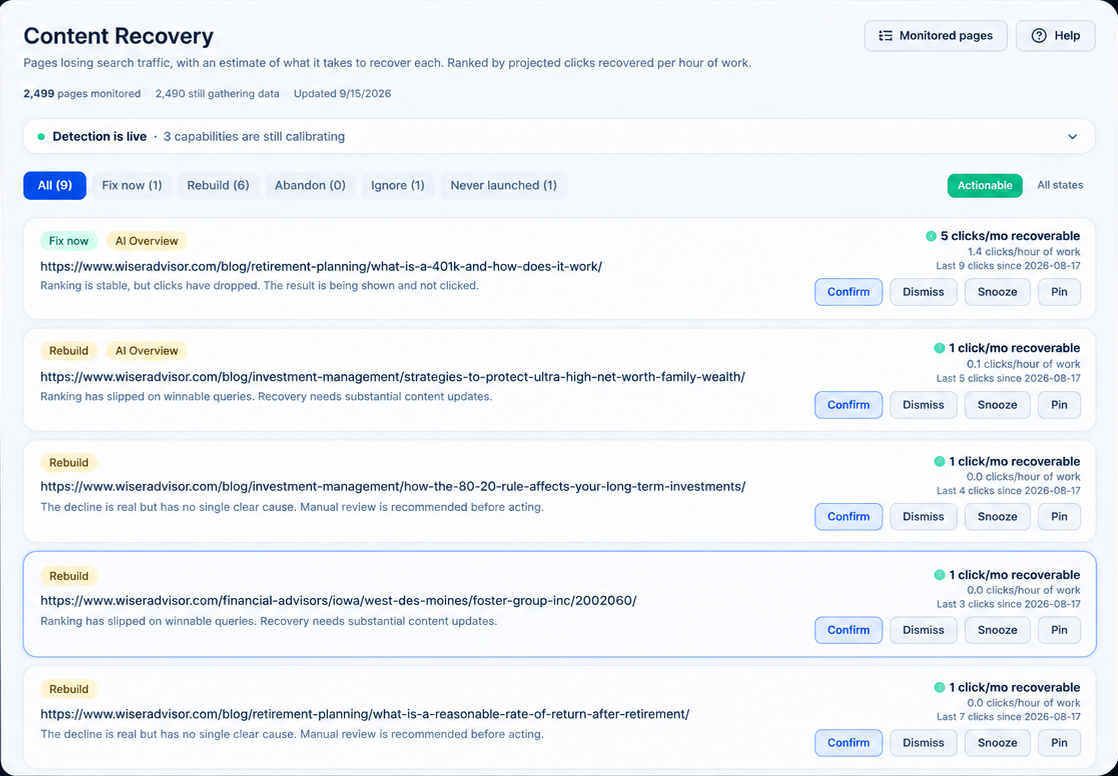
The Recovery Inbox: a prioritized list of declining pages, each with a verdict chip, a reason label, and an opportunity value

Losing Traffic Is Not the Problem. Not Knowing What to Do About It Is.

Your dashboards are full of red arrows. None of them tell you which fights are worth having.

Everything flags the drop. Nothing ranks the fix.

Ahrefs, Semrush, and Search Console all show you pages losing traffic. Then they leave you to guess which ones are actually worth your time.

You spend weeks on pages that were never coming back.

Some declines are permanent. Falling demand, a query that moved on, a page the market left behind. Reviving it is effort you will never get back.

You cannot prove your last fix worked.

You refreshed a stack of pages last quarter. Traffic moved. Was it you, or was it the whole market moving? Nobody on the team can say for sure.

AI answers are quietly taking your clicks.

A page can hold its ranking and still bleed clicks, because the answer now sits at the top of the results and the user never scrolls. That looks like decay, but the fix is different.

Your reporting is a spreadsheet and a hunch.

Which pages to touch, in what order, and whether it paid off. Right now that lives in your head, not in a system.

You do not need another red arrow.

You need a verdict, a reason, and proof. That is Content Recovery.

Four Words That Replace a Week of Guessing.

Content Recovery reads the decline, weighs how realistic a comeback is, and gives each page one plain call. You work the list top to bottom instead of staring at a graph.

Fix NowHigh-value pages with a recoverable decline. The best return on your time. Start here.
RebuildWorth saving, but a light edit will not cut it. These need a real reworking, and we tell you why.
AbandonThe honest call. Demand left, the page will not come back, and your effort belongs elsewhere. Deliberately conservative, so we only say this when we mean it.
IgnoreThe dip is noise, not decay. No action needed. We keep it off your list so the real problems stand out.

Most tools give you every declining page as one long, flat list. We tell you which four piles they belong in.

A Drop Has a Cause. We Name It.

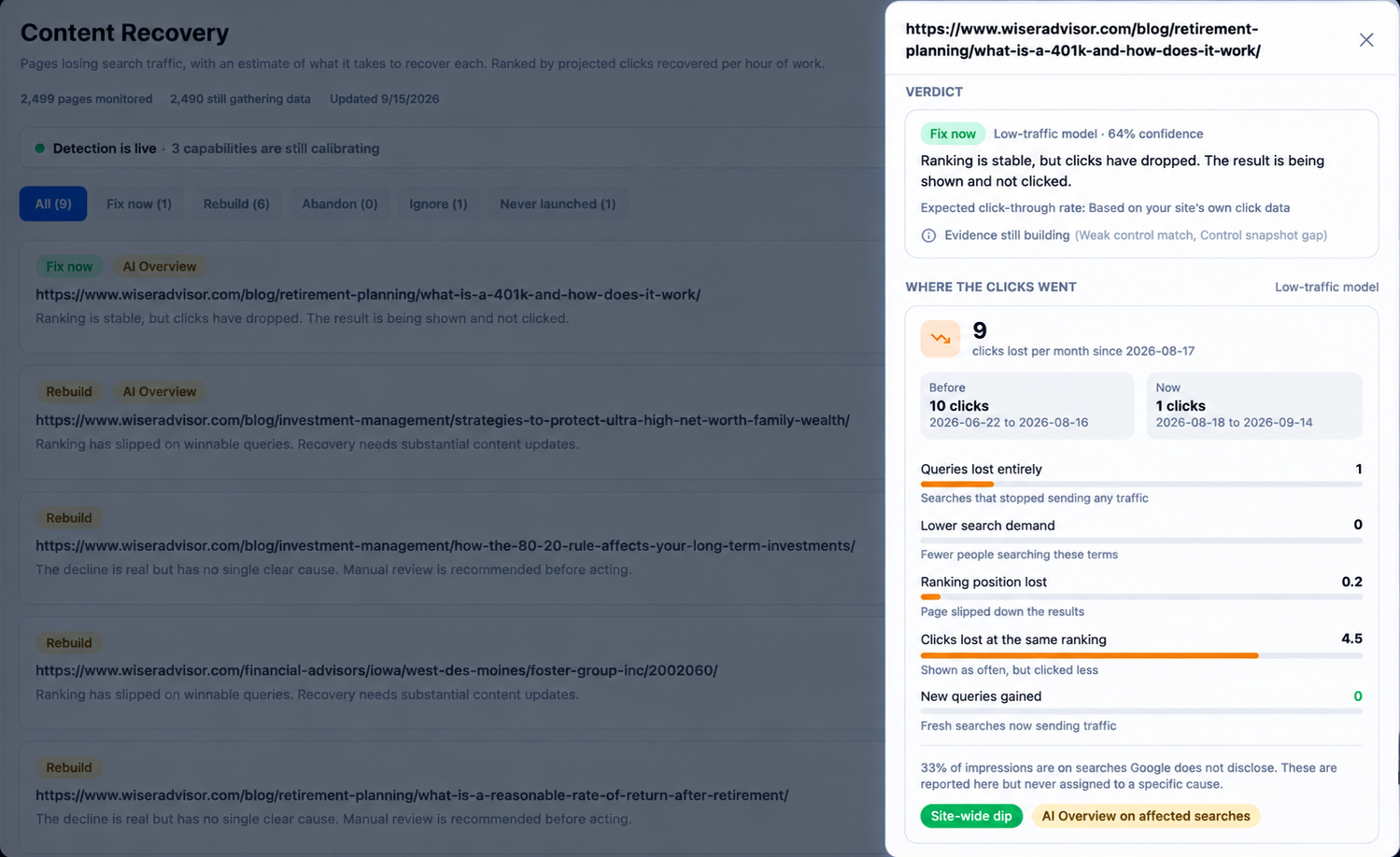
"Traffic is down" is not a diagnosis. Content Recovery separates the reasons a page is bleeding, because each one points to a different fix. Guessing the cause is how you waste a rewrite on a page that actually lost demand.

  • Lost rankings: you slipped down the results and the clicks followed.
  • Lost queries: searches you used to win no longer land on the page.
  • Falling demand: the topic itself is cooling, and no rewrite changes that.
  • Clicks taken by AI answers: you still rank, but the answer now sits above you and the click never happens. Track those clicks separately.
Start Free Trial
Content Recovery diagnosis view: the decline reason labelled clearly for a single page, with the supporting trend behind it
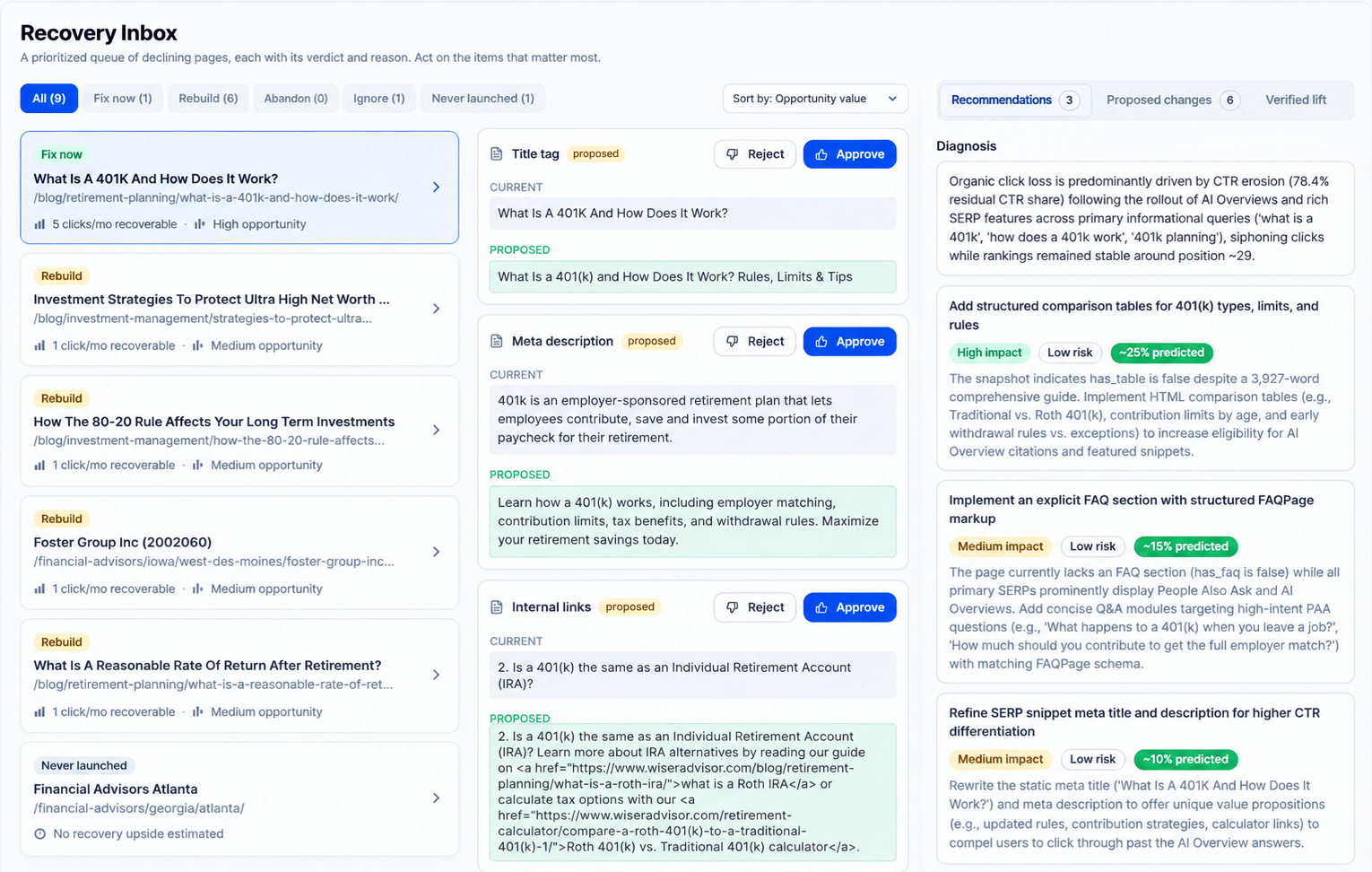
Recovery Inbox: the prioritized queue of declining pages with verdict chips down the side

A Queue You Clear, Not a Dashboard You Stare At.

The Recovery Inbox stacks your declining pages by opportunity, most valuable first, each already carrying its verdict and its reason. You open the top item, act, and move on. No hunting, no spreadsheet, no deciding where to start.

  • Pages ranked by the size of the opportunity, not by alphabet or date.
  • Every item arrives with its verdict and its cause already attached.
  • Pin the pages you care about, exclude the ones you do not, and let Content Recovery fill the rest.
  • Clear the queue and know exactly what you touched and why.
Start Free Trial

We Do Not Just Tell You to Fix It. We Tell You If the Fix Worked.

After you change a page, Content Recovery measures it against similar pages you did not touch. If those pages moved too, it was the market. If yours moved and theirs did not, that was your fix. You get real lift, including the honest truth when there was no lift at all.

Know what is worth fixing

Not every drop is recoverable. We tell you which ones are, so your team spends effort where it pays.

Know why it dropped

Lost rankings, lost queries, falling demand, or clicks taken by AI answers. Each one needs a different fix, and we name it.

Know if it worked

Every change is measured against similar pages you did not touch. Real lift, not a hopeful guess. Including the honest truth when there was no lift at all.

In early testing, a refreshed batch of 12 pages marked Fix Now showed measured lift on 9 within 6 weeks, averaging +34% clicks. Two showed no lift. We reported those too.

The agency question

Last quarter your team updated a stack of pages. Can you tell your client which ones actually made a difference? Almost nobody can. Content Recovery can.

Why not just point an MCP at Search Console?

An MCP can tell you a page is bleeding. It cannot tell you whether the bleeding will stop if you act, and it cannot prove your fix is why it stopped. Proving recovery needs a stable per-page baseline, a set of similar pages you did not touch to compare against, and months of history to separate your fix from the whole market moving. That is a system, not a prompt. It is exactly what Content Recovery runs.

Live in Minutes. Sharper Every Week.

Connect Search Console.

One secure click. No passwords stored. This is the data Content Recovery runs on.

Get your verdicts.

Your declining pages arrive in the Recovery Inbox, each sorted into fix now, rebuild, abandon, or ignore, with the reason attached.

Act, then see the proof.

Work the queue, make your changes, and watch each page measured against the ones you left alone.

Most of Content Recovery works from the moment you connect Search Console, because it reads the history Google already holds. A few signals need to watch your site for a couple of months before they are trustworthy, and we mark those clearly in the product with a Maturing chip instead of pretending they are ready. You always know whether a number is solid or still settling.

Everyone Sees the Drop. One Tool Scores the Comeback.

Here is where the usual tools stop, and where Content Recovery keeps going.

CapabilityAuthority RadarPeec AIOtterly AIAhrefs Brand RadarProfound
Flags pages losing trafficYesNoNoNoNo
Scores whether the decline is recoverableYesNoNoNoNo
Plain verdict per page (fix / rebuild / abandon / ignore)YesNoPartialNoNo
Names the specific cause of the dropYesNoNoNoNo
Flags clicks lost to AI answers, not just rankingsYesNoNoNoNo
Measures whether your fix actually workedYesNoNoNoNo

Spotting the decline is the easy part. Knowing which ones to fight, and proving you won, is the whole job.

Built for the People Who Have to Answer for the Traffic.

Agencies

Walk into the renewal with proof. Show each client exactly which pages you recovered and which fixes moved the needle.

In-house SEO teams

Stop defending guesswork in the leadership meeting. Bring a ranked list, a reason for each page, and measured lift.

Content teams

Know which existing pages to refresh before you write a single new one, and prove the refresh paid off.

Ecommerce brands

Find the category and product pages quietly bleeding revenue, and learn which are worth saving.

SaaS marketers

Protect the pages that bring in signups, and catch the slow decline before it shows up in the pipeline.

Your Best Pages Are Slipping. Find Out Which Ones You Can Save.

Connect Search Console and see your Recovery Inbox in the next few minutes. Free.

7-day free trial. No credit card. Cancel anytime.

Questions, Answered Straight.

No, and be wary of anyone who says they can. Nobody controls Google or demand. What we guarantee is that you will know which pages are worth fixing, why each one dropped, and whether your fix actually worked. That is how real recovery happens.

We weigh the decline against how realistic a comeback is, and we are deliberately conservative about calling a page a lost cause. When we say abandon, it is because the effort genuinely belongs elsewhere, and we would rather protect your time than flatter a page.

After you change a page, we compare it against similar pages you did not touch. If the untouched pages moved too, the market moved. If only yours moved, that was your fix. It is the difference between a real result and a hopeful guess.

Yes. Content Recovery runs on your Search Console history, and connecting it takes one secure click with no passwords stored.

Most of it, yes, because it reads the history Google already holds. A few signals watch your site for a couple of months before they are trustworthy, and we label those clearly in the product rather than pretending they are ready.

You can ask an AI whether a page dropped. You cannot ask it to prove your fix caused a recovery, because that needs a stable baseline, a set of comparison pages you did not touch, and months of history. That is a system, not a prompt.

They flag the drop. We score whether it is recoverable, name the cause, and measure whether your fix worked. It is built to sit alongside your current tools or replace them, depending on your stack.

Minutes. Connect Search Console and your Recovery Inbox is waiting in the same session.

Content Recovery is included in every Authority Radar plan. Every plan includes a 7-day free trial with no credit card.