Best AI Visibility Tools in 2026: Top 10 Trackers, Ranked and Tested

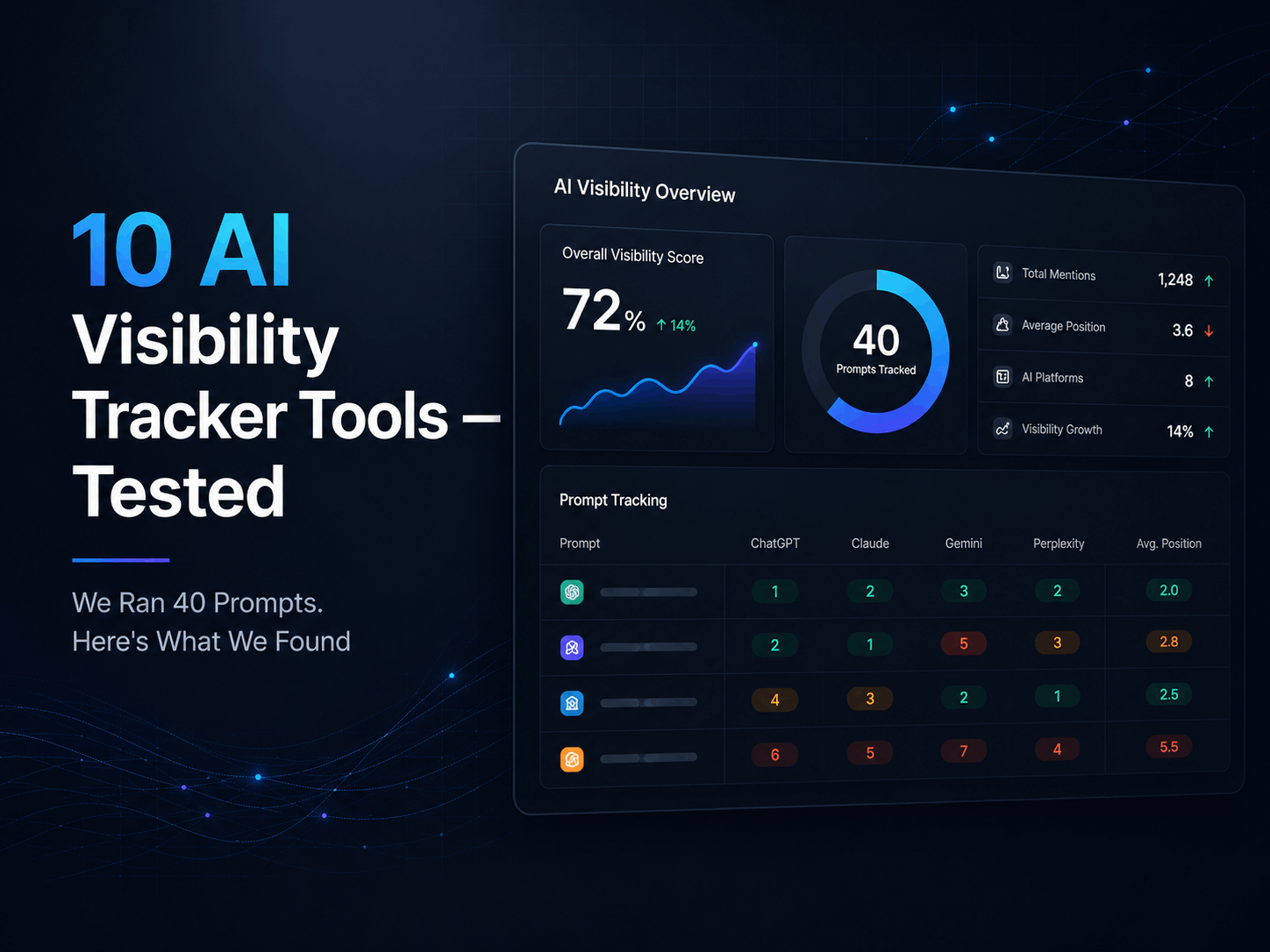
Quick answer: The best AI visibility tools in 2026 are Authority Radar, Profound, KIME, Otterly.AI and Peec AI, with SE Ranking, Ahrefs Brand Radar, Semrush, Scrunch AI and Rankability rounding out the field. The right pick depends on your goal. Choose Authority Radar if you want AI visibility tied to your real Google Search Console data, with a clear path to fix what is holding you back. Choose Profound for enterprise and regulated industries. Start with Otterly.AI if you want the cheapest serious entry point. Want a 60 second read on where you stand right now? Run a free AI visibility check first, then use this guide to pick a tool.
If you are still measuring your brand's health purely through Google rankings, you are looking at less than half the picture. A growing slice of your audience has moved on from typing queries into Google and scrolling links. They ask ChatGPT, Perplexity, Gemini, or Claude, and they get one synthesized answer back. Either your brand is in that answer, or it is not.
The scale is hard to argue with. ChatGPT serves over 900 million weekly active users. Perplexity crossed 100 million monthly active users in 2025. Google AI Overviews appear in nearly half of all U.S. searches. According to Contently, AI tools now generate around 45 billion monthly sessions globally, with 83 percent of that usage happening in mobile apps that most analytics setups miss.
Here is the number that should get your attention. LLM referred traffic converts at roughly six times the rate of traditional Google Search, according to Webflow's research. These are not casual browsers. They asked an AI a specific question, got a recommendation, and came looking for you directly.
That is what AI visibility tools are built to reveal. They tell you when, where, and how your brand surfaces across large language models, and the better ones tell you what to do about it. We spent weeks testing these platforms, running real prompts, checking whether the citation data matched what we saw querying the LLMs by hand, and comparing what each tool promised against what it actually delivered. This is our honest take on the 10 best AI visibility tools available right now.
First, the terminology
AEO (Answer Engine Optimization) is optimizing your content to appear in direct answers across search and AI platforms. It once referred to featured snippets and voice search. In 2026 it covers AI generated answers broadly.
GEO (Generative Engine Optimization) is a more specific term, coined in a 2023 research paper by academics from Princeton, Georgia Tech, IIT Delhi, and the Allen Institute for AI, presented at ACM SIGKDD 2024. It refers to optimizing content to be cited by generative AI systems. The paper tested nine strategies across 10,000 queries and found specific approaches can lift AI citation rates by up to 40 percent.
You will see both terms used interchangeably. The goal is the same: be the brand AI engines recommend when people ask questions in your category. An AI visibility tool is what lets you measure how well that is working.
What these tools actually track
The better platforms go well beyond a simple "were you mentioned" report:
Share of Voice: how often your brand appears in AI answers versus competitors, across a set of tracked prompts. Learn how to measure AI share of voice per platform.
Citation tracking: which specific URLs AI engines pull from when they reference your category. A mention means the AI said your name. A citation means it treated your page as a source, a much stronger signal.
Brand sentiment: whether AI describes you positively, neutrally, or negatively. You can be mentioned often and still lose if AI frames you as the expensive option or lists features you discontinued.
Hallucination detection: AI can state confident, wrong facts about you, such as outdated pricing or features you do not offer. One tool we tested flagged an LLM stating our pricing at roughly half the real figure, the kind of error a mention count would never surface.
Prompt intelligence: which questions trigger, and fail to trigger, your appearance. That is where optimization starts. See the tactics to get cited by ChatGPT.
One thing worth saying upfront: tracking alone does not move the needle. The Princeton and Georgia Tech research found that adding statistics to content improves AI citation rates by 41 percent, adding authoritative citations can lift citation likelihood by up to 115 percent for lower authority pages, and tables are cited 2.5 times more often than plain prose. Those are content decisions, not dashboard decisions. The best tools help you find the gaps. You still have to act on them.
Also worth a five minute check before you blame your tool: if you use Cloudflare, its default settings may be blocking AI crawlers. Check your server logs for the "ChatGPT-User" user agent. Many sites have quietly cut off their own AI indexing without realizing it.
How we evaluated each tool
We did not rely on vendor demos. We looked at:
LLM coverage: which AI platforms it tracks, and whether they match where your audience actually is
Hallucination detection: does it flag when AI says something factually wrong about you
Data freshness: real time, daily, or weekly, because visibility can shift in a week
Citation depth: URL level citation data, or just mention counts
Prompt methodology: custom prompts you define, or a proprietary database you cannot control
Competitor intelligence: can you see how rivals perform in the same prompts
Google Search Console integration: can it connect your real search demand to your AI visibility, so you prioritize the prompts that already matter
Actionability: does it tell you what to do, or only what happened
Pricing transparency: is pricing clearly stated, or gated behind a sales call
With those criteria in place, here is what we found.
Quick comparison: top 10 AI visibility tools (2026)
# | Tool | Best for | LLMs tracked | GSC integration | Starting price | Free option |
|---|---|---|---|---|---|---|
1 | Authority Radar | AI visibility tied to Search Console data, with a fix-it workflow | 8 | Yes, one click, native | $49/mo ($39 annual) | Free check + trial |
2 | Profound | Enterprise and regulated industries | 8+ | No | $499/mo | Yes |
3 | KIME | Multi client agencies | 10 | No | EUR 149/mo | Yes |
4 | Otterly.AI | Solo marketers and SMBs | 6 | No | $29/mo | Yes |
5 | SE Ranking AI Tracker | SEO teams in one workflow | 5 | Partial (via SEO suite, GA4) | $119/mo add-on | Yes |
6 | Ahrefs Brand Radar | Existing Ahrefs users | 6 | Partial (via Ahrefs suite) | $699/mo | Beta free tier |
7 | Semrush AI Toolkit | Enterprise SEO suites | 5+ | Partial (via Semrush suite) | ~$745/mo | Yes |
8 | Peec AI | Mid market brands | 6+ | No | $99/mo | Yes |
9 | Scrunch AI | Custom prompt tracking | 8+ | No | $300/mo | Yes |
10 | Rankability | Agency reporting | 4+ | No | $79/mo | Yes |
The 10 best AI visibility tools
1. Authority Radar
Best for: Brands and SEO teams who want to understand why they are invisible in AI answers, and have a clear path to fix it, using their real Google Search Console data.
When we tested AI visibility tools, a pattern showed up fast. Most told the same story: here is your share of voice, here are the prompts where you appeared, here is how you compare to two or three competitors. Useful as a starting point, but not enough to change anything.
The question that kept coming back was simple: we are not being cited by Perplexity for this prompt, so what is causing that, and what do we do about it? Most tools could not answer. Authority Radar was built around that question.
Two things set it apart. First, it works upstream. While most trackers measure outcomes like mention frequency and share of voice, Authority Radar's AI visibility tracking maps the authority and E-E-A-T signals AI models use when deciding which brands to include in the first place. Second, and this is the part almost no standalone tracker does, it connects to Google Search Console in one click and uses your real search data to prioritize.
You see the queries you already earn impressions for, cluster them into topics, and check whether AI actually recommends you for those same topics. That link between real search demand and AI visibility is the difference between a dashboard and a plan. You can read how that workflow plays out in our guide to Search Console AI visibility opportunities.
What we tested and found: We ran 40 prompts across ChatGPT, Gemini, Perplexity, Claude, and AI Overviews. The citation level data was detailed in the right way, not just "your brand appeared," but which URLs were pulled, what authority signals those pages carried, and where our content fell short. The Authority Gap Analysis was the feature we returned to most.
It breaks down, side by side, the authority signals your visible competitors have that you do not, which third party sources cite them, what content structures they use, and where the gap is widest.
The Citation Heatmaps were close behind, showing visually which pages AI engines treat as sources versus which pages you assume are important. The hallucination detection layer flagged several cases where AI surfaced inaccurate claims about our product.
Features, mapped:
AI Share of Voice and citation tracking across 8 major engines: ChatGPT, Gemini, Claude, Perplexity, DeepSeek, Grok, Copilot, and Meta AI
Google Search Console intelligence: one click GSC connection with query clustering, CTR gap analysis, and cannibalization detection, so your AI strategy is driven by real search demand
Content Recovery: detects content decay and flags pages that are losing traffic or slipping out of AI citations, so you know exactly what to refresh and when
Authority Gap Analysis: competitor authority signals broken into actionable categories
Citation Heatmaps: visualizes which of your pages AI engines actually treat as sources
Prompt Intelligence: the exact queries triggering and missing your brand
Hallucination detection: flags when AI states factually wrong claims about you
Sentiment monitoring: how AI actually describes your brand
Content briefs and AI content creation: turns the gaps into drafts
Free entry point: a no cost AI visibility check before you commit
Honest take: Authority Radar is built for people who want to act on the data, not just watch it. If you want lightweight monitoring to start, Authority Radar will be the good starting point. and if your goal is improving your position in AI search rather than only tracking it, and especially if you want that work grounded in your Search Console data, this is the platform we would build a program around.
Pricing: Starter is $49 per month, or $39 per month billed annually, with a 7 day free trial and a free AI visibility check available with no signup.
2. Profound
Best for: Enterprise brands, regulated industries, and teams with compliance requirements.
Profound has been in this space longer than almost anyone, and for enterprise buyers it remains the benchmark. SOC 2 Type II compliance, role based access controls, multi brand and multi region architecture, and SSO are all here. What makes it well suited to regulated industries is the combination of coverage and factual accuracy verification, a non negotiable where a misrepresented product claim is a compliance risk, not just a PR problem.
In testing, the prompt analytics were among the deepest we saw. Profound also uses synthetic personas to simulate different buyer stages, so you can see how your brand appears in early research questions versus late decision questions. The honest constraint: at $499 per month for the entry Lite plan, it is out of reach for most small teams, and the depth can feel like overhead if your needs are straightforward. It also does not connect to Google Search Console, so it will not tie your AI visibility back to your real search demand.
Pros: the most enterprise mature platform in the category, excellent compliance, strong factual accuracy monitoring.
Cons: expensive for SMBs, built for teams with dedicated analysts, limited authority building guidance, no GSC link.
Pricing: from $499 per month (Lite).
See the detailed Authority Radar vs Profound comparison.
3. KIME
Best for: Agencies managing multiple clients who need real time coverage across the broadest set of AI platforms.
KIME was built from the ground up for AI visibility rather than retrofitted from an SEO tool, and it shows. It tracks 10 AI models in real time: ChatGPT, Perplexity, AI Mode, Gemini, Claude, Grok, DeepSeek, Meta AI, Copilot, and Google AI Overviews. That is the widest live coverage we found at this price tier, and it is on the entry plan rather than gated behind enterprise pricing.
The standout is the Action Centre, an optimization engine that generates specific recommendations alongside the visibility data. Multi seat access from the EUR 149 per month entry tier is a real advantage for agencies. The real time monitoring felt genuinely live rather than cached.
Pros: widest real time LLM coverage at this tier, agency friendly economics, genuine optimization logic.
Cons: newer entrant, less authority signal depth than Authority Radar, no Search Console integration, brand recognition still building.
Pricing: from EUR 149 per month.
4. Otterly.AI
Best for: Solo marketers, freelancers, and small businesses who want to start without a major commitment.
If you are new to this category and not ready for a serious subscription, Otterly is almost certainly where to begin. At $29 per month for the Lite plan, it is the most accessible entry point on this list and consistently delivers more than its price suggests. It tracks brand mentions and citations across six AI platforms with a daily refresh, is used by more than 20,000 marketing professionals, and has earned recognition from G2, Gartner, and OMR.
The GEO audit was the most praised feature in independent reviews, and it deserved it. The gap analysis surfaces prompts where competitors are visible and you are not, so you can build a priority list without a dedicated analyst. Weekly email updates close the loop for solo operators.
Pros: most affordable meaningful tracker, fast setup, award winning at its price, excellent starting point.
Cons: six platform coverage excludes Grok, DeepSeek, and Meta AI, limited authority intelligence, no GSC integration, not built to scale to enterprise.
Pricing: from $29 per month (Lite).
See the detailed Authority Radar vs Otterly.AI comparison.
5. SE Ranking AI Visibility Tracker
Best for: SEO teams who want AI visibility data without adopting a separate tool.
SE Ranking built its reputation as a solid all in one SEO platform, and its AI Visibility Tracker module extends that into GEO without a second subscription. It covers ChatGPT, Gemini, AI Overviews, AI Mode, and Perplexity, and sits natively alongside rank tracking, backlink analysis, site audit, and GA4. For teams already inside SE Ranking, that unified view is practical. You can see how a page that ranks on Google performs in AI answers, from the same dashboard.
The AI Competitor Research Tool was one of the more useful competitive features at this tier. The honest limitation: the AI features are an add on (around $119 per month on top of your base plan), and the depth does not match a dedicated standalone tool. Its Search Console connection is partial, it flows through the broader SEO suite rather than driving AI prompt tracking directly.
Pros: genuinely unified SEO and AEO workflow, solid competitor intelligence, historical trend data.
Cons: AI features are an add on cost, not as deep as standalone trackers, limited hallucination detection.
Pricing: around $119 per month add on.
See the detailed Authority Radar vs SE Ranking comparison.
6. Ahrefs Brand Radar
Best for: Teams already invested in Ahrefs who want to layer in AI visibility data.
Ahrefs brings a real advantage: a prompt index of more than 260 million prompts sourced from real search behavior, not synthetic queries. That means the questions tracked more closely match what real buyers ask. The integration with Ahrefs' data is also an asset. You can see how domain authority and backlinks correlate with AI citation rates, a connection most dedicated tools cannot draw. For context, brand mentions correlate with AI citation probability at 0.664, while backlinks correlate at 0.218.
The practical catch: independent reviews in early 2026 documented accuracy gaps between what Brand Radar reports and what surfaces on manual queries. Weigh that if precise data is critical.
Pros: largest real query prompt index, free during beta for paid Ahrefs customers, strong SEO to AI correlation data.
Cons: accuracy concerns documented by reviewers, limited to 6 platforms, significant add on cost at full tier.
Pricing: free for paid Ahrefs customers during beta, full tier from $699 per month.
See the detailed Authority Radar vs Ahrefs Brand Radar comparison.
7. Semrush AI Toolkit
Best for: Enterprise teams already running their stack through Semrush.
Semrush brings GEO into one of the most widely used marketing platforms. For teams who live in Semrush, adding AI visibility without a new tool is convenient. The Question Report is genuinely useful, it surfaces the real questions users ask AI about your brand or category, doubling as prompt research. The sentiment analysis is strong.
The honest framing: the AI Toolkit feels like features added to an SEO platform rather than an AI visibility platform built from scratch. For teams whose primary goal is GEO depth, there are more purpose built options.
Pros: one platform for SEO and AEO, strong stability, excellent sentiment analysis.
Cons: AI features are add ons that compound in cost, not designed natively for AI visibility, less citation depth.
Pricing: around $745 per month for meaningful AI features at scale.
See the detailed Authority Radar vs Semrush AI Toolkit comparison.
8. Peec AI
Best for: Mid market brands that have outgrown entry level tools but are not ready for enterprise pricing.
Peec AI sits sensibly between Otterly and Profound: more analytical depth than the former, less overhead than the latter. It covers 6 or more LLMs, delivers prompt level citation tracking, and produces competitive share of voice reports specific enough to drive content decisions. What stood out was the reliability of the citation data, it is URL specific, not mention counts dressed up. Setup was fast.
Pros: reliable URL level citation data, good mid market price to depth ratio, fast setup.
Cons: less authority intelligence than higher tier tools, fewer integrations, no Search Console link, limited hallucination detection.
Pricing: from $99 per month.
See the detailed Authority Radar vs Peec AI comparison.
9. Scrunch AI
Best for: Agencies and B2B brands with complex prompt libraries and niche competitive landscapes.
Scrunch takes a different approach. Rather than running a preset prompt library, it gives you granular control over exactly which prompts are tracked, how often, and against which competitors. For B2B brands where buyer questions are highly specific, that flexibility has real value. Credit based pricing ($300 per month for 350 prompt credits) suits teams that want precise control over spend. Coverage is strong at 8 or more platforms, with multi client dashboards.
The flip side: all that customization needs setup investment and ongoing maintenance. If your team has the capacity, the output is more relevant. If not, you will underuse what you pay for.
Pros: best customization for complex B2B use cases, strong multi model coverage, granular cost control.
Cons: higher setup investment, prompt library needs maintenance, no GSC integration, credits can escalate.
Pricing: from $300 per month (350 prompt credits).
See the detailed Authority Radar vs Scrunch AI comparison.
10. Rankability
Best for: Agencies that report on traditional SEO and AI visibility together for the same client.
Rankability is not trying to be the deepest AI visibility platform. It is trying to be the most useful for agencies that need one coherent story across SEO and AI search, in a format clients understand. The Search Performance Index is the headline feature, a single metric combining AI answer presence, keyword rankings, local visibility, and video into one comparable number. The white label reporting was the strongest we tested at this price, with clean week over week trend views.
The key constraint is coverage: four platforms is the narrowest on this list. For clients where AI visibility depth matters more than unified reporting, it is not the right fit.
Pros: best client facing reporting format, unified SEO and AI metric, accessible starting price.
Cons: narrowest AI model coverage, lighter on deep citation and authority intelligence, no Search Console integration.
Pricing: from $79 per month.
How to choose the right AI visibility tool
There is no single right answer. It depends on your goal, your team, and how far along your GEO program is.
Just getting started and do not want to over invest? Begin with Otterly at $29 per month. Use it for 60 days, learn what the data means, and you will be a smarter buyer of a more powerful tool afterward.
An SEO team already living in SE Ranking or Semrush? Add their native AI modules first for useful signal without disrupting your workflow.
An agency managing multiple clients? KIME's multi seat economics and 10 model coverage are a strong value proposition. If your clients also need authority intelligence and a Search Console grounded roadmap, Authority Radar gives you something more diagnostic.
In a regulated industry? Profound's compliance infrastructure and factual accuracy monitoring make it the right call.
Want to move from tracking to actually improving? Authority Radar is built for that work, and it is the one tool here that ties AI visibility to your real Google Search Console data and flags content decay before it costs you citations. Start with the free AI visibility check.
Client reporting is your main deliverable? Rankability's unified Search Performance Index and white label reports are the most practical.
Content decay: why a tracker is only half the job
Here is something worth knowing from the research side. According to Frase's 2025 AI Traffic Report, roughly 50 percent of content cited in AI answers is less than 13 weeks old. AI engines have a measurable preference for recent information over content sitting unchanged.
That means AI visibility is not only a tracking problem. It is a content maintenance problem. Pages that earned AI citations six months ago can lose them when a competitor publishes fresher, more data rich content on the same topic. This is content decay, and it is one of the most common reasons visibility quietly erodes.
A tracker will show you when a page slips, but only if you check it often enough to catch the shift. This is where Authority Radar's Content Recovery helps: it detects content decay automatically, flags the pages losing traffic or slipping out of AI citations, and points you to exactly what needs refreshing, so you are not manually auditing dozens of pages hoping to catch the drop.
The practical habit: build a quarterly review cadence for your highest value pages. Update statistics, refresh examples, add recent data points. A good tracker plus a content refresh habit is what compounds over time.
Frequently asked questions
What is an AI visibility tool?
It is a platform that monitors how your brand appears in AI generated answers across large language models like ChatGPT, Gemini, Perplexity, and Google AI Overviews. Instead of tracking your position in search results, it measures whether AI engines mention you, cite your content, describe you accurately, and how you compare to competitors, in the context of the prompts your audience actually uses.
Which AI visibility tool integrates with Google Search Console?
Among the tools tested, Authority Radar offers the most direct Google Search Console integration. It connects in one click and uses your real GSC queries for clustering, CTR gap analysis, and cannibalization detection, then checks whether AI engines recommend you for those same topics. Some SEO suites such as SE Ranking, Ahrefs, and Semrush connect Search Console or GA4 at the suite level, but their AI modules do not use that data to drive AI prompt tracking the same way.
What is the difference between GEO and AEO?
GEO (Generative Engine Optimization) is optimizing content for citation in AI generated answers from platforms like ChatGPT, Gemini, and Perplexity. AEO (Answer Engine Optimization) is broader and historically included featured snippets and voice search, but in 2026 it is often used interchangeably with GEO. Both describe the same goal: getting your brand into the answer, not just the results list.
What is AI hallucination detection and why does it matter?
AI hallucination is when a model generates confident but factually wrong information about your brand, such as incorrect pricing, features you do not offer, or comparisons to competitors you never had. The best AI visibility tools flag this so you can correct it before it spreads. Without it, you can have high mention frequency and still lose customers to misinformation you never knew existed.
What is content decay in AI search?
Content decay is when a page gradually loses rankings, traffic, or AI citations over time, usually because the information ages and competitors publish fresher content. Since around half of AI cited content is less than 13 weeks old, decay is a leading cause of falling AI visibility. Tools like Authority Radar's Content Recovery detect it automatically and flag which pages to refresh.
Do I need a separate tool if I already use Semrush or Ahrefs?
Both have added AI visibility features worth using if you already work in those ecosystems. That said, most teams who take GEO seriously add a dedicated tracker for deeper citation analysis, hallucination detection, authority intelligence, and Search Console grounded prioritization. The native AI features in general SEO suites are a useful starting point, not a complete solution.
How many LLMs should my tool track?
At minimum: ChatGPT, Gemini, Perplexity, and Google AI Overviews. The strongest tools track 8 to 10 platforms including Claude, Grok, Copilot, Meta AI, and DeepSeek. The right number depends on your audience. B2B buyers heavily favor ChatGPT, while consumer audiences spread across more platforms.
What is the difference between a brand mention and a citation?
A mention means the AI named your brand. A citation means it referenced one of your pages as a source. Mentions are often driven by brand entity recognition. Citations are driven by content quality, page authority, and how well your content is structured for AI comprehension.
Is there a free AI visibility tool I can use today?
Yes. Authority Radar offers a free AI visibility check with no signup. Otterly offers a free trial, and Ahrefs Brand Radar has a free tier during beta for Ahrefs users. Running a free check first is a smart way to confirm whether you have a visibility problem before you invest.
Does my content format affect whether AI cites me?
Significantly. Research from Princeton and Georgia Tech found tables are cited 2.5 times more often than prose, adding statistics improves citation rates by around 41 percent, and clear FAQ sections and definitions help AI comprehension. Format is a real lever, not a cosmetic one.
Start with where you stand today
You cannot improve what you have not measured. Before you commit to any paid platform, run a free, no signup AI visibility check to see whether ChatGPT, Gemini, and Perplexity currently mention and cite your brand. Then, if you want AI visibility tied to your real Google Search Console data, content decay detection, and a clear path to fix the gaps, start a free trial of Authority Radar.