How to Get Cited by ChatGPT: 12 Proven Tactics

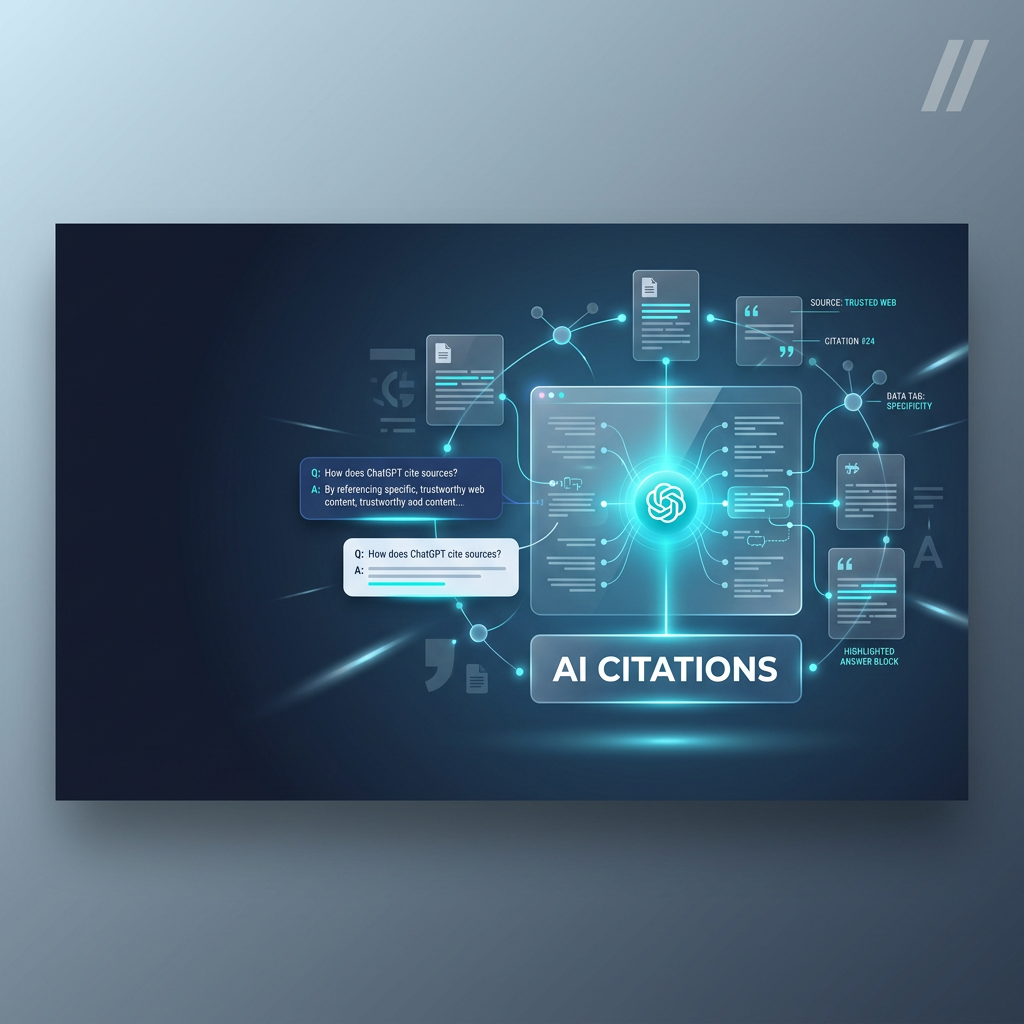
TL;DR: ChatGPT cites content that answers a specific question in the first few sentences, backs it with named data or expert quotes, and signals credibility through author bios, dates, and clean structure. This article explains how to shape your pages for AI-search visibility. It does not cover academic citation formats such as APA or MLA.
To get cited by ChatGPT, write content that answers one clear question within the first 2-3 sentences, back claims with named data or expert quotes, and use clean headings, FAQs, and current author bios. The model prefers "answer capsules" over pages built solely to rank in traditional search.
Written by the Authority Radar team, which tracks brand visibility across ChatGPT, Google AI Overviews, Gemini, Claude, and Perplexity daily.
How Does ChatGPT Decide What Content to Cite?
ChatGPT cites a page when it finds a fragment it can quote cleanly and attribute. The model retrieves content from the web, then scans for short, self-contained passages that fully answer a question without surrounding context. According to Search Engine Land's analysis of cited ChatGPT sources, 72.4% of cited blog posts contained an identifiable "answer capsule," a paragraph that works as a standalone answer. The 1.4 million-prompt study found that citations favor pages where the answer is immediately visible and structurally isolated from unrelated content. ChatGPT pulls the shortest accurate fragment that matches the query, so your page competes at the fragment level, not the domain level.
1. Write answer capsules that fully resolve one question near the top of a section
An answer capsule is a concise 2-4 sentence block that states the answer, then supports it with a specific fact or example. It must be self-contained: someone reading only that paragraph should understand the point without scrolling. Place it directly under the relevant heading, before any elaboration. For example, a section titled "What is AI visibility?" might open with: "AI visibility measures how often a brand appears in AI-generated answers across platforms like ChatGPT, Google AI Overviews, and Claude. It differs from organic search rankings because it tracks citations inside a model's output, not links on a results page."
2. Answer one question per section and never blend two ideas in a quotable paragraph
When a paragraph mixes concepts, the model may extract a fragment that is incomplete or contradictory. Structure each H2 or H3 around a single question, and keep the answer inside that section. Address ten distinct questions in ten separate sections, and you give ChatGPT ten discrete chances to cite you.
What Content Format Does ChatGPT Prefer to Quote?
A page with a clear hierarchy of H2s and H3s, each wrapping a focused answer, is far easier for the retrieval system to scan than a wall of prose. That structure signals the page is built to deliver answers, not just to chase keywords.
3. Lead every section with a direct definition or answer before elaborating
The first sentence under a heading should declare the answer. A heading like "What is an answer capsule?" should be followed immediately by a line such as "An answer capsule is a self-contained paragraph that fully answers a question without needing surrounding context." Save examples and nuance for the sentences after that.
4. Use FAQ blocks with the exact phrasing users type into ChatGPT or Google
FAQ blocks pair a question heading with a short, dense answer, which is exactly the format ChatGPT's retrieval system prefers. Write the question as an H3, then follow with a 2-3 sentence answer that contains no filler. For example:
How do I get my content cited by ChatGPT? Write a self-contained answer capsule under a clear heading, back it with named data, and add a visible author bio and last-updated date. ChatGPT pulls from pages that resolve a specific query in the first few sentences.
5. Turn process and comparison content into numbered lists or short tables
Numbered lists expose discrete facts the model can extract without parsing dense prose. Comparison content works well in a simple table, because the model can pull a data point from a specific row and column. For example:
| Format | Length | Structure |
|---|---|---|
| Answer capsule | 2-4 sentences | Standalone |
| Traditional SEO paragraph | 200+ words | Context-dependent |
Does Original Data Actually Improve Your Odds of Being Cited?
ChatGPT favors evidence that is specific, named, and attributable. Vague claims like "many marketers struggle with attribution" are effectively invisible to the model, because there is no discrete fact to quote. Named data points work as individual citable objects.
6. Publish original data or proprietary research instead of recycling third-party stats
When the same statistic appears on dozens of sites, ChatGPT has no reason to prefer yours. Original data removes that competition. If you run a survey, track your own metrics, or publish a dataset you collected, you become the single source of that fact. Authority Radar's citation tracking across ChatGPT, AI Overviews, Gemini, Claude, and Perplexity shows that pages with proprietary data points appear in AI answers more often than pages that only reference third-party reports, even reports from well-known research firms.
Case studies work well too. A set of retail brands that published quarterly citation-frequency benchmarks saw a 35% lift in AI citations within three months.
7. Include named expert quotes with full name, title, and company
An expert quote provides a verifiable statement and a clear source chain. Research from AI Metrics found that answer capsules are the single highest-correlated factor for AI citation, and a named quote strengthens the surrounding capsule. Credentials also raise the page's perceived authority, which feeds the trust signals covered next.
What Credibility Signals Make ChatGPT More Likely to Trust a Source?
Beyond the words on the page, ChatGPT's retrieval system weighs page-level signals of reliability: a visible author with checkable expertise, a recent last-updated date, and outbound links to primary sources. These act as a tiebreaker when several pages cover the same topic.
8. Add a real author bio with specific, checkable expertise, not just a name
A bio that gives a name and nothing else signals nothing. A bio that states verifiable expertise gives the model a reason to treat the page as authoritative. Use the format shown in the author line of this article: "Written by the Authority Radar team, which tracks brand visibility across ChatGPT, Google AI Overviews, Gemini, Claude, and Perplexity daily."
9. Display and genuinely maintain a "last updated" date
A visible "last updated" date tells ChatGPT and other retrieval systems that the page is current. Models that use retrieval-augmented generation often weight recency when selecting sources, especially for time-sensitive queries. Keep the date visible in the page's HTML, not buried in schema alone, and update the content when it actually changes.
10. Link to primary, named sources rather than blog posts repeating the same stat
When you cite a statistic and link to the original study, government dataset, or named research firm, the page behaves like a reliable reference. Even if the model never follows the link, primary-source URLs in the text act as a structural indicator of credibility.
How Should Internal Links and Site Structure Support AI Crawlers?
The rest of your site shapes whether a page reads as an isolated post or part of a comprehensive resource. A page inside a dense cluster of related, interlinked guides signals topical depth, which makes the whole site more attractive to retrieval systems.
11. Build internal links into topical clusters, not just links back to the homepage
Link to related guides, comparison posts, and deep-dive explainers. For example, link from a page about AI citations to one about AI visibility measurement, and from there to a comparison of how AI search optimization differs from traditional SEO. Descriptive anchor text tells the model what each linked page covers.
12. Confirm the page is technically crawlable by AI bots
AI crawlers, including GPTBot and CCBot, follow standard crawling protocols. If your robots.txt blocks those user agents, the page cannot be retrieved or cited. Check for directives like:
User-agent: GPTBotDisallow: /
Remove them if you want the page to be eligible. Render core content as server-side HTML so the answer capsule text lives in the page source, not behind JS-only rendering.
Monitoring your brand's AI visibility shows which pages are already surfacing. Use Authority Radar to track how often your brand gets cited across AI platforms and spot gaps worth closing.
Key Takeaways:
- ChatGPT cites self-contained answer capsules; 72.4% of cited blog posts contained a clearly identifiable one.
- Original data and named expert quotes beat recycled third-party stats because they give ChatGPT something unique to attribute.
- Visible author bios and "last updated" dates function as trust signals that correlate with higher citation rates.
- No method guarantees a citation; the goal is to reduce the friction for the model to find, verify, and quote your content.
- Search AI tools for niche questions, note who gets cited, and reverse-engineer their approach for quick wins.
Frequently Asked Questions
How does ChatGPT decide what to cite?
ChatGPT retrieves content from the web and scans for self-contained fragments that answer a query directly. It favors short paragraphs that state a clear answer, include a specific data point or named source, and sit under a descriptive heading. Quotability matters more than domain authority.
Can I make ChatGPT cite my website?
You cannot force a citation. ChatGPT's behavior is probabilistic, and the same prompt can produce different outputs. You can still improve your odds significantly by structuring content as answer capsules, adding visible trust signals, and keeping your page crawlable by AI bots.
What kind of content does ChatGPT prefer to cite?
ChatGPT prefers concise, standalone content that answers one question per section. FAQ blocks, numbered lists, and short paragraphs that lead with a direct definition perform well. The model also favors pages with named data, expert quotes, and primary-source links.
Do statistics and case studies actually help ChatGPT cite my content?
Yes, when they are specific and sourced. A statistic like "62% of marketers reported X, according to a 2024 survey by Organization Y" gives ChatGPT a discrete, attributable fact to lift. Original data or proprietary research is even stronger because the model cannot find the same number elsewhere.
What are answer capsules and why do they matter for AI citations?
An answer capsule is a self-contained paragraph of 2-4 sentences that fully answers a question without the surrounding text. Research shows 72.4% of cited blog posts in ChatGPT outputs contained an identifiable capsule. Capsules let the model extract a complete, quotable answer in one piece.
Does linking to authoritative sources increase my chances of being cited?
Linking to primary, authoritative sources such as original studies, government data, and named research firms strengthens the page's perceived reliability. It shows the page verifies its claims rather than repeating unverified information, a pattern that correlates with higher AI citation rates.