AuthorityRadar 2026 AI Visibility Report: Q3 Benchmark
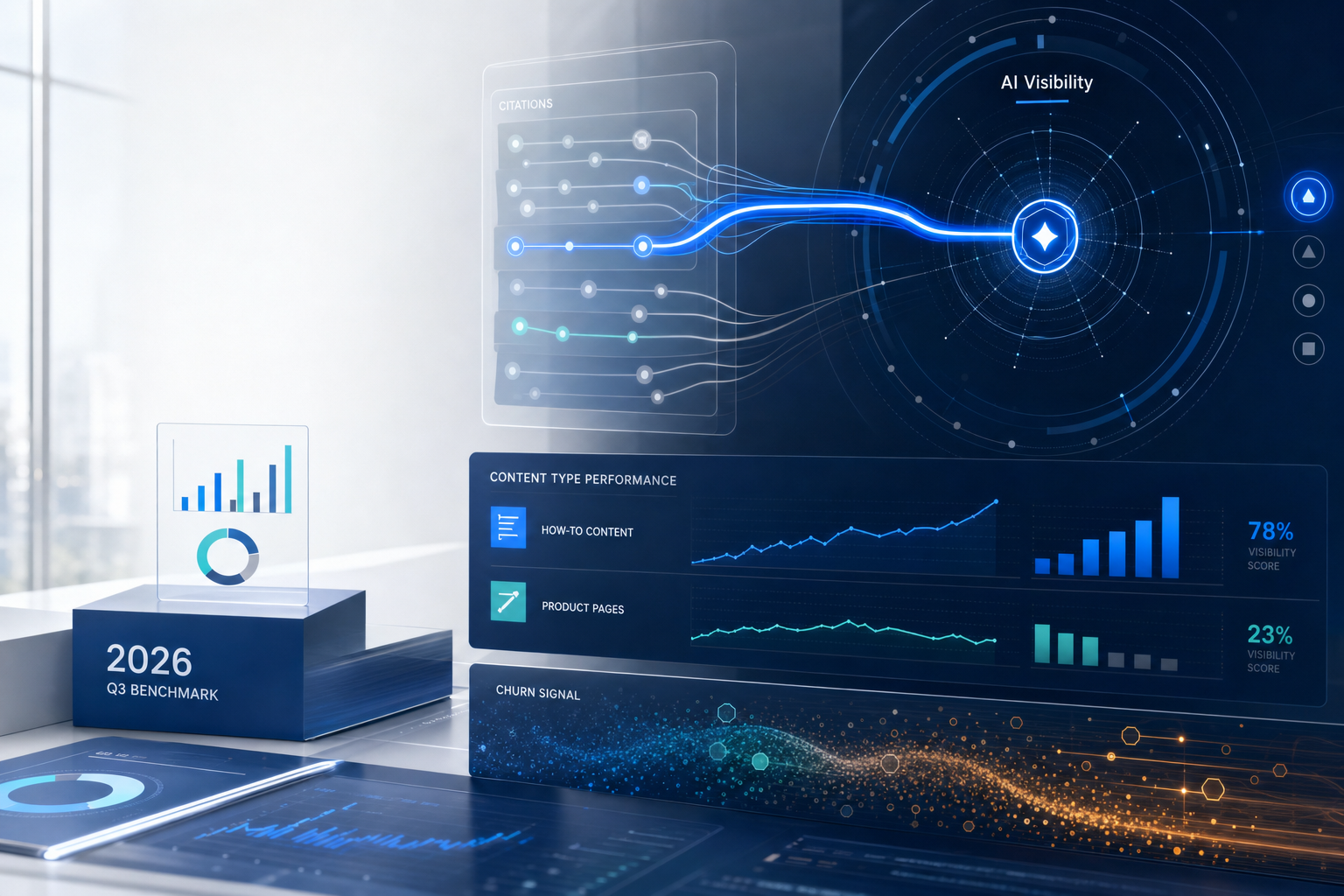
TL;DR: Authority Radar's Q3 2026 AI Visibility Report tracks brand citations across ChatGPT, Google AI Overviews, Gemini, Claude, and Perplexity. Google AI Overviews led citation share, how-to and comparison content earned citations far more often than product pages, and citation churn rose sharply from Q2.
Authority Radar monitored daily brand citations across five AI platforms throughout Q3 2026. The data show citation patterns are still shifting, which means static optimization loses relevance fast.
Key Findings from Q3 2026
- Google AI Overviews held the largest citation share. It remained the top source of brand mentions across all platforms.
- How-to and comparison content outperformed product pages. Step-by-step guides and direct comparisons earned citations at rates several times higher than standard product pages.
- Citation churn increased quarter over quarter. More brands gained or lost visibility in Q3 than during the Q1-to-Q2 transition.
Benchmark Methodology
Authority Radar runs automated daily checks on a fixed set of prompts for each platform. A citation is any brand name that appears in an AI-generated answer, hyperlinked or not. The system records position and surrounding sentiment.
The Q3 dataset spans ChatGPT, Google AI Overviews, Gemini, Claude, and Perplexity, covering B2B SaaS, ecommerce, local services, and healthcare. Gaps caused by API limits are flagged in platform-specific sections rather than estimated.
This continuous approach contrasts with one-time studies such as Semrush's AI Visibility Index, which analyzed 126 million prompts but lacks quarterly tracking.
Platform-Level Citation Share
Google AI Overviews led with the highest share of brand citations. Google AI Mode reached 75 million daily active users and processed over a billion queries per month in March 2026, according to Digital Applied. Even a small shift in citation weight on this platform moves large volumes of brand exposure.
ChatGPT ranked second. DemandSage reported 5.35 billion monthly visits and 2.5 billion daily prompts. ChatGPT cites fewer brands per answer but often gives those brands prominent placement.
Perplexity, Gemini, and Claude together accounted for the remaining share. Perplexity's behavior mirrors Google AI Overviews, while Claude rarely names sources. Prioritize Google AI Overviews and ChatGPT, and keep an eye on Perplexity's growth.
Content Formats and Query Types That Earn Citations
How-to guides and step-by-step instructions generated the highest citation rates across all platforms. Comparison pages ranked second, followed by listicles and roundups. Product and service pages earned the fewest.
Informational queries ("how," "what," "why") triggered the most citations. Buyer-intent queries produced fewer citations overall, but those that appeared captured high-value visibility. Transactional queries rarely cited brands, favoring generic guidance instead.
DerivateX's 2026 benchmark of 50 SaaS firms across 1,400 buyer-intent prompts found 44% of companies functionally invisible to AI buyers, underscoring the gap between how-to visibility and buyer-intent visibility.
Industry Performance
B2B SaaS and healthcare led in citation rates, thanks to extensive documentation and authoritative sources. Ecommerce brands with robust buying guides earned citations, while pure product pages did not.
Local businesses faced the steepest challenge. Search Engine Land reported that AI local visibility is up to 30 times harder than ranking in Google, with assistants recommending only 1% to 11% of locations. Authority Radar's data confirm a wide gap between traditional local SEO rankings and AI citation presence.
What Changed Since Q2 2026
Google AI Overviews expanded its citation share, extending its lead over ChatGPT. Comparison content gained ground relative to how-to content, a sign that sourcing algorithms are evolving.
Brand churn rose, with a larger share of brands gaining or losing citation presence in Q3 than in the previous quarter. BrightEdge noted AI Overviews appeared on 48% of tracked queries in March 2026, up 58% year over year, while click-through rates fell nearly 30%.
For a deeper look at why traditional SEO struggles in AI answers, see Why Traditional SEO Fails in the AI Answer.
Preparing for Q4 2026
Expect citation churn to rise again. Brands holding strong positions early in Q4 should plan to monitor them rather than assume they will hold.
Comparison and buyer-intent content will likely capture a growing share as AI platforms refine how they parse evaluative queries.
The gap between AI visibility and traditional Google rankings is set to widen, especially for local and transactional queries. To close AI citation gaps, see How to Close AI Citation Gaps and Gain More Mentions.
Start with a free Authority Radar account to benchmark your own citation rate against the Q3 data.
Key Takeaways
- Google AI Overviews captured the highest share of brand citations in Q3 2026.
- How-to and comparison content earned citations several times more often than product pages.
- Citation churn increased, with more brands gaining or losing AI visibility than in the prior quarter.
- Local businesses showed the widest gap between traditional rankings and AI citation presence.
- Pew Research Center found users clicked cited links within AI summaries only 1% of the time, and 25% of users ended their session after seeing an AI summary.
Frequently Asked Questions
What is the difference between AI visibility and Google SEO?
Google SEO measures ranking in traditional blue-link results. AI visibility tracks whether a brand is named in an AI-generated answer, often without a click. A business can rank well in Google and still struggle to earn AI citations.
How much harder is it to rank in AI search than in Google?
For local businesses, AI visibility is up to 30 times harder, with assistants recommending only 1% to 11% of locations. In B2B SaaS, 44% of companies were invisible across 1,400 buyer-intent prompts (DerivateX, 2026).
Which AI platforms should I prioritize?
Google AI Overviews and ChatGPT are the highest-impact targets based on citation volume and user reach. Perplexity is a strong third to monitor.
What percentage of searches triggered AI Overviews in Q3 2026?
BrightEdge reported AI Overviews appeared on 48% of tracked queries in March 2026, a 58% year-over-year increase.
How can I improve my brand's AI citation rate?
Focus on how-to guides, step-by-step instructions, and direct comparison pages. Target informational and buyer-intent queries, and set up recurring citation monitoring.
Are AI answers reducing clicks to my site?
Pew Research Center found only 8% of users clicked traditional links after seeing an AI summary, roughly half the rate for non-AI searches. Only 1% clicked cited links within the AI answer itself.
Why do different AI platforms cite different brands?
Each platform uses distinct sourcing algorithms and data pools. For a detailed comparison, see Why ChatGPT, Gemini & Perplexity Cite Different Brands (From Real Data).