Why Traditional SEO Fails in the AI Answers: Tracking Citations and Sentiment in LLMs

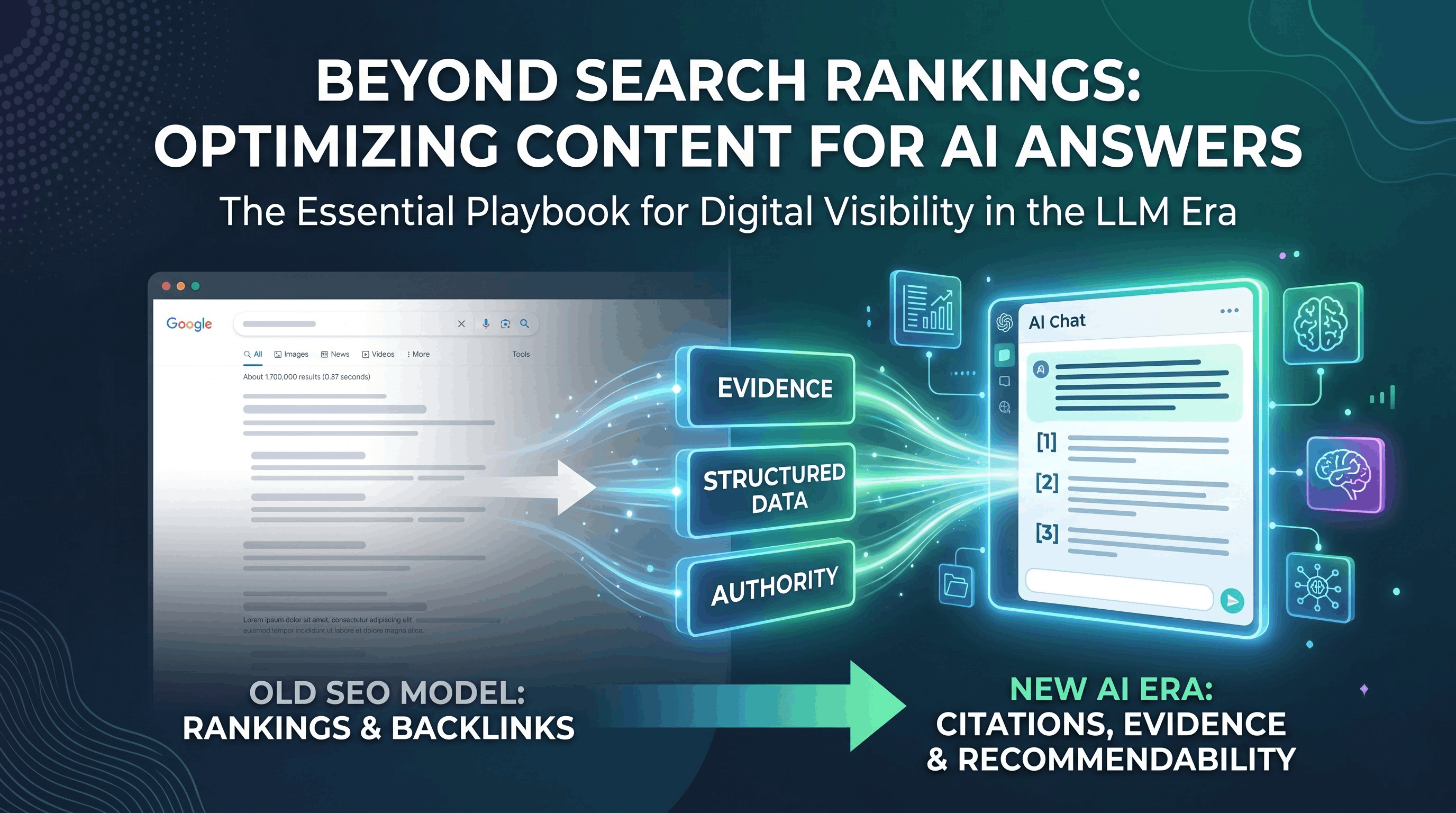
AI assistants increasingly answer search intent directly, often with citations, summaries, and recommendations. That means ranking #1 in Google no longer guarantees visibility where decisions are actually being shaped.

Why Traditional SEO Fails in the AI Answers: Tracking Citations and Sentiment in LLMs

AI assistants now deliver direct answers that cite sources and surface evidence; ranking #1 on search engines no longer guarantees being quoted. To win AI-era visibility you must optimize for citations, evidence grounding, stance, and content recommendability — not just organic rank or backlinks. This means structuring pages for extraction, increasing inline citations, and proving content is authoritative and recommendable to LLMs.

The problem: why classic SEO signals are losing their grip

Traditional SEO focuses on keyword rankings, domain authority, and backlinks. Those metrics still matter for human searchers, but AI assistants answer queries by synthesizing multiple sources and choosing which snippets to cite. LLMs prioritize concise, well-grounded answers and often ignore high-ranking pages that lack structured evidence or clear recommendability signals. The result: many top-ranked sites receive zero AI citations.

Evidence and metrics that matter in the AI era

Move beyond position tracking. Track the following metrics to measure AI visibility:

  • Citation Share of Voice (SOV): percentage of AI answers that cite your domain vs competitors.

  • Evidence Pack Presence: count of inline citations, structured references, and anchored quotes AI can use as grounding.

  • Stance & Sentiment: how positively or negatively AI mentions your brand in answers.

  • Recommendability: a composite signal that measures content clarity, factual grounding, and authoritative formatting.

Why this shift happens (technical reasons)

AI systems extract and synthesize content differently than web crawlers. They rely on: 1) easily parsable evidence (headings, schema, numbered steps); 2) inline citations and direct quotes; 3) signals of trust — structured references, dates, author names, and canonical sources; and 4) formats that reduce hallucination risk for the model. Pages optimized only for search ranking often lack these features.

The AI Answer Shift: Why Rankings Aren’t Enough

Search used to be straightforward. A user typed a query, the search engine ranked pages, and the user clicked through to a result. Traditional SEO was built around that behavior: rank for the keyword, earn the click, optimize the page, repeat.

That model is changing fast.

Today, more queries are being answered directly inside AI interfaces. Instead of ten blue links, users increasingly get a synthesized response. The assistant pulls together information from multiple sources, chooses what to cite, and often gives the final answer before the user ever visits a website. In that environment, ranking is no longer the full visibility metric. Being used in the answer matters more than simply being available in the index.

This is where traditional SEO starts to fail.

A page can rank highly and still get ignored by an LLM because it does not present information in a format the model can easily extract and trust. Models tend to prioritize:

  • Extractability — content that can be easily pulled into short facts, lists, steps, or summaries

  • Evidence grounding — clear citations, data references, and supporting context

  • Recommendability — content that contains direct, quotable conclusions or recommendations

  • Low hallucination risk — information with visible authorship, dates, source links, and factual structure

That changes the KPI stack dramatically.

Traditional SEO KPIs vs AI visibility KPIs

Traditional KPI

Why it mattered before

AI-era replacement signal

Keyword rank

Measured search visibility

Citation presence in AI answers

Backlink volume

Proxy for authority

Evidence presence and source usability

Organic traffic

Measures clicks from SERPs

Answer-level Share of Voice

CTR

Measures SERP appeal

Brand mention + recommendation rate

Domain authority

Site strength proxy

Citation frequency + stance quality

A brand can still dominate classic SERPs while being mostly invisible in AI-generated answers.

Internal Authority Radar research reflects this pattern. In the supporting notes and findings, there are examples where brands with strong rankings and domain authority received few or zero citations across high-value AI query sets because the page content lacked explicit evidence blocks, clear entity coverage, or a concise recommendation line.

This shift is also consistent with how major platforms are evolving. Google’s Search Generative Experience shows the move toward answer-first search interfaces rather than pure link lists:
https://blog.google/products/search/introducing-search-generative-experience/

Similarly, Perplexity and other answer-oriented engines surface concise responses with source citations, rewarding pages that are easier to parse and trust:
https://www.perplexity.ai/

That’s the core shift: ranking remains useful, but citation tracking becomes the new KPI.


Competitor Research: How Ahrefs, SEMrush, and Others Fall Short

Traditional SEO platforms still do their original jobs well. If you need backlink analysis, rank tracking, audits, crawl diagnostics, or keyword opportunity mapping, the major players remain strong. The problem is that AI visibility requires a different layer of measurement, and that’s where most of them stop short.

The missing layer includes:

  • citation detection inside LLM responses

  • sentiment or stance scoring

  • evidence-pack extraction

  • entity gap analysis

  • multi-model monitoring

  • answer-level share-of-voice tracking

Where the major tools perform well — and where they fall behind

Tool

Core strengths

AI visibility gaps

What tools like Authority Radar add

Ahrefs

Backlinks, Site Explorer, content gap analysis

No query-level LLM response tracking, no stance analysis, no AI citation measurement

Project-based AI query aggregation, citation extraction, sentiment/stance scoring

SEMrush

Keyword research, position tracking, content tooling

Limited AI-era monitoring; lacks robust answer-level SOV and evidence analysis

Multi-model monitoring, citation trends, entity gap analysis

Moz

Domain metrics, basic SEO workflows

No LLM monitoring, no response-level sentiment or evidence detection

Recommendability scoring, answer framing analysis

Screaming Frog

Technical crawling, on-site diagnostics

No assistant-level execution or AI response analysis

Technical SEO + AI extractability workflow

Emerging AI add-ons

AI writing or content support

Often limited to generation, not measurement

Tracking, scoring, monitoring, and action recommendations

Ahrefs

Ahrefs is excellent at showing what a domain has earned in terms of backlinks, anchor profile, referring domains, and keyword opportunities. But it does not tell you how your brand appears inside actual LLM answers. It can show that your page is authoritative by traditional standards, but not whether ChatGPT cites it, whether Gemini frames it positively, or whether Claude ignores it entirely.

Ahrefs’ core capabilities remain rooted in search and link intelligence:
https://ahrefs.com/blog/

That matters because brand visibility inside AI results is not just a function of page authority. It is also a function of answer usability.

SEMrush

SEMrush has expanded heavily into AI-assisted content workflows, topic planning, and optimization. But those features are primarily about producing content, not measuring how LLMs use content after publication.

You may get keyword suggestions and content guidance, but you still won’t see a robust cross-model answer analysis showing:

  • whether your domain was cited

  • whether competitors were favored

  • whether your brand was framed positively

  • whether the answer included supporting evidence

SEMrush’s public direction still leans toward classic SEO and content intelligence:
https://www.semrush.com/blog/

Moz

Moz helped define authority-led SEO thinking, but domain metrics alone are increasingly disconnected from AI visibility. A strong domain score does not guarantee that a model will quote your page if your structure is weak, your evidence is thin, or your answer lacks extractable phrasing.

Screaming Frog

Screaming Frog is invaluable for technical SEO. It can identify broken pages, duplicate tags, crawl depth issues, and structural weaknesses. But it cannot simulate assistant responses or tell you whether an AI system will cite your content. It audits the page. It does not audit the answer ecosystem.

Why this matters operationally

The real issue is not that legacy tools are “bad.” It’s that they were built for a different distribution model.

They measure:

  • rank

  • crawlability

  • backlinks

  • organic click opportunity

But they do not measure:

  • AI citation frequency

  • sentiment inside assistant answers

  • evidence extraction

  • prompt/query-level share of voice

  • assistant-specific answer behavior

Illustrative benchmark

Using the AI-era signal set of citation + sentiment + evidence visibility, a hypothetical coverage model looks like this:

  • Ahrefs: 20%

  • SEMrush: 15%

  • Moz: 10%

  • Screaming Frog: 5%

  • Tools like Authority Radar: 95–100%

Those percentages are illustrative, but they reflect the exact gap your product documents are highlighting: traditional platforms capture only a small fraction of the signals that now determine AI-era discoverability.

Illustrative case study: Brand Y

Imagine a SaaS company with a Domain Rating of 80, strong backlinks, and solid rankings for its top commercial keywords. By traditional standards, the SEO team would say the brand is doing very well.

But once the team monitors 20 high-intent prompts across 10 LLM environments, it finds a very different reality:

  • the brand is cited rarely

  • competitors are mentioned more often

  • the answers are neutral, not enthusiastic

  • supporting evidence is thin or absent

A deeper analysis shows two clear issues:

  1. entity coverage gaps — the page does not contain enough of the terms and concepts the models expect for the topic

  2. no extractable recommendation line — the content explains, but doesn’t summarize in a quotable way

After adding:

  • a one-line recommendation

  • a structured evidence section

  • clearer entity coverage

  • better on-page framing

the brand’s AI citation share of voice increases from 2% to 18% in seven weeks — without a corresponding change in backlinks or rankings.

That’s exactly why traditional SEO fails here: it doesn’t show the missing layer.


Why Legacy Tools Fall Short at Scale

The issue becomes even more obvious when you look at scale.

No assistant-level scraping

LLM outputs are not static. A small change in prompt wording, session history, model version, or temperature can alter the result. Legacy SEO platforms generally snapshot SERPs or crawl websites. They do not sample assistant answers continuously enough to measure dynamic citation behavior.

No stance or sentiment scoring

A brand mention alone is not enough. You need to know whether the assistant is:

  • recommending you

  • comparing you neutrally

  • warning against you

  • positioning you behind a competitor

Without stance scoring, AI visibility monitoring is incomplete.

No evidence-pack detection

Modern assistants tend to trust and reuse pages that make evidence easy to lift. That includes:

  • visible source links

  • statistics with attribution

  • structured explanation blocks

  • concise takeaways

Most SEO tools do not score this.

Limited multi-model coverage

AI visibility today spans:

  • ChatGPT

  • Gemini

  • Claude

  • Perplexity

  • Bing Copilot

  • Google SGE / AI Overviews patterns

A brand can perform well in one environment and poorly in another. Without multi-model coverage, teams get a partial and often misleading picture.

The result is simple: teams keep optimizing for ranking and links while missing the mechanics that determine whether they appear in AI answers at all.


Core Mechanics: Citation Tracking and Sentiment Analysis

To operationalize AI visibility, you need a repeatable workflow:

Query design → assistant execution → response parsing → citation & stance extraction → scoring → reporting

1) Query setup

Start with projects organized by use case and intent.

Examples:

  • “best project management tool”

  • “best CRM for startups”

  • “how to reduce churn in SaaS”

  • “best AI visibility tracking tools”

For each project, define:

  • target queries

  • query variants

  • tracked competitors

  • target landing page

  • desired supporting evidence

  • entities you want surfaced

This matters because AI visibility is contextual. You are not measuring generic brand awareness. You are measuring performance against specific prompts.

2) Execution across assistants

Run the same query set across multiple AI systems:

  • ChatGPT

  • Claude

  • Gemini

  • Perplexity

  • Bing Copilot

  • Google SGE / AI-first interfaces where applicable

Use consistent prompt templates and controlled execution settings where possible. Store the full response, not just the final score.

3) Response parsing

Once answers are collected, extract:

  • cited URLs

  • source mentions

  • brand mentions

  • comparison language

  • positive/negative qualifiers

  • structured evidence indicators

4) Scoring formulas

Citation Share of Voice

This is one of the clearest AI-era KPIs.

If your domain is cited 3 times across the monitored responses and total citations across all tracked domains are 15, your SOV is:

Stance score

Authority Radar documentation frames stance on a normalized scale.

Interpretation:

  • 1.0 = strongly positive

  • 0.5 = neutral

  • 0.0 = strongly negative

Internal benchmarks referenced in your materials indicate roughly 90% stance detection accuracy on labeled datasets, with weaker reliability in jargon-heavy or ambiguous verticals.

Recommendability score

This is a composite score showing how likely a model is to present your content as a useful source.

Illustrative weights:

  • Extractability: 30%

  • Evidence presence: 30%

  • Clarity: 20%

  • Authoritativeness: 20%

Confidence score caveat

Many models imply or expose confidence-like signals, but your internal research notes a major issue: high confidence does not always mean strong grounding. Internal analysis shows over-optimism in roughly 20% of cases, so confidence should be treated as advisory rather than authoritative.

5) Evidence pack detection

A strong evidence pack includes:

  • inline URL citations to primary sources

  • attributed statistics

  • structured “Key facts” or “In short” sections

  • explicit references to studies, documentation, or canonical resources

Sample output

Query: “best CRM for startups”

Cites your domain

Stance

Confidence

Evidence Pack

ChatGPT

Yes (1/3 sources)

0.78

0.85

Yes

Perplexity

No

0.52

0.80

No

Gemini

Yes (2/4 sources)

0.66

0.90

Yes

Claude

No

0.48

0.70

No

Practical metric guidance

  • Use weekly or monthly rolling windows to reduce volatility.

  • Log prompt variants and conditions for reproducibility.

  • Exclude false positives where the model mentions your brand inaccurately.

  • Track trends by query cluster, not just by single prompt.


Real-World Failures and Fixes: From Data to Action

Failure #1: Strong rankings, low citations

Problem: The page ranks, but AI systems do not quote it.
Root cause: The content lacks extractable evidence and a quotable summary.

Fix:

  • add a clear “In short” line near the top

  • include evidence blocks with numbered references

  • use question-based H2s and concise answer paragraphs

Failure #2: Neutral or negative stance

Problem: The brand is mentioned, but not positively.
Root cause: Outdated positioning, mixed framing, weak comparative proof, or negative third-party context.

Fix:

  • refresh content with stronger proof points

  • add author/date/source trust signals

  • publish FAQ sections that directly address objections

  • improve comparative framing against competitors

Failure #3: High confidence, weak grounding

Problem: The answer sounds confident, but does not cite meaningful evidence.
Root cause: Models often overstate certainty when the answer is concise but under-supported.

Fix:

  • add primary source references

  • link directly to data

  • include attributed stats and named sources

  • make the support visible, not buried

Quick wins in the next 48–90 days

  1. Add TL;DR and one-line recommendations to your top 10 high-value pages.

  2. Rebuild one flagship page with evidence blocks + schema + clearer extractability.

  3. Monitor 20 priority prompts across at least 5 assistants every week.

  4. Compare citation share against 3–5 competitors.

  5. Improve pages with high rank but low AI citation rates first.

KPI dashboard to track

  • Citation Share of Voice by query

  • Citations found per page

  • Stance trend by brand and query cluster

  • Percent of responses with evidence pack

  • Lift in conversions or assisted traffic after SOV improvement


The Solution: Building AI-Resilient SEO Strategies

The best way to respond is to stop treating AI visibility as a side effect of SEO and start treating it as a measurable system.

A practical strategy has three layers: detect, optimize, and amplify.

1) Detect

Build project-level monitoring around your most valuable query sets.

You want a system that groups:

  • prompts

  • pages

  • competitors

  • brands

  • workspaces

  • scoring history

That lets teams track trends over time instead of reacting to isolated screenshots.

2) Optimize

Once weak spots are identified, improve content for AI extractability:

  • front-load the answer

  • use short, quotable summaries

  • structure sections around likely AI prompt phrasing

  • add visible evidence and source references

  • improve entity coverage

  • update author, date, and trust markers

This is where most gains happen.

3) Amplify

Once your content is structurally stronger, increase the likelihood it gets reused and trusted:

  • earn links from authoritative, relevant sources

  • publish original research or benchmark content

  • strengthen citation-worthy sections with data and proof

  • create pages designed to answer narrow, high-intent questions cleanly

The goal is not just “more backlinks.” It is more reusable authority.

This is where tools like Authority Radar become useful. Not because they replace SEO fundamentals, but because they add the missing AI-era layer:

  • project aggregation

  • query-level monitoring

  • citation extraction

  • stance scoring

  • evidence analysis

  • recommendability insights

  • competitor comparison

  • action-oriented recommendations

That is the system traditional SEO stacks are missing.


Conclusion: Traditional SEO Still Matters — But It’s No Longer Enough

Traditional SEO is not dead. Rankings, crawlability, authority, and backlinks still matter. But they are no longer enough to explain whether your brand is visible where modern search decisions are increasingly happening: inside AI-generated answers.

If your team only measures keyword positions and organic traffic, you are missing the most important visibility shift in search since the rise of mobile. The new winners will be the brands that understand how LLMs choose sources, how assistants frame recommendations, and how content must be structured to become quotable, grounded, and trusted.

The right question now is not:

“Do we rank?”

It is:

“Are we cited, recommended, and trusted inside the answer?”

That is the new frontier of SEO.


Ready to track how your brand appears across AI answers?

Start by identifying your top 20 high-intent prompts, measure citation share across assistants, and fix the pages that rank well but fail to get cited. Tools like Authority Radar make that process measurable, repeatable, and actionable.