How we measure ghost citations

Method and data notes for our ghost citation study. Last updated 20 November 2026. Data as of 20 November 2026.
A ghost citation happens when an AI engine uses a brand's page as a source but never names the brand in the answer text. This page explains exactly how we counted them, what we left out, how we checked our own work, and where the numbers should not be trusted. The results are in the main article: Cited is not named: 15% to 17% of AI citations never mention the brand.
If you only read one thing here, read the section called "Limits". We would rather you quote our numbers with the right caveats than quote them without.
The short version
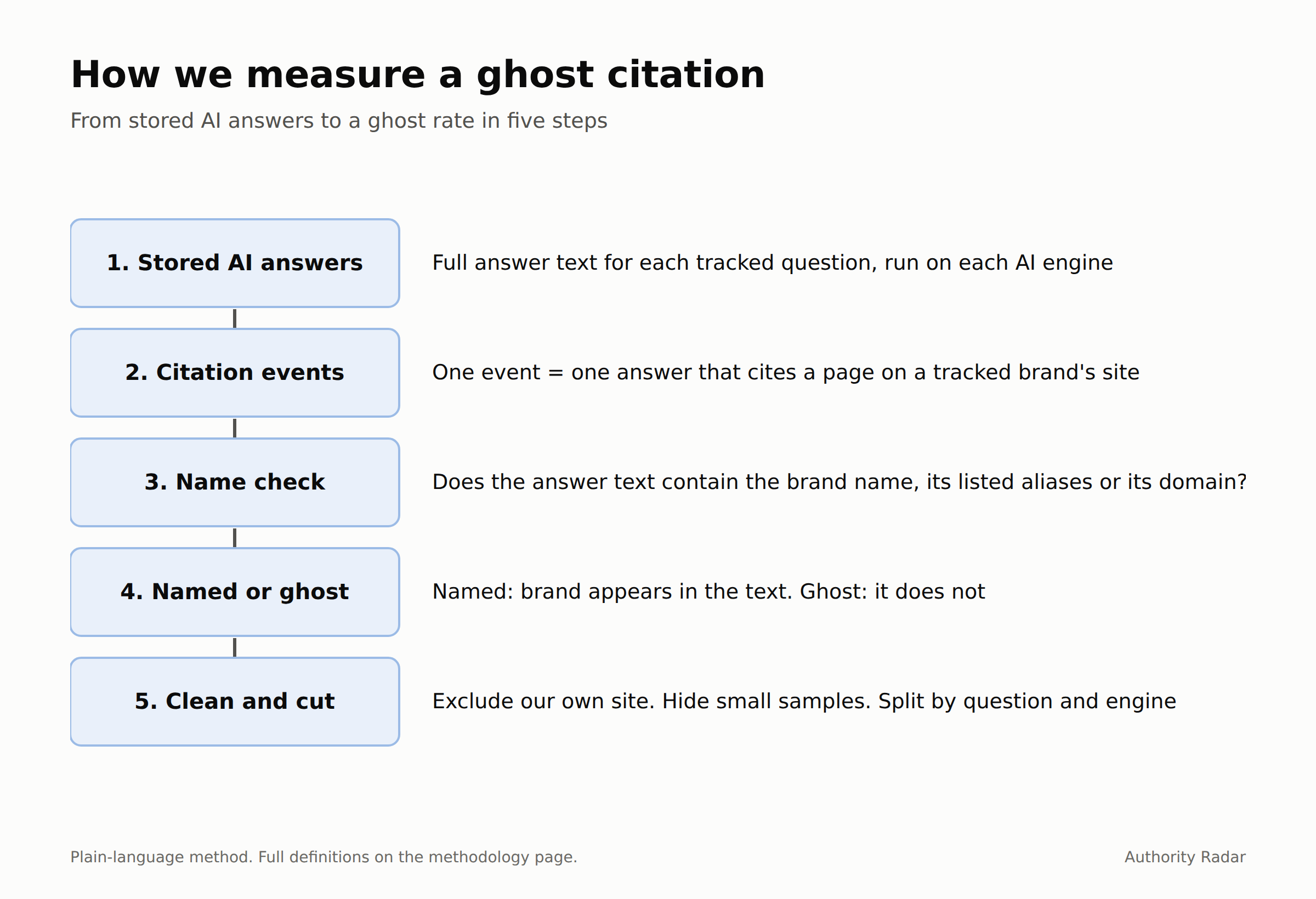
We stored the full answer text from AI engines for questions that Authority Radar customers track.
We looked at every case where an answer cited a page on the tracked brand's own website. Each one is a citation event.
For each event we checked whether the answer text names the brand.
If it does, the brand was named. If it does not, it is a ghost citation.
We removed our own site, cut out samples that were too small, and split the results by question type and AI engine.
What data this covers
Citation events analysed | 11,583 |
Questions tested | 326 |
AI engines | 11 |
Data as of | 20 November 2026 |
The data comes from the questions that Authority Radar customers track. We run each question on several AI engines over time and keep the full answer, including the list of sources the engine cites.
What we excluded
Our own site. Authority Radar tracks itself, and that adds 4,613 events. We leave those out because they are not customer data, so every figure on this page covers customer data only.
Answers shorter than 200 characters (2 events), because they are error or empty responses, not real answers.
AI engines with fewer than 500 events in a given cut are not shown on their own. We do not publish figures for them.
Definitions
Term | What it means here |
|---|---|
Citation event | One stored AI answer that cites one page on a tracked brand's own website. If an answer cites two of the brand's pages, that is two events. |
Named | The brand appears somewhere in the answer text. |
Ghost citation | A citation event where the brand does not appear in the answer text. |
Ghost rate | Ghost citations divided by citation events, as a percentage. |
Branded question | A question that contains the brand name (or one of its listed aliases). Example: "Is [Brand] good for small agencies?" |
Unbranded (generic) question | A question that does not contain the brand name. Example: "What is a cheap tool for tracking AI visibility?" |
Question type | Informational, commercial or transactional, as classified by the Authority Radar product when the question was saved. |
How we decided whether a brand was "named"
This is the step that matters most, so we describe it in full.
What counts as the brand name. For each brand we used:
the brand name as entered in the account,
the alias list Authority Radar generated for the brand (common spellings, product and company names),
the website's domain, and its short form (for example the part before the dot),
for a subdomain such as a help site, the main domain's name rather than the subdomain word ("help" would match ordinary text).
How we matched. The match is not case sensitive and must be a whole word, so a brand name hidden inside a longer word does not count. We checked the text twice, once as written and once with apostrophes removed, so "Brand's" and "Brands" both match.
Two fixes we made after checking. Our first pass counted too many ghosts in two places, because the alias list was missing the way the AI actually wrote the name:
One brand tracked as "ProductNamePM" was written by AI engines as "ProductName". After adding that, about 2,000 false ghost events became correctly named.
One education brand was written out in full by AI engines but not in our alias list. We added the full name (68 events).
We looked for the same problem in the 15 brand domains that supply the most events (about four in five of all events) and found no others. The brands with the highest ghost rates were checked by reading their answers. In each case the answers were about general topics, and the brand's page was used as a source without the brand being named. These are genuine ghost citations.
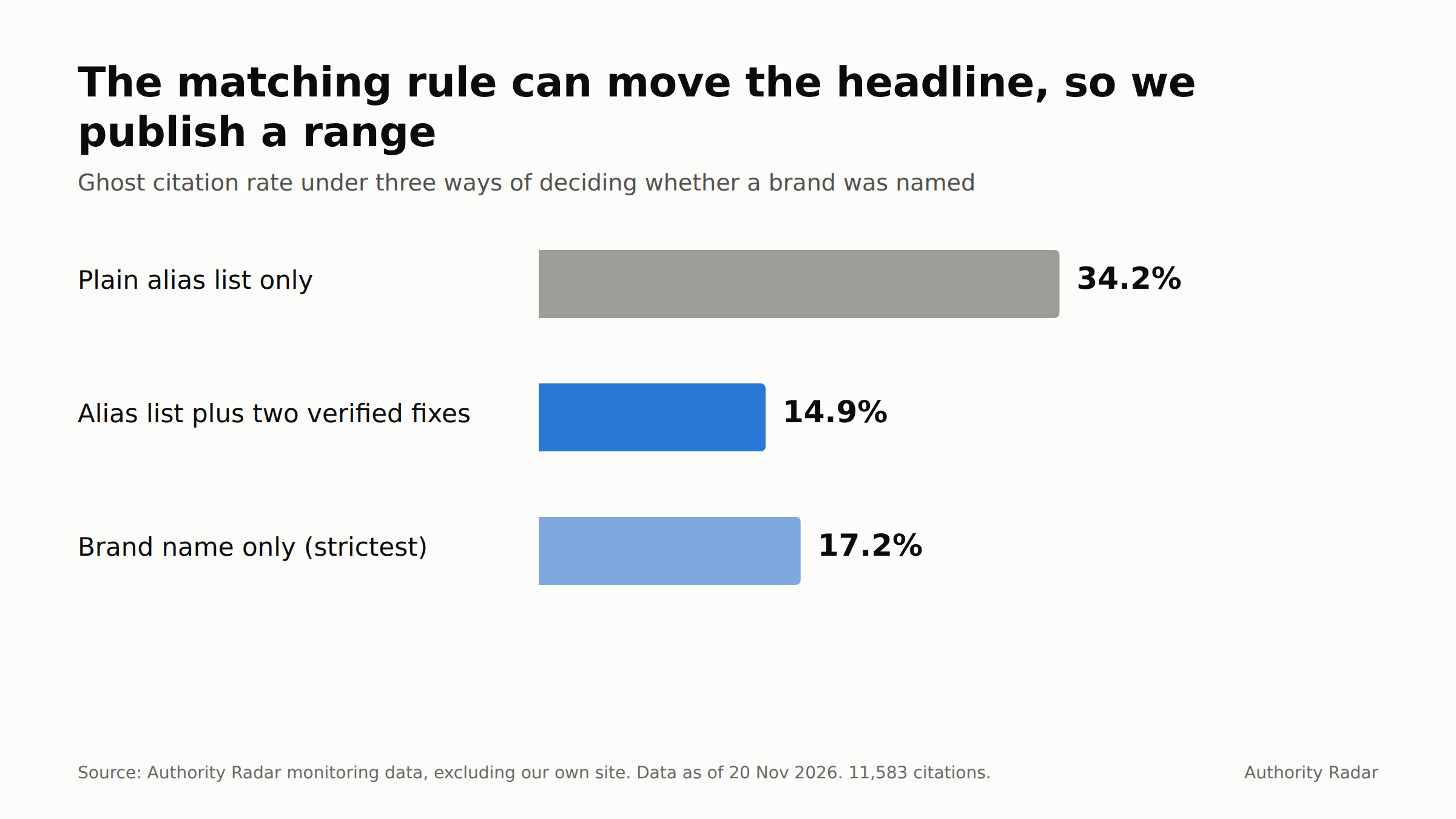
The matching rule changes the answer, so we publish a range
How "named" is decided | Ghost rate |
|---|---|
Our alias list as generated, with no fixes | 34.2% |
Alias list plus the two verified fixes above | 14.9% |
Brand name and domain only (no product names or other aliases) | 17.2% |
We publish 15% to 17% as the overall figure. The lower number counts naming a related product (for example a product that belongs to the brand) as naming the brand. The higher number does not.
We also tested a stricter version that removes web addresses from the answer text before matching, so a link that contains the brand's domain does not count as naming the brand. That gives a higher ghost rate (38.3% without the fixes), which confirms that some "named" results rest on a web address in the text. We use the standard rule in the article and say so.
How we identified branded and unbranded questions
We checked each question against the same brand-name and alias list. If the question contains any of them, it is branded. Otherwise it is unbranded.
This matters because a question that names the brand almost always produces an answer that names it back, which tells us very little. The informative cases are the generic questions that a customer who does not yet know the brand would ask.
Results tables
All figures exclude our own site. Ghost rate uses the 14.9% method (alias list plus two verified fixes) unless stated.
Overall
Measure | Events | Ghost rate |
|---|---|---|
All questions | 11,583 | 14.9% (17.2% on the brand-name-only rule) |
Branded questions | 5,048 | 0.1% |
Unbranded questions | 6,535 | 26.3% |
By AI engine, unbranded questions only
Engine | Events | Ghost rate | Note |
|---|---|---|---|
Perplexity | 2,341 | 48.4% | |
Gemini | 619 | 32.6% | Smaller sample |
OpenAI | 2,038 | 5.3% | |
DeepSeek | 807 | 4.3% | |
Claude | 271 | 14.0% | Under 500, directional only |
Copilot | 125 | 78.4% | Under 500, not for quoting |
Meta AI | 147 | 68.7% | Under 500, not for quoting |
Grok | 53 | 3.8% | Under 500, not for quoting |
AI Overviews, AI Mode, ChatGPT deep scan | 32 to 56 each | 0.0% | Too small to say anything |
By question type, unbranded questions only
Type | Events | Brands (domains) | Ghost rate |
|---|---|---|---|
Informational | 4,509 | 24 | 30.8% |
Transactional | 224 | 6 | 22.3% |
Commercial | 1,742 | 33 | 14.4% |
By brand
Of the 33 brands with at least 20 events: 20 were never ghosted, 13 had at least one ghost, 5 had a ghost rate of 10% or more and 2 had a ghost rate above 50%. On unbranded questions only, 17 brands had at least 20 events: 5 were never ghosted, 12 had at least one, and 4 had more than half of their citations ghosted.
Limits (please read)
This is our tracked set, not the web. Brands and questions were chosen by Authority Radar customers. They are not a random sample of brands or of what people ask AI. Do not read these figures as "AI search does X". Other published ghost citation studies count every site an AI engine cites. Ours counts only citations to a brand's own website, so our percentages are not directly comparable with theirs.
A few brands carry a lot of weight. Two brands supply about 45% of the unbranded events (2,949 of 6,535), and both are genuinely ghosted often. The pooled 26.3% figure for unbranded questions is therefore pulled up by them. The typical brand sits much lower: the median brand's ghost rate on unbranded questions is about 3%, and over half of brands were never ghosted on all questions. We show the per-brand picture in the main article for this reason.
Engine behaviour changes. AI engines update their models and how they show sources. These results describe what we stored up to 20 November 2026. They are not a promise about today or tomorrow.
Stored answers are not the same as what one person sees. Our runs use a fixed setup for each question. A person using an AI app may see a different answer because of location, history, product version and settings.
We count naming in text, not what readers do. We have not measured clicks, trust or recall. We only measure whether the name is in the answer text.
Small groups are noisy. Cuts under 500 events are shown for completeness or hidden. Small cuts can swing a lot.
We do not publish a trend over time. The set of tracked brands changed month to month, so quarter-by-quarter changes mostly reflect which brands were tracked, not AI behaviour.
We do not yet publish results by page type. The sample for each page type comes from too few brands. We will add it when the data supports it.
No brand or customer is named. Where we describe an example, we describe the category only.
Questions and corrections
If you spot an error or want to know more about how a number was built, contact us at our contact page. We will fix real mistakes and note the change here.
See whether AI names your brand on the questions your customers ask. Run the free check (about 2 minutes).