Cited is not named: 15% to 17% of AI citations never mention the brand

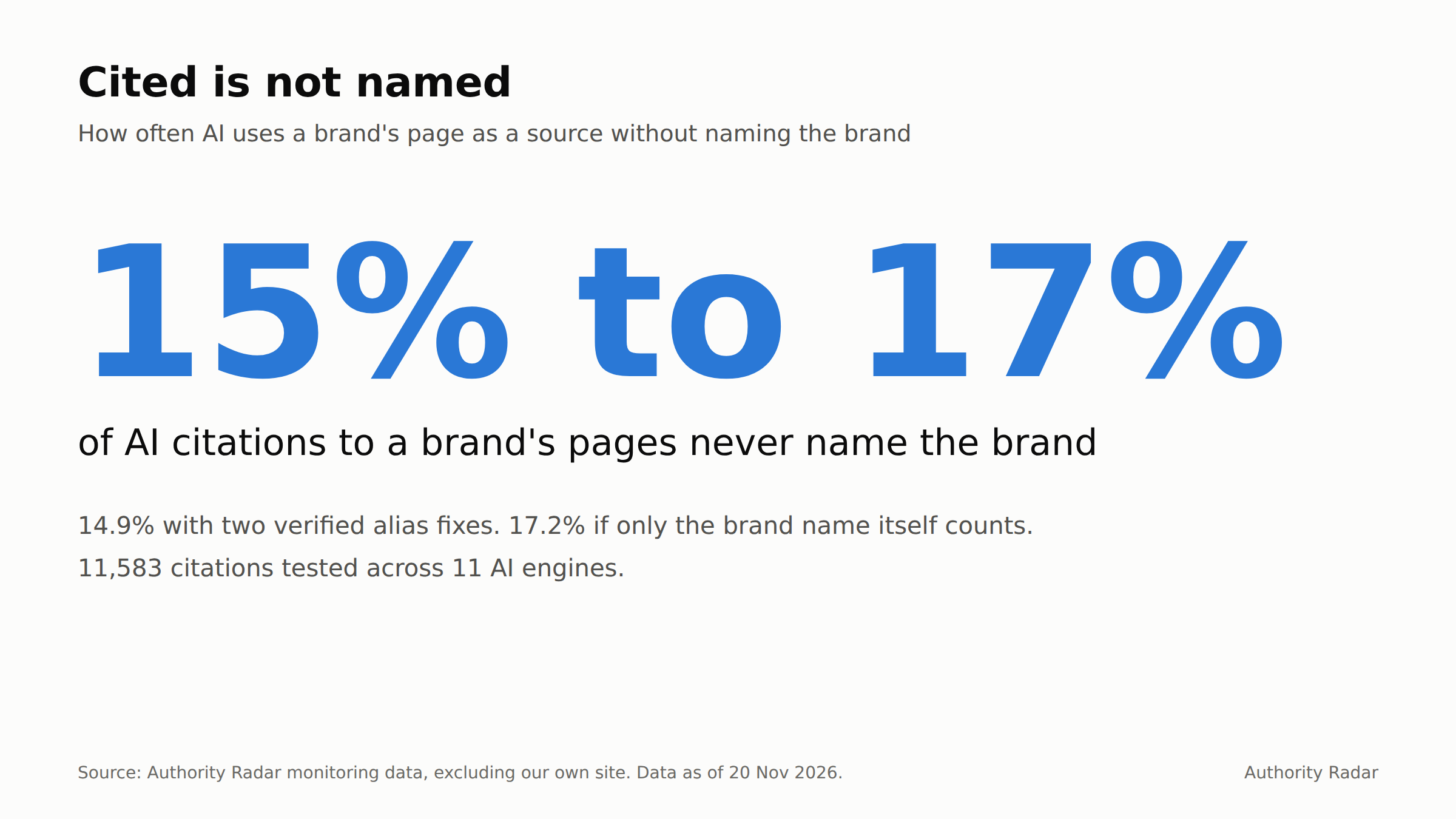
What 11,583 AI citations across 11 AI engines show about the gap between being used as a source and being named in the answer.
The short version
When an AI engine cites a page from a brand's own website, you would expect the brand to be named in the answer. Often it is. Sometimes it is not. This is known as a ghost citation, a term coined by Kevin Indig in his study with Semrush: the page is used as a source, and the brand never appears in the answer text.
We measured how often this happens across the questions that Authority Radar customers track.
- About 15% to 17% of citations were ghost citations. The exact figure depends on how you decide that a brand was "named", so we publish a range. How we counted.
- The question decides most of it. When the question names the brand, the ghost rate was 0.1%. When it was a generic question, a customer who does not know the brand yet might ask, it was 26.3%.
- The AI engine matters on generic questions. Perplexity left the brand out 48.4% of the time, Gemini 32.6%, OpenAI 5.3%, DeepSeek 4.3%.
- Ghosting is uneven across brands. On generic questions, 5 of 17 brands lost out 40% or more of the time, and 5 were never ghosted. The typical brand sat around 3%.
If you only remember one line: cited is not named.
What a ghost citation is
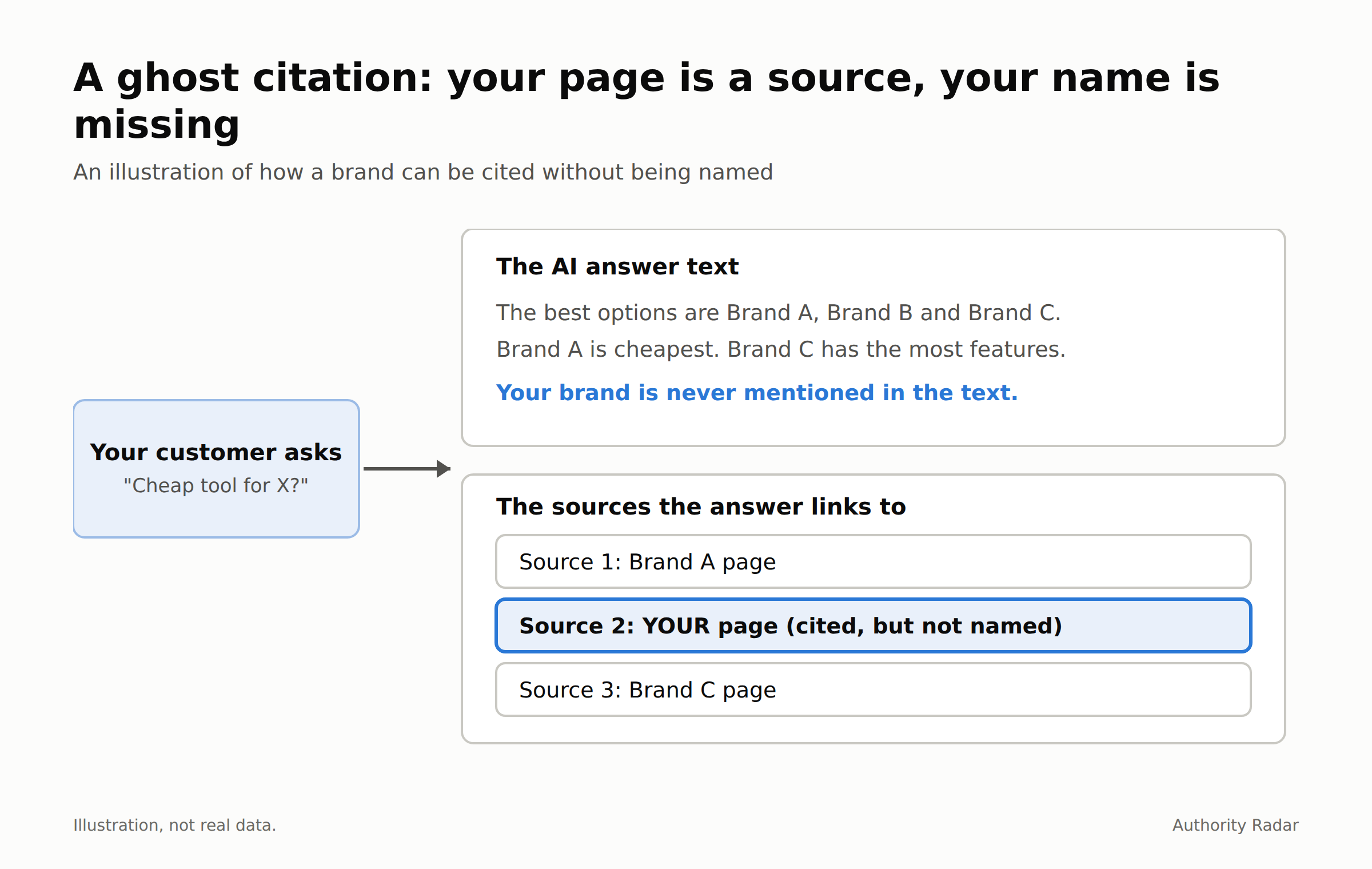
Illustration, not real data.
Ask an AI engine a question and it usually gives you two things: a written answer, and a list of the sources it used. Most brand monitoring looks at the second part. Is my site in the source list? That is a fair thing to check, but it leaves out the first part, which is the text people actually read.
A ghost citation is the gap between the two. Your page is in the source list. Your name is not in the answer.
Here is a simple example. A customer asks, "What is a cheap tool for tracking AI visibility?" The answer says, "The best options are Brand A, Brand B and Brand C." Your page is one of the sources behind that answer, but your brand is not among the options. You were used, and you were not named.
We are not saying this is always bad for a brand. We do not yet know how many readers click through to sources, or how much a name in the text is worth compared to a link in the source list. What we can measure is how often a brand's page is used without the brand being named. That is the number this study is about.
What we measured
We looked at stored AI answers from the questions that Authority Radar customers track.
| Citation events | 11,583 |
| Questions tested | 326 |
| AI engines | 11 |
A citation event is one stored answer that cites one page on a tracked brand's own website. For each event we checked whether the answer text names the brand, using the brand name, its known aliases and its domain. We left out Authority Radar's own tracked site, because it is not a customer. Other studies of ghost citations count every site an AI engine cites. Ours counts only citations to a brand's own website, so our percentages are not directly comparable with theirs. We describe every step, and the checks we ran, on the methodology page.
Two points before the findings. First, this is our tracked set. Customers chose the brands and the questions, so these are not a random sample of the web. Second, the results describe what we stored up to 20 November 2026, not what any engine will do tomorrow.
Finding 1: The question decides whether you get named
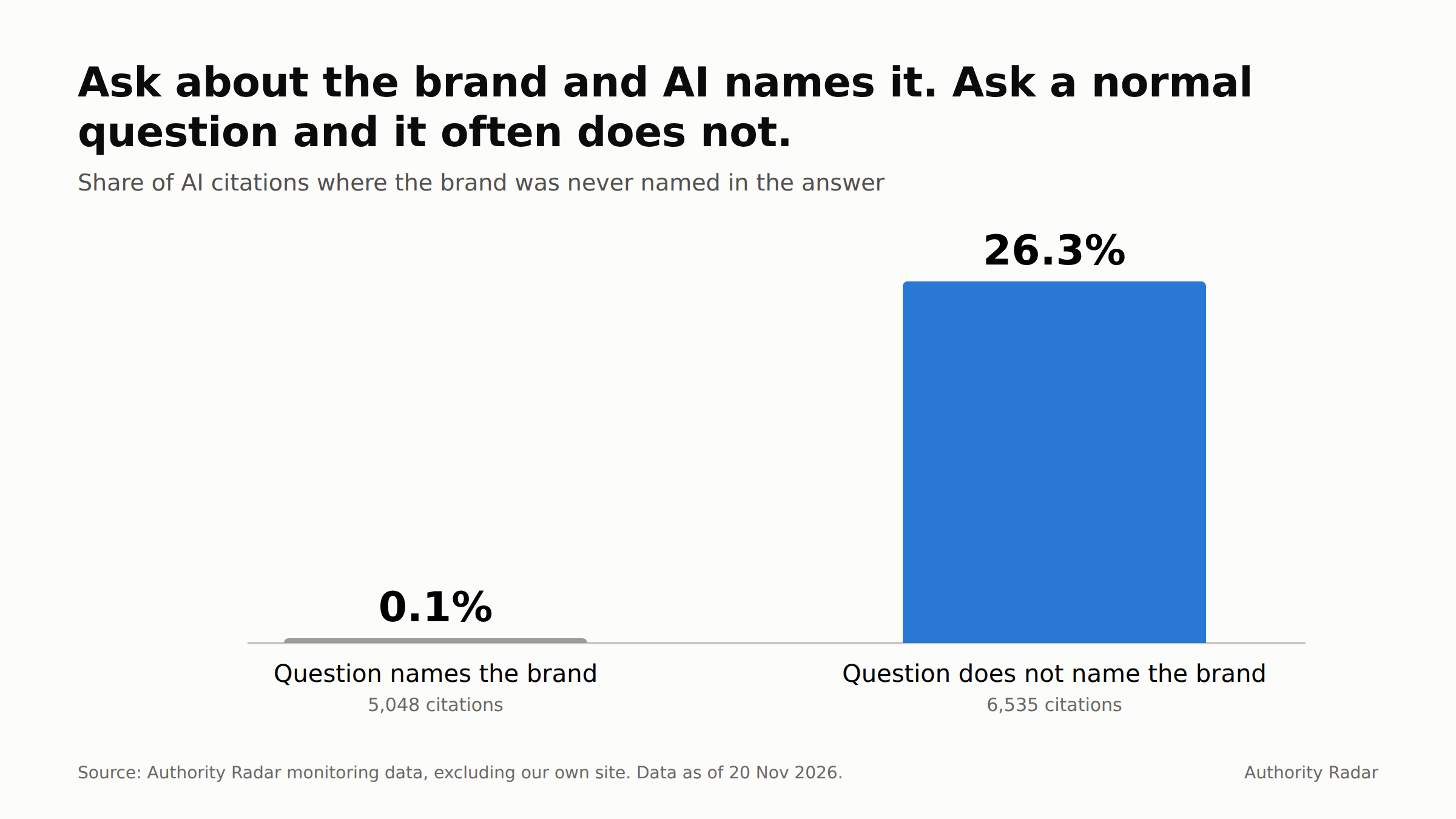
We split every question we tested into two groups.
- Questions that name the brand. For example, "Is [Brand] good for small agencies?" Out of 5,048 citations, only 4 were ghosts. That is 0.1%.
- Questions that do not name the brand. For example, "What is a cheap tool for X?" Out of 6,535 citations, 1,717 were ghosts. That is 26.3%.
This makes sense once you say it out loud. If the question contains your name, the answer is almost certain to contain it too. The ghost problem lives in the other group: the questions a customer asks before they know who you are.
That is also the group many brand checks skip. A quick test that types the brand name into an AI engine will almost always look fine. It tests the easy case.
The takeaway: if you only check AI answers with your brand name in the question, you will not see ghost citations.
Finding 2: On generic questions, the AI engine matters a lot
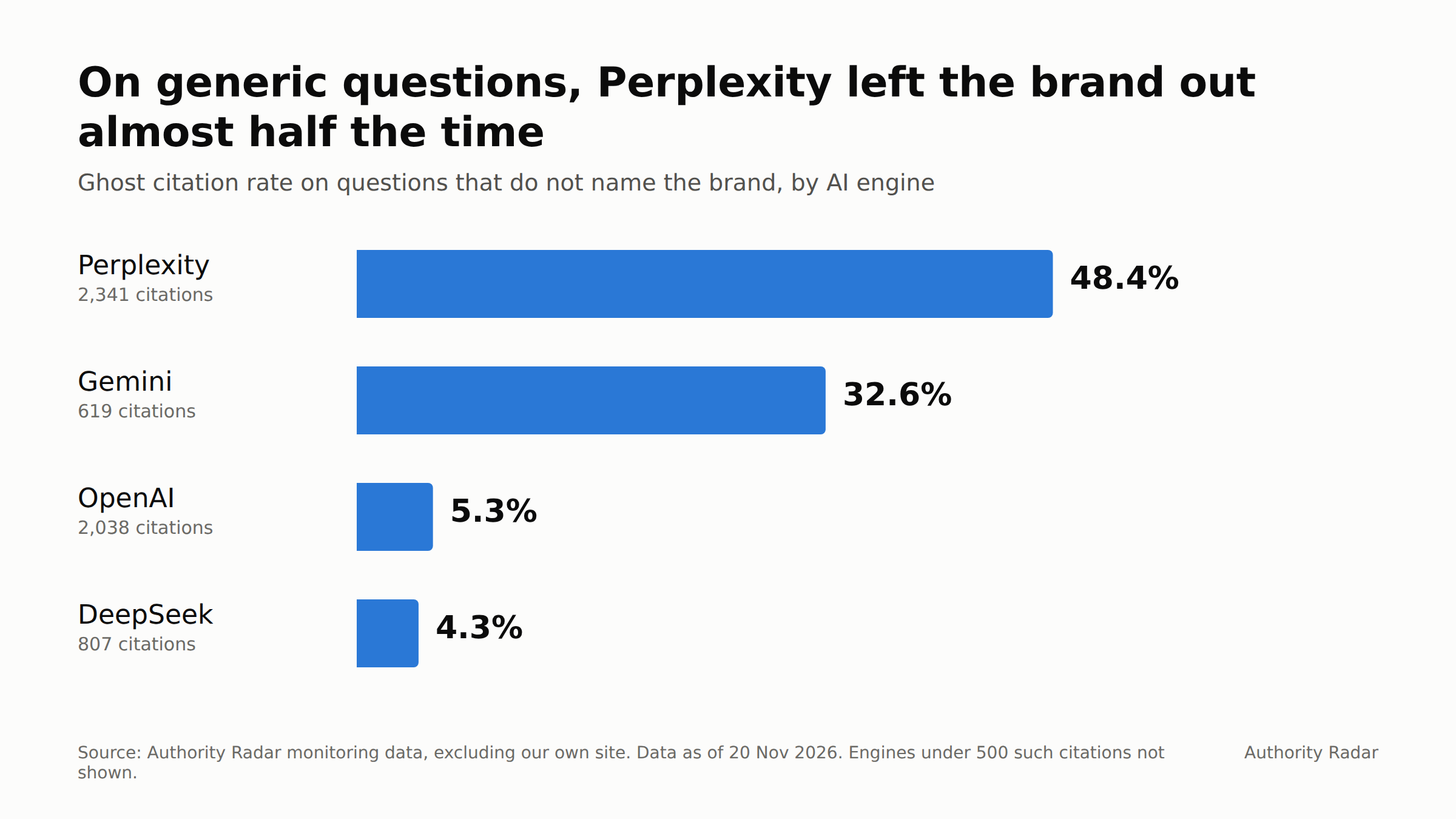
On generic questions, the engines behaved very differently.
| Engine | Generic-question citations | Ghost rate |
|---|---|---|
| Perplexity | 2,341 | 48.4% |
| Gemini | 619 | 32.6% |
| OpenAI | 2,038 | 5.3% |
| DeepSeek | 807 | 4.3% |
Perplexity used a brand's page as a source and left the brand out in 1,134 cases. OpenAI did it 107 times, on a similar number of citations (2,038).
Is that just because Perplexity was asked about different brands? We checked. Among the brands where we had at least 30 citations on both Perplexity and OpenAI (18 brands, across all questions), Perplexity's ghost rate was higher for 4 of them and lower for none, averaging 10.1% against 1.1%. So the gap is not only a result of which brands were tracked.
Why does Perplexity ghost more? We do not know. A guess is that it tends to show its sources as a separate list and write the answer without naming each one. That is a guess, and we have not tested it.
Two cautions. The Gemini figure rests on a smaller sample (619 citations) than the others. And for Claude, Copilot, Meta AI and Grok, we had fewer than 500 generic-question citations each, so we do not publish engine figures for them.
The takeaway: a brand can be named reliably on one engine and left out on another, so one engine's result does not tell you about the rest.
Finding 3: Ghosting is uneven, and a few brands carry it
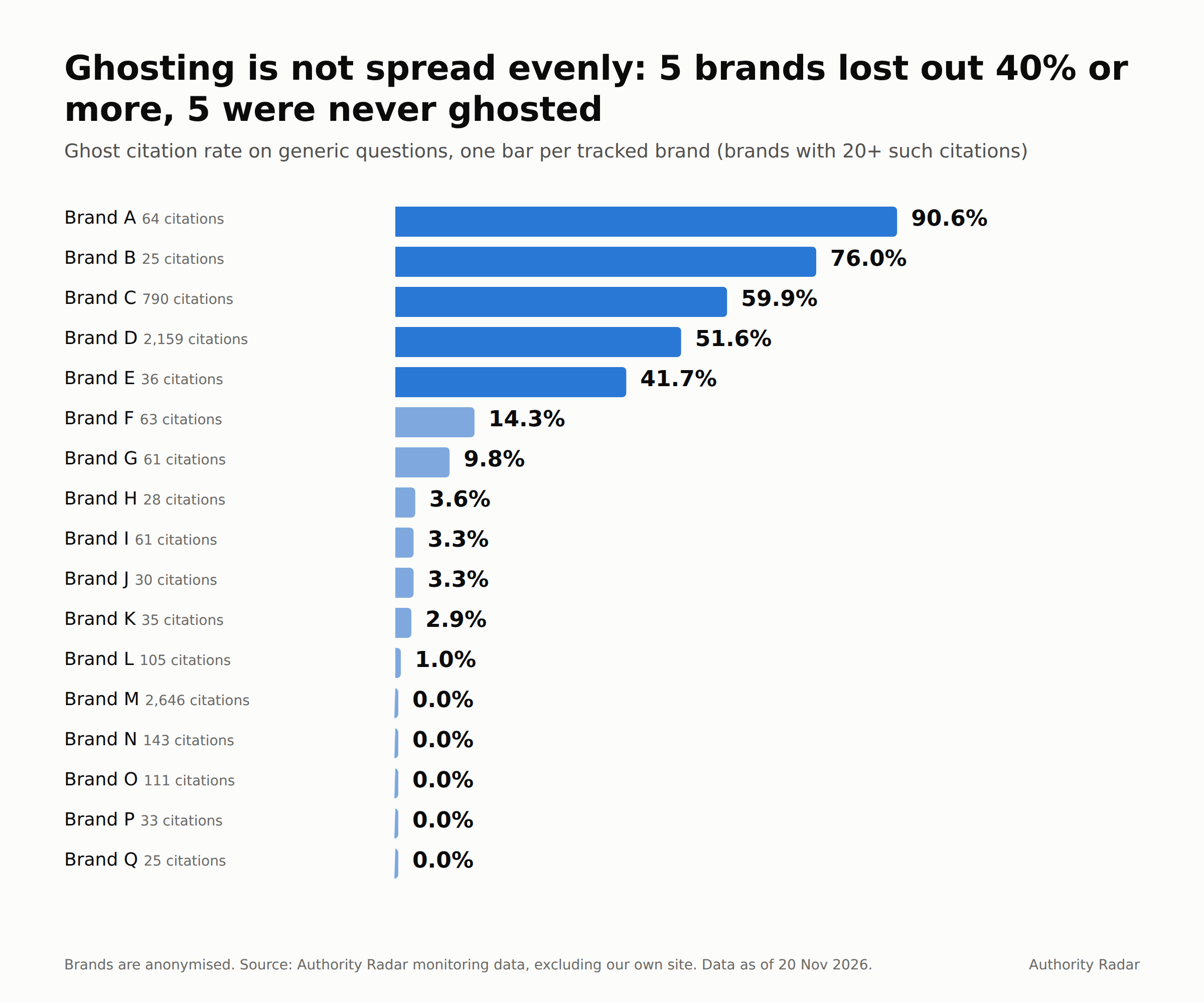
The pooled figure of 26.3% on generic questions hides a lot of variation. Here is the same data, one bar per brand. We include brands with at least 20 generic-question citations and anonymise them.
- 5 of 17 brands were ghosted 40% or more of the time. The worst was above 90%.
- 5 of 17 brands were never ghosted.
- The typical brand sat around 3%.
Two of the heavily ghosted brands also supply a large share of the data: together they account for about 45% of all generic-question citations in the study. That pulls the pooled number up, which is why we show the per-brand view.
We read the answers behind the biggest ghost rates. The pattern was consistent. The brands were being used as sources for general questions about their category: prices and specifications of a type of product, or how long it takes to sell a business in a particular city. The answers gave good information and did not mention the brand. These are real ghosts, not matching errors.
Across all questions, 20 of the 33 brands with at least 20 citations were never ghosted at all. Ghost citations are not a problem for everyone. They are a problem that concentrates.
The takeaway: the average hides the story. Check your own brand rather than assuming you are typical.
Finding 4: Informational questions leave the most brands out
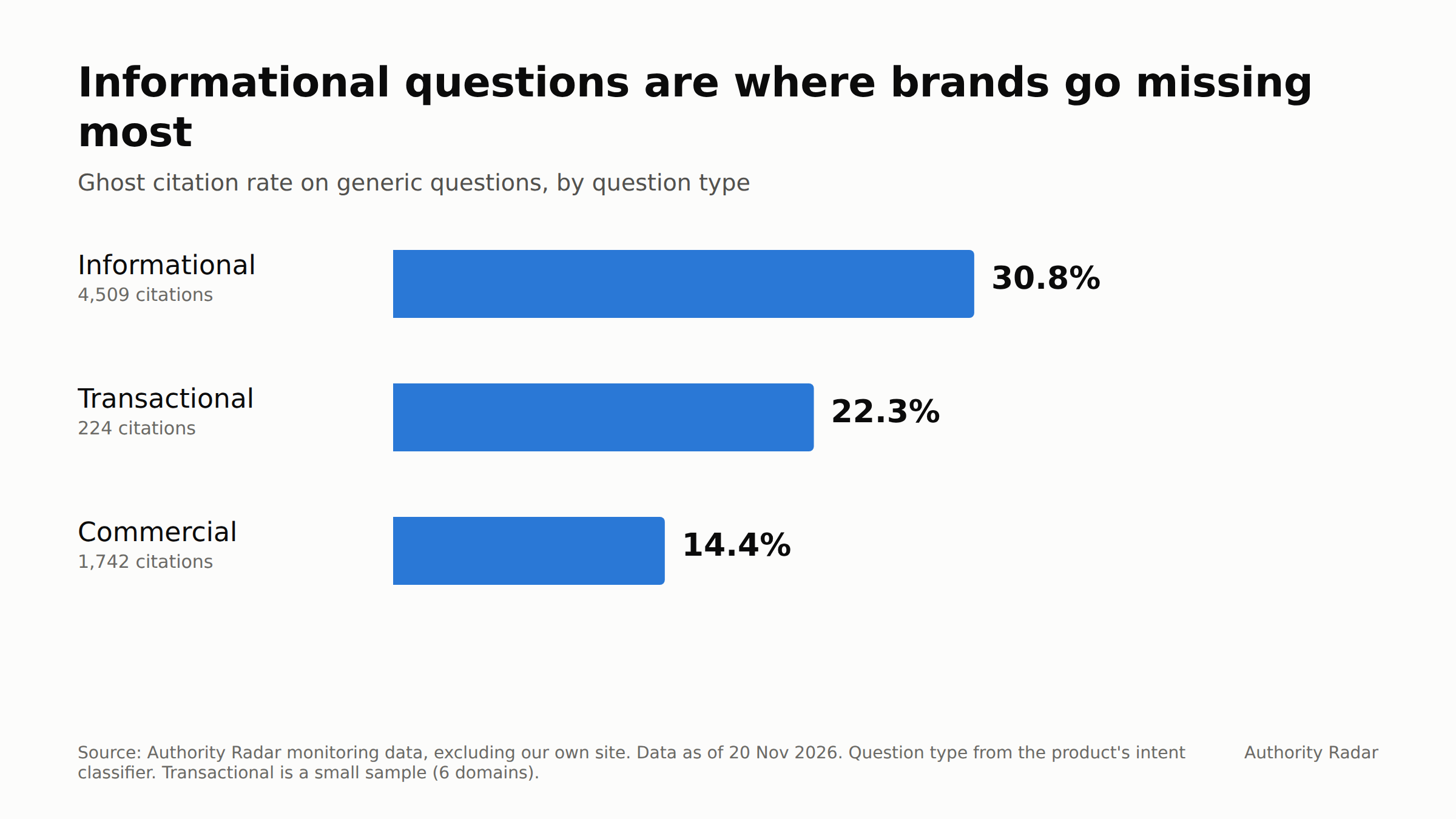
We also split generic questions by type, using the product's classification of each question.
| Question type | Citations | Ghost rate |
|---|---|---|
| Informational (learning about a topic) | 4,509 | 30.8% |
| Commercial (comparing options) | 1,742 | 14.4% |
| Transactional (ready to buy) | 224 | 22.3% |
Informational questions had the highest ghost rate. That fits the idea that when someone is learning about a topic, the answer tends to teach rather than recommend, and may not name brands at all. Transactional questions are a small sample (224 citations across 6 brands), so read that row as a hint only.
Why this matters, and what we cannot say
Why it matters. In many AI answers, the written text is what people read first and the source list is shown separately. If your page shapes the answer but your name is not in it, a reader gets the information without learning who provided it. For a brand that wants to be remembered, that is a gap worth knowing about.
What we are not saying.
- We are not saying ghost citations cost you customers. We have not measured clicks, visits or recall.
- We are not saying a source list link is worthless. It can still send visits.
- We are not saying these numbers describe all of AI search. They describe the brands and questions our customers track.
- We are not telling you which page changes reduce ghosting. We have an early pattern by page type, but it rests on too few brands for us to publish. We would rather say that than guess.
- We are not showing a trend over time. The set of tracked brands changed month to month, so quarter-to-quarter changes mostly reflect which brands were tracked.
How to check your own brand
You can do a version of this test without any tool.
- Write five generic questions that your customers ask before they know your name. Not "Is [Brand] good?" but "What is the best way to do X?" or "How much does X cost?"
- Run each question on at least three AI engines. Include Perplexity, because it behaved very differently in our data. Run each question more than once, because answers vary between runs.
- For each answer, note one of three things. Named: the answer text mentions your brand. Cited but not named: your page is in the source list but your name is not in the text. Absent: neither.
- Compare the engines. A brand can look fine on one engine and be missing on another.
- Track it over time. One check is a snapshot, not a result.
| Question | Engine | Named | Cited, not named | Absent |
|---|---|---|---|---|
Authority Radar does this check for you across engines and over time. Run the free check to see whether AI names your brand on the questions your customers ask. It takes about 2 minutes.
Frequently asked questions
What exactly counts as "named"? The brand name, a known alias or the domain appears in the answer text. The match is not case sensitive and must be a whole word. Full details are on the methodology page.
Why a range of 15% to 17% and not one number? Because the answer depends on a judgement call: whether naming a product that belongs to the brand counts as naming the brand. If it counts, the ghost rate is 14.9%. If only the brand name and domain count, it is 17.2%. We would rather show the range than pick the number that sounds better.
Does the study include Authority Radar's own site? No. Authority Radar tracks itself, but it is not a customer, so every figure here covers customer data only.
Are the numbers the same on every AI engine? No. On generic questions they ranged from about 4% to 48% for the engines with enough data.
How do I know the brand matching is right? We checked it by reading the answers behind the highest ghost rates, and we found and fixed two cases where our alias list was missing the way the AI wrote a brand's name. Those two fixes changed the headline from 34.2% to 14.9%, which is why we publish the range and the method.
Will these results hold next month? We cannot promise that. AI engines change. We will refresh the study and note changes on the methodology page.
The method in one box
- 11,583 citation events, 326 questions tested, 11 AI engines.
- A citation event is one stored answer citing one page on a tracked brand's own website.
- Named means the brand name, a known alias or the domain appears in the answer text. Ghost means it does not.
- Authority Radar's own tracked site is excluded. Every figure covers customer data only.
- Brands are anonymised. We report no trend over time.
- This is a tracked set chosen by customers, not a random sample of the web.
- Data as of 20 November 2026. Full method: methodology page.
Cited is not named. Check whether AI names you on the questions your customers ask: run the free check.
How to cite this study: Authority Radar, "Cited is not named: 15% to 17% of AI citations never mention the brand", 2026. Data as of 20 November 2026.