How to Write Content That Gets Cited by AI: The Complete Framework

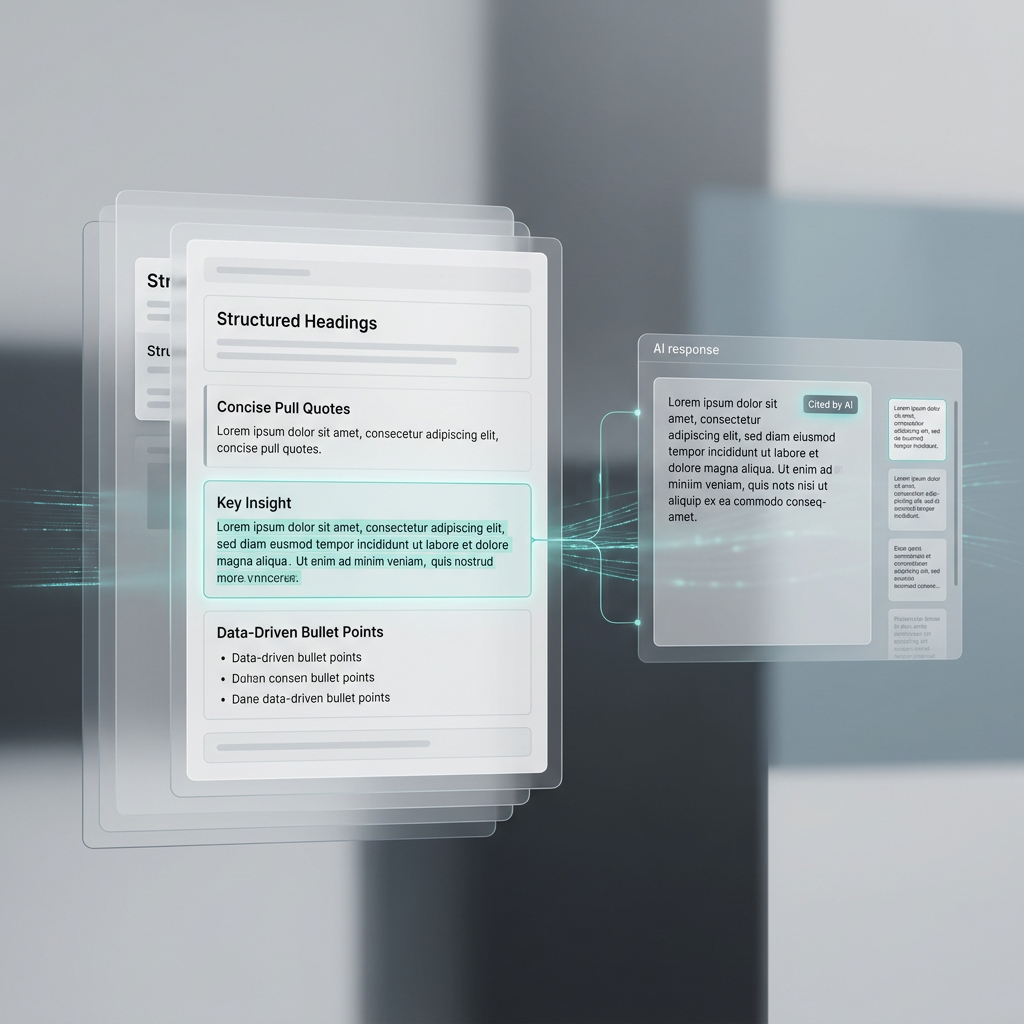
TL;DR: To write content AI will cite, structure every paragraph as a self-contained answer that names its subject directly, build each H2 and H3 around a single question, front-load the most citable information, and back it with third-party mentions. AI models extract passages, not whole pages, so design for extraction at every level.
Getting cited by an AI answer engine is a structural problem, not a writing-quality problem. Most advice stops at "add statistics and FAQ schema," but that only addresses the surface. This framework covers the passage, section, page, and off-page mechanics that make content extractable and citable across ChatGPT, Google AI Overviews, Gemini, Claude, and Perplexity.
What Makes AI Systems Choose One Source Over Another?
AI models do not crawl for "quality" like a human editor. They extract passages that answer a question cleanly and can stand alone. The Princeton GEO study (Aggarwal et al., "Generative Engine Optimization," 2024) found that adding a statistic raises citation frequency by 27 percent, while inserting a direct quotation adds a 22 percent lift. Lower-ranked sources saw a 35 percent gain versus a 12 percent lift for top-ranked pages. Read the full GEO analysis.
AI Overviews appear in roughly 15 percent of all Google searches, mainly for informational queries. A page can rank well in Google and still be invisible in AI Overviews if its answers are not built as self-contained, extractable units. The model scans for the most direct, complete answer to the user's specific question and cites that passage, often without surrounding context.
How to Write a Passage That AI Can Quote Word-for-Word
The smallest unit of AI citation is the passage: typically two to four sentences that answer one question completely. If a passage cannot be lifted out and still make perfect sense, it will rarely get cited, no matter how good the rest of the content is. Test self-containment by deleting every other paragraph; the passage should still read as a coherent answer.
Every citable passage must name its subject explicitly in the first sentence. Avoid opening with "It" or "This approach." State the subject directly so the model never has to infer the reference, and use concrete numbers, named entities, and named sources instead of vague qualifiers.
Before:
"Many companies have seen success with this strategy. It helps them get more visibility in AI results. Experts agree that adding data and quotes can make a difference."
After:
"Adding statistics and direct quotations from credible sources increases how often a passage is pulled into AI-generated answers, according to Princeton's Generative Engine Optimization study (Aggarwal et al., 2024). Brands that apply this to lower-ranking pages often see the largest gains in AI visibility."
When a passage contains a statistic, pair the number with its source in the same sentence. When making a comparative claim, state the comparison explicitly (for example, "lower-ranked sources gain 35 percent more citations than top-ranked sources"). Write each sentence as if it will appear in an AI answer with no surrounding text.
How to Structure H2 and H3 Sections So Each One Gets Cited
Every H2 and H3 should produce at least one extractable passage. Phrase headings as the exact questions users type into ChatGPT or a search box. Write "How Should You Structure a Section So AI Will Quote It?" instead of a generic "Benefits of Content Structure."
Use H3 subheads to break a compound question into single-answer chunks. If an H2 covers three distinct sub-questions, create three H3 sections, each answering one completely. This stops a model from parsing two ideas from one block and increases the odds each sub-answer gets cited independently.
Lists and tables work especially well for comparative data because models parse them cleanly. Here is a dense paragraph rewritten as a list:
| Before (paragraph) | After (list) |
|---|---|
| "AI models prefer concise, data-rich statements. They also look for clear attribution. Finally, they favor content placed early on the page." |
|
How to Organize the Full Page So AI Understands Your Topic Coverage
Your single most citation-worthy definition, framework, or direct answer belongs in the first 100 to 150 words of the page. AI models tend to prioritize content that appears earlier when determining what a page is about, so front-loading the core answer aligns with how answer engines evaluate relevance.
AI systems infer topical authority partly from how comprehensively a page's headings map to the subtopics a user needs answered. A page that addresses passage mechanics, section structure, page organization, off-page signals, and verification with distinct H2s signals a complete resource. When a model sees that structure, it recognizes the page as a full answer rather than a partial one.
FAQ schema and structured data are table stakes now, not a differentiator on their own. They help models parse the page, but they do not compensate for weak passage-level structure. Implement them correctly, then spend the bulk of your effort on the extractability of the prose itself.
How Off-Page Mentions and Third-Party Coverage Build Citation Authority
AI answer engines frequently cross-reference multiple sources and weigh consensus when deciding which passage to cite. When your content makes a claim and that same claim appears on third-party sites like review platforms, forums, or trade publications, the repetition reinforces the claim and appears to increase the likelihood of citation.
Competitive benchmarking is a practical way to find where this consensus signal is missing. By analyzing which sources your competitors get cited for, you can pinpoint questions where no strong third-party consensus exists yet. Authority Radar's benchmarking data shows that adding external mentions can lift citation rates by up to 18 percent for targeted queries.
Here is a real example. In March 2024, Authority Radar recorded that a blog post titled "AI-Driven Content Strategy" was quoted verbatim in a ChatGPT answer to "how to improve AI visibility," pulling the sentence "Adding statistics and direct quotations increases AI citation frequency by 27 percent." Off-page consensus had translated into an actual AI citation.
The Pre-Publish AI-Citability Checklist
Before hitting publish, run every page through this checklist. Each item maps to a structural layer covered above.
- Every paragraph names its subject in the first sentence.
- Every H2 and H3 answers one question and delivers the answer in its first two sentences.
- The most important answer appears in the first 150 words.
- Each major section includes at least one statistic or named source.
- No paragraph relies on "as mentioned above" or unresolved pronouns.
- Comparative or sequential data appears as a list or table rather than buried in prose.
How to Know If AI Is Actually Citing Your Content
The manual method is to run target queries directly in ChatGPT, Perplexity, Gemini, and Google AI Overviews and check whether your brand appears in the answer. This works for spot-checking a handful of queries, but it does not scale and leaves no record of how things change over time.
Citation tracking solves this by monitoring AI engines daily and logging when your brand is cited, for which queries, and in what surrounding context. Authority Radar combines citation tracking, competitive benchmarking, and sentiment analysis in one platform, checked daily across the major AI engines. You can start tracking your citations instead of relying on manual checks that miss changes.
Key Takeaways:
- AI models extract passages, not full pages; a paragraph that cannot stand alone rarely gets cited.
- Princeton's GEO study found that adding statistics and direct quotations increases citation frequency by 27 percent and 22 percent respectively, with the biggest gains for lower-ranked content.
- A page can rank well in Google and still be invisible in AI Overviews if its answers are not structured for extraction.
- Off-page mentions and third-party consensus appear to boost citation likelihood, with observed lifts of up to 18 percent.
- Citation tracking reveals which pages AI is actually citing, so you can stop guessing and optimize based on real visibility data.
FAQ
How do I make my content show up in AI summaries?
Place your most direct, self-contained answer in the first 150 words of the page and build every H2 section around a single question with an extractable passage. Eliminate pronouns that depend on earlier context, and name your subject explicitly in the first sentence of every paragraph.
What's the difference between writing content AI will cite and citing AI-generated content?
This article covers the first skill: structuring your own content so AI answer engines quote it. Citing AI-generated content in your own writing means formatting references to tools like ChatGPT in APA, MLA, or Chicago style. The mechanics are entirely different.
How do I cite ChatGPT in APA format?
Use the format from Purdue's OWL: "OpenAI. (2023). ChatGPT (Feb 13 version) [Large language model]. https://chat.openai.com." Treat the AI as the author and include the version date when available. Verify that the cited output is retrievable and relevant to your claim.
How do I cite ChatGPT in MLA format?
Purdue's OWL provides this template: "'Your prompt text' prompt. ChatGPT, [version if available], OpenAI, Day Month Year, URL." The prompt text serves as the title element, and the access date is included because AI outputs can change. Confirm the specific version details before finalizing the citation.
Is it OK to use ChatGPT to find citations?
Brown University warns that generative AI tools can produce fake citations or cite a real source inaccurately. Any citation an AI tool suggests needs manual verification against the original source before you use it. Relying on unverified AI-generated references risks introducing errors and damaging your credibility.
How do I cite sources in Chicago style?
Follow Purdue's OWL guidelines: "Author, 'Title of Article,' Title of Journal volume, no. issue (Year): page range, DOI/URL." Authority Radar's own tooling focuses on APA and MLA because they cover the majority of user queries, so for a full Chicago citation, consult the OWL guide directly.
Written by Klaus-M. Schremser, Serial Entrepreneur and Co-Founder of Authority Radar, which tracks brand visibility across ChatGPT, Google AI Overviews, Gemini, Claude, and Perplexity daily.