GEO vs SEO: The Complete Guide for 2026

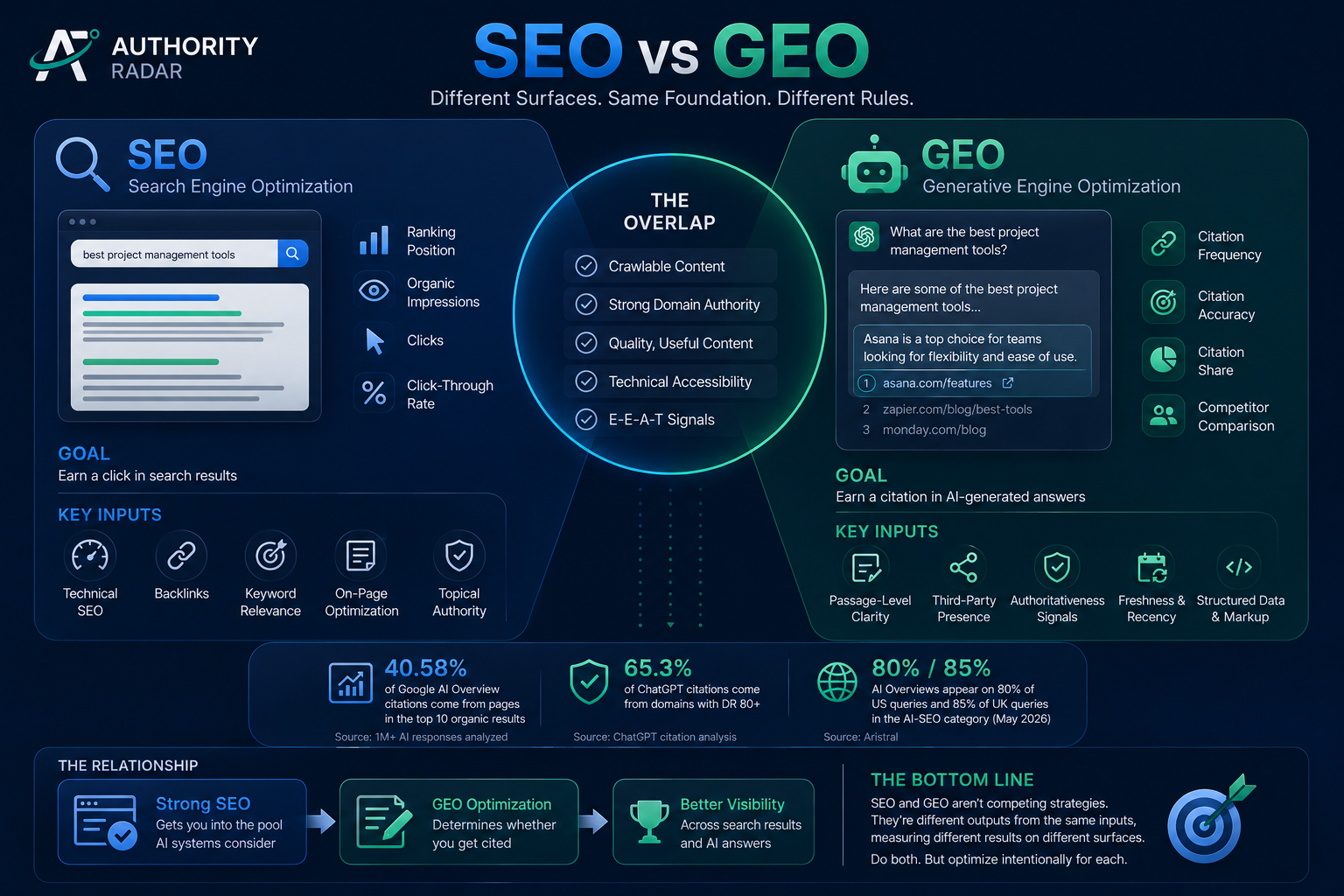
The most important thing to understand about GEO versus SEO is that they aren't competing strategies you choose between. They're different outputs from the same inputs, aimed at different surfaces, measuring different results. A page that ranks well in organic search and a page that gets cited in ChatGPT responses are using the same raw materials, crawlable HTML, clear structure, credible authority, to succeed in two environments that now operate by genuinely different rules.
That said, the overlap is less than most "do both" articles imply, and the divergence matters more than most SEO-centric teams want to admit. This guide breaks down exactly what each discipline measures, where the inputs overlap, where they don't, and how to decide which one to prioritize for a given piece of content.
What SEO Actually Measures
Search engine optimization is the practice of improving how a page performs in traditional search engine results pages, primarily Google and Bing. The outputs it measures are clear and have been stable for years: ranking position, organic impressions, clicks, and click-through rate.
The inputs that drive those outputs are well-documented: crawlability, indexation, page speed, backlinks, topical authority, keyword relevance, and on-page signals like title tags and structured data. The goal is a clickable blue link in a ranked list.
This system worked as the near-exclusive discovery mechanism for the web for roughly two decades. It still works. Organic search still drives the majority of trackable web traffic for most businesses. SEO is not obsolete.
What changed is that it's no longer the only surface that matters.
What GEO Actually Measures
Generative engine optimization is the practice of structuring content so AI systems like ChatGPT, Perplexity, Gemini, and Google AI Overviews cite it when generating an answer. The term comes from a 2023 research paper from Princeton, Georgia Tech, IIT Delhi, and the Allen Institute for AI, which is also the most credible empirical foundation the discipline currently has.
The output GEO measures is different from SEO's output in one fundamental way: there is no click required. An AI system reads your content, extracts a passage, synthesizes it into an answer, and may or may not attach a citation link. Whether the user clicks that link is a separate question from whether your content was cited at all. As of early 2026, AI Overviews reduce the organic click-through rate for the top-ranking Google page by 58% for affected queries, which means ranking first in traditional search now sometimes means losing traffic to the AI summary that appears above you.
The success metric for GEO is not position. It's citation frequency, citation accuracy, and citation share: how often your content is referenced, whether the facts attributed to you are correct, and how that compares to competitors who are also being cited for the same queries.
The Critical Overlap: SEO Still Feeds GEO
This is the data point most GEO discussions bury, but it's the most practically important one.
Analysis of over one million AI-generated responses found that 40.58% of citations in Google AI Overviews come from pages already in the top 10 organic search results. ChatGPT, separately analyzed, shows that 65.3% of pages it cites come from domains with a domain rating of 80 or above. In Aristral's monitoring of queries in the AI-SEO category in May 2026, AI Overviews fired on 80% of US queries and 85% of UK queries.
What this means practically: GEO without a baseline SEO foundation has very little to work with. A page on a domain with low authority and no organic traction is unlikely to be in the retrieval pool these systems pull from in the first place. Strong SEO is not sufficient for GEO, but it is the floor that makes GEO possible.
The relationship is directional, not symmetric. Strong SEO gives you access to the pool of pages AI systems consider. GEO-specific optimization determines whether your page gets cited once it's in that pool.
Where They Diverge: The Inputs That Are GEO-Specific
Once you're operating on a domain with reasonable authority and organic traction, the GEO-specific optimizations are genuinely different from what traditional SEO prioritizes.
Passage-Level vs Page-Level Optimization
SEO optimizes a page to earn a click. The page is the unit. Title tags, meta descriptions, heading structure, and word count all signal what the page is about to a crawler ranking thousands of pages against each other.
GEO optimizes a passage to earn a citation inside an answer. The passage is the unit. A 2,000-word page might get cited on the strength of one 80-word paragraph that directly answered a question cleanly, while the other 1,920 words are never read by the model's retrieval system. This shifts what "good content" means at the structural level: not "how well does this page cover the topic" but "how many passages on this page are self-contained, direct, and citable without the surrounding context."
Third-Party Presence vs Owned Content
SEO operates primarily on your own pages. You optimize your site, earn backlinks to your site, and rank your site's pages. The domain you control is the primary lever.
GEO requires presence off your own site. AI systems don't restrict themselves to your domain. They pull from wherever their retrieval index finds relevant content, which means your brand's presence in third-party publications, reviews, industry databases, Wikidata, and editorial coverage all feed into how confidently an AI system can cite you. A study of AI citations found that 89% or more of links cited were earned media rather than brand-owned content, and 47% came specifically from journalistic sources.
The practical implication is uncomfortable for teams used to controlling their content production: the surfaces AI systems trust most are the ones you don't fully control.
Citation Metrics vs Ranking Metrics
SEO success is measured by Google Search Console data: impressions, position, clicks, CTR. These are available, standardized, and have been the basis of SEO reporting for years.
GEO success has no equivalent standard dashboard. The metrics are citation frequency, citation share, sentiment, and prompt coverage, tracked across multiple AI platforms, each with its own citation behavior. Google Search Console's AI Performance report, introduced in 2026, shows AI impressions but not click data, context, or which specific queries triggered a citation. We've written a detailed breakdown of what the GSC AI Performance Report actually shows and where its current limitations sit.
What the Proven Tactics Are
The original Princeton-led GEO research paper is the most credible source on what actually moves GEO performance. It found four tactics that measurably improved visibility in generative responses:
Adding statistics lifted AI visibility by up to 40%. Adding quotations from credible sources had a comparable positive effect. Citing named sources inline increased citation likelihood. Clearer sentence structure (what the researchers called "fluency optimization") also improved results.
What the research did not find significant effects for: keyword density, backlink count, or most of the classic on-page SEO signals that drive traditional rankings. The inputs that matter for GEO are about content quality and citeability, not optimization mechanics.
Side-by-Side Comparison
Dimension | SEO | GEO |
|---|---|---|
Target surface | Google and Bing search results | ChatGPT, Perplexity, Gemini, AI Overviews, AI Mode |
Unit of optimization | Page | Passage |
Success metric | Ranking position, CTR, organic clicks | Citation frequency, citation share, sentiment |
User action required | Click to site | None (citation may appear without a click) |
Primary content signals | Keyword relevance, backlinks, authority, page structure | Statistical density, direct answers, named sources, schema |
Off-site strategy | Earn backlinks to your domain | Earn editorial mentions and citations on platforms LLMs retrieve from |
Measurement tools | Google Search Console, Analytics | AI visibility tracking platforms (no standard equivalent to GSC yet) |
Relationship to each other | GEO without SEO foundation has low retrieval probability | SEO without GEO leaves AI-surface visibility unmeasured |
When to Prioritize Which
This is where most GEO vs SEO guides stop at "do both" without giving you a decision framework. Here's a more useful breakdown.
Prioritize SEO when:
Your domain has low authority (under DR 30 or equivalent). Until your pages are in the organic top 20 for category queries, they're unlikely to be in the retrieval pool AI systems draw from. Build the foundation first.
The target query type is transactional. Someone searching "buy project management software" is likely clicking a link, not reading an AI answer. Conversion from this traffic requires ownership of the page they land on.
You need trackable, reliable attribution. GEO traffic is largely invisible to standard analytics. If you're accountable to click-based metrics, SEO-driven traffic is currently more measurable.
Prioritize GEO when:
Your query targets are informational and high-volume. Definitions, comparisons, how-tos, and explanatory content are the query types most likely to trigger an AI Overview or chatbot answer, which means the traffic that used to come from ranking is now being absorbed into the AI answer itself.
You're in a category where buyers research in ChatGPT before searching Google. This is increasingly true in software, professional services, and high-consideration B2B decisions. If buyers are asking ChatGPT "what's the best X for Y" before they ever type a query into Google, GEO visibility is where the consideration set gets formed.
Your brand awareness in AI systems is currently zero or wrong. If you test your brand in ChatGPT and get a hallucination, an absence, or a competitor's description, GEO-specific remediation (entity building, third-party presence, structured data) becomes the priority over producing more SEO content.
Prioritize both simultaneously when:
You have a piece of content that's both a strong organic ranking opportunity and a high-citation-probability topic. These exist most clearly in the educational content around your core category. A page that defines what your product category is, ranks organically for that definition query, and uses the GEO structural principles above will do more work than two separate pages optimized for one surface each.
How GEO Changes Specific Query Types
One thing competitors almost never address in GEO vs SEO comparisons: the impact isn't uniform across query types. Different query categories show dramatically different patterns.
Definition and explainer queries ("what is GEO", "how does RAG work") are now heavily AI-answer territory. AI Overviews fire on the vast majority of these. The organic blue link is increasingly a fallback for users who want more than the summary, not the primary click destination. For this query type, GEO optimization of the definition passage is often more impactful than an additional 500 words of supporting SEO content.
Comparison queries ("GEO vs SEO", "ChatGPT vs Perplexity") sit in a middle zone. AI systems answer these but users frequently want more depth than a summary provides, so organic click-through is higher here than on pure definition queries. Both surfaces matter, but the GEO optimization (a clear, scannable comparison table with named criteria) also happens to be good SEO content structure. This is the highest-overlap zone.
Commercial investigation queries ("best AI visibility tracker", "top GEO tools") have shifted significantly. These now trigger AI Overviews with named tool recommendations in a substantial share of searches. If your brand isn't named in those AI-generated tool recommendations, you're invisible in the highest-intent moment of the buyer journey, regardless of where you rank in the links beneath the AI summary.
Navigational and branded queries remain firmly in SEO territory. Someone searching for your brand name is looking for you specifically. AI systems don't intercept branded intent the same way they intercept informational intent.
Local and transactional queries are the last redoubt of click-through intent. "Best Italian restaurant near me" and "buy running shoes size 11" still produce click-driven traffic, though local AI results are growing. For these query types, traditional local SEO and transactional page optimization remain the dominant playbook.
What to Measure, Concretely
Most GEO vs SEO comparisons leave measurement vague. Here's what a concrete reporting setup looks like for both surfaces.
For SEO: Google Search Console is the standard. Track organic impressions, position by query cluster, CTR, and page-level traffic. These numbers are stable, standardized, and benchmarkable.
For GEO: No equivalent standard exists yet. The practical approach requires three layers working together. First, a defined prompt set of 25 to 40 queries your buyers actually use, run consistently across platforms. Second, a tool that tracks whether your brand appears in the responses and whether it's a mention or a citation. Third, self-reported attribution on your highest-intent conversion forms, specifically asking users whether they found you through a chatbot or AI search, since that traffic often doesn't carry referral parameters that analytics can automatically attribute.
The two measurement systems will not align neatly. A brand can have strong GSC impressions and zero citation share on the same query, or vice versa. Running them in parallel and noting the divergence is itself informative: wherever organic performance is strong but AI citation is low, that's a gap GEO optimization can close without needing to build more authority.
The Practical Stack for 2026
The teams that are winning in both environments aren't running two separate content programs. They're running one program that satisfies both outputs. The practical workflow looks like this:
Start with SEO fundamentals as the floor: crawlable architecture, solid domain authority, correct indexation, and proper schema markup. Without this, GEO optimization has no retrieval foundation to build on. The case for why traditional SEO remains foundational even in an AI-first world isn't that SEO failed but that it's insufficient on its own.
Write every important page with passage-level citeability in mind. Lead with the direct answer in the first 100 words. Name your subject explicitly in every passage (don't rely on a pronoun reference two paragraphs back). Include a statistic with a named source. Structure one FAQ block on the page with clean Q&A formatting.
Build entity presence off your own site deliberately. PR, editorial mentions, review platforms, and professional database listings all feed the AI retrieval pool in ways your own blog posts don't.
Measure both outputs separately. Use Search Console for the SEO output and an AI visibility tracking tool for the GEO output. Why different AI engines cite different brands for the same query is real and platform-specific, which means a single number can't tell you where you actually stand across both surfaces.
What to Ignore
A significant share of "GEO tactics" circulating in 2026 are speculative. The honest list of what doesn't have strong evidence behind it includes: submitting content to AI training feeds (no public mechanism exists), using specific file structures to influence model memory, and treating llms.txt as a confirmed citation lever rather than an experimental proposal. None of these have survived basic controlled testing across engines.
The proven levers remain: statistics, named sources, quotations, clean schema, and earned mentions on the platforms AI systems actually retrieve from. That's a short list, but it's the defensible one, and it maps almost exactly to the content quality signals that have always mattered for organic search.
Frequently Asked Questions
Is GEO replacing SEO?
No. GEO adds a measurable new surface, AI-generated answers, that didn't meaningfully exist before 2023. It doesn't replace the organic search traffic that SEO drives. The most accurate frame is that SEO remains the foundation and GEO is the layer on top of it, and since most AI retrieval pools are drawn from pages with strong organic authority, the two are more complementary than competing.
Do the same tactics work for both GEO and SEO?
Partially. Crawlability, schema markup, topical authority, and clean content structure help both. The tactics that diverge are around passage-level optimization (a GEO priority), backlink volume (more central to SEO), and off-site entity presence (critical for GEO, secondary for SEO).
Can a page rank in Google and get cited by AI for the same query?
Yes, and this is more common than it might seem. About 40% of AI Overview citations come from pages already in the top 10 organic results for that query. A page optimized for both organic ranking and passage-level citeability will routinely appear in both surfaces.
How do I know if my content is getting cited by AI?
Google Search Console's AI Performance report shows impressions but not citations, click data, or context per query. For citation-level tracking across platforms like ChatGPT, Perplexity, and Gemini, you need a dedicated AI visibility tracking tool that runs your prompt set across platforms and reports on mention and citation separately.
Which is harder to do well, GEO or SEO?
They're hard in different ways. SEO is harder to start because it requires domain authority that takes time to build. GEO is harder to measure because the standard dashboards don't exist yet. A team that's already built reasonable organic authority will often find GEO changes are structurally simpler (rewriting passages, adding statistics, improving schema) than the foundational authority-building SEO requires.
What does GEO mean for zero-click searches?
Zero-click searches, queries resolved by the AI summary without any click to a source page, are already over half of all Google searches and rising. For affected query types, GEO is the only available form of visibility, since the click is no longer on the table. Citation presence in the AI answer is the equivalent of the #1 ranking in a world where the click went away.