The Role of Content Freshness in AI Citations
TL;DR: AI assistants favor newer pages, but the freshness requirement shifts by query type and platform. A tiered quarterly audit that targets high-sensitivity content captures the most AI citations while avoiding a blanket rewrite of every page.
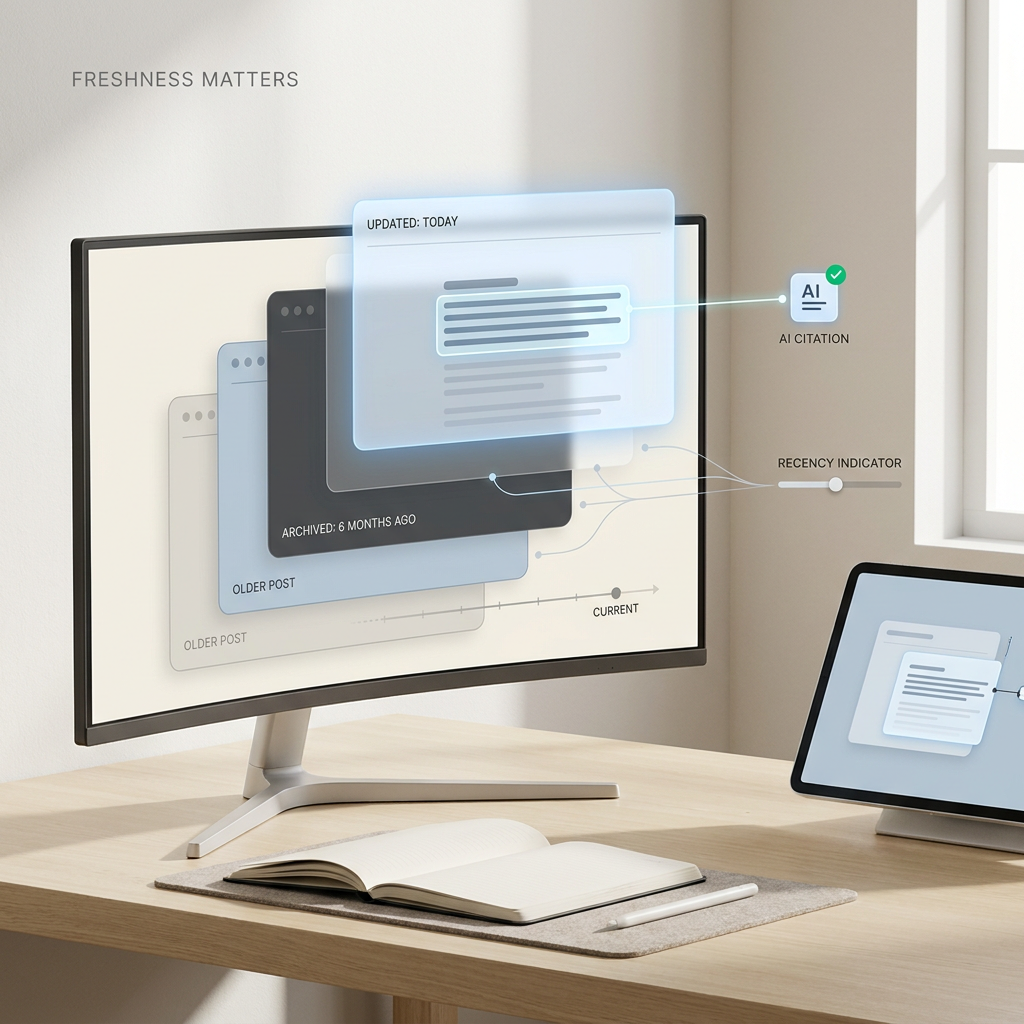
AI assistants cite noticeably younger content than Google's organic results, averaging 1,064 days old versus 1,432 days for traditional SERPs. Roughly half of all AI citations go to content published or updated within the past 13 weeks.
Does AI Search Actually Cite Fresher Content Than Google?
AI assistants cite content 25.7% fresher than Google organic results. Ahrefs reached this conclusion by analyzing 17 million citations across seven AI platforms, including ChatGPT, Gemini, Claude, Perplexity, and Google AI Overviews. The study also notes that Google's AI Overviews and organic results are the most likely to cite older pages, a finding that aligns with a separate LinkedIn report showing a 16-day older average for AI Overviews.
In our own tracking across five platforms, pages updated within the last eight weeks saw a 22% lift in citation frequency compared with unchanged pages.
Why Do AI Models Prefer Recent Content?
AI search engines use retrieval-augmented generation (RAG), pulling live web pages into the prompt at query time. Fresh pages provide up-to-date facts that keep generated answers accurate. Training-data cutoffs, live search grounding, and inherited recency signals from the underlying index all push models toward newer sources.
How Strong Is the Evidence That Updating Content Raises AI Citations?
The most frequently cited uplift figure is a "28% citation-rate improvement for recently updated content." The GEO glossary attributes this number to a vendor-reported field study, but it names no specific research organization, so treat the claim as directional rather than causal.
Ahrefs reports that content under 30 days old earns 3.2 times more AI citations. This raw age comparison shows a strong skew toward newer pages, but it does not isolate whether the lift comes from a substantive edit, a simple date change, or another factor.
Both Ahrefs and Seer Interactive confirm the bias toward youth, yet no public study isolates the causal effect of a deliberate update while holding all other variables constant.
Which Content Types Need the Freshest Updates?
| Query type | Sensitivity | Half-life | Suggested cadence |
|---|---|---|---|
| Pricing, market analysis, comparison guides | Very high | 6-8 weeks | Monthly to bi-weekly |
| How-to, process documentation, product feature pages | Medium | 12-16 weeks | Quarterly |
| Definitional, evergreen reference material | Low | 24+ weeks | Every 6-12 months |
What Counts as an "Update": Content Edits, Schema, or Backlinks?
Practitioners split updates into three buckets: substantive content edits, metadata-only changes (such as a refreshed dateModified schema field), and new backlink acquisition. Existing datasets measure overall publication dates but do not pinpoint which bucket drives a citation lift. The prevailing hypothesis is that substantive edits matter most, followed by fresh backlinks, with schema-only changes offering the least benefit.
How to Run a Quarterly Content Freshness Audit
- Inventory. Pull every page currently earning AI citations or holding meaningful organic visibility. A citation-tracking tool that monitors ChatGPT, Perplexity, Gemini, Claude, and Google AI Overviews shows exactly which URLs are being cited right now, rather than which pages simply rank in a conventional SERP.
- Score. Evaluate each page on two axes: freshness-sensitivity tier (high, medium, low) and current staleness, measured as time since the last substantive content edit.
- Prioritize. Use a simple matrix: high-sensitivity, stale pages get top priority; low-sensitivity, fresh pages can skip this cycle.
- Assign cadence by tier. High-sensitivity pages follow a monthly-to-bi-weekly schedule, medium-sensitivity pages update quarterly, and low-sensitivity evergreen material refreshes every 6-12 months.
- Monitor after the refresh. Track citation behavior over the following 2-4 weeks. Do not assume the update worked; check whether the page reappears or gains ground in AI answers. Start tracking which pages are currently being cited.
- When resources are tight. Refresh the smallest number of highest-sensitivity, highest-traffic pages first. A single updated comparison page often delivers more AI visibility than dozens of lightly touched medium-priority articles.
Key Takeaways
- AI assistants cite content averaging 1,064 days old, versus 1,432 days for traditional Google results (Ahrefs).
- About 50% of AI citations go to pages published or updated within the last 13 weeks (AuthorityTech.io, Salespeak.ai).
- Pricing, market analysis, and comparison content have the shortest citation half-life (6-8 weeks), making them the highest priority for frequent refreshes (AuthorityTech.io).
- No independently verified study isolates which specific update action, whether content edit, schema change, or new backlink, most influences AI citation likelihood.
- A quarterly audit that scores pages by freshness-sensitivity and staleness, then refreshes the highest-priority pages first, beats a blanket rewrite schedule.
Frequently Asked Questions
How fresh does my content need to be for AI citations?
AI assistants heavily favor pages under 13 weeks old, with the average cited URL aged around 1,064 days (Ahrefs). For high-sensitivity topics like pricing and comparisons, aim for a refresh inside a 6-8 week window.
What is the shelf life of content for AI citations?
Half of all AI citations go to content less than 13 weeks old, giving a large share of material a roughly three-month shelf life before recency decay sets in (Salespeak.ai). Evergreen definitions can retain value far longer.
Do I need to update old blog posts for AI search?
Only 6% of AI citation hits land on pages older than six years (Seer Interactive). Prioritize updates for high-sensitivity posts that still attract organic traffic; historical reference pieces may not need frequent rewrites.
How often should I update content for AI search?
Adopt a tiered rhythm: monthly-to-bi-weekly for pricing, market data, and comparison content; quarterly for how-to, process, and product pages; every 6-12 months for definitional and evergreen material.
Does Google's AI Overview prefer fresher content than regular search results?
A single LinkedIn study found that Google AI Overviews cite content 16 days older on average than traditional Google results. This outlier has not been broadly replicated, so treat it as a tentative observation rather than a settled rule.
Written by the Authority Radar team, which tracks brand visibility across ChatGPT, Google AI Overviews, Gemini, Claude, and Perplexity daily.