How to Handle Negative AI Mentions: Detection and Response

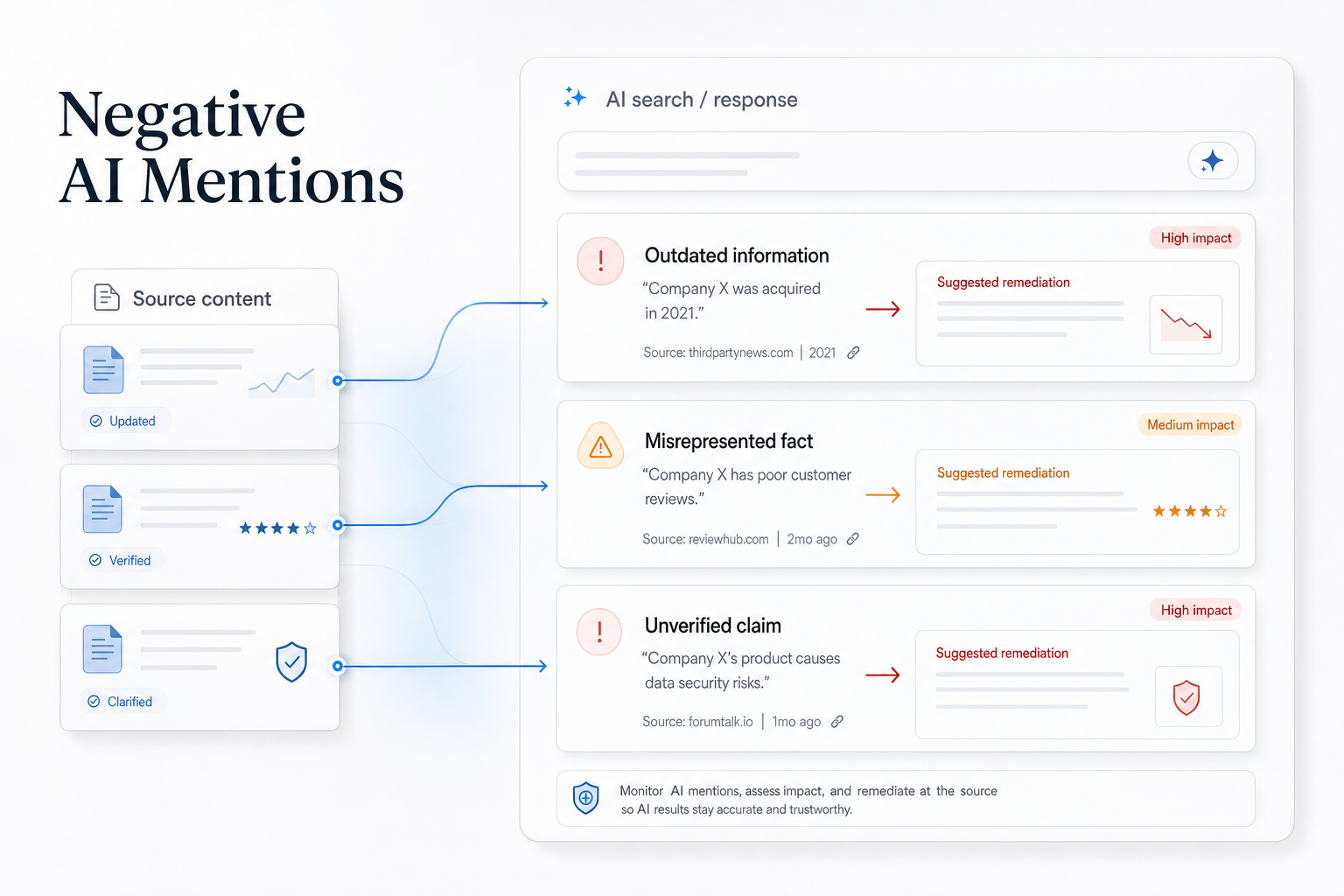
TL;DR: Negative AI mentions come in three types: factual errors, accurate-but-negative framing, and hallucinations. Each needs a different fix. Detect them by running the exact buyer-intent prompts your audience uses and logging which URLs the model cites. Because no brand can directly edit an AI's output, remediation runs through source content, entity signals, and third-party platforms over weeks or months.
Handling negative AI mentions means first identifying the type, then fixing the underlying source data, strengthening positive signals, or disputing content on the platforms the AI pulls from. You can't edit an AI's output directly, only its inputs.
What Kind of Negative AI Mention Are You Actually Dealing With?
A brand can have accurate pricing on its own website and still watch an AI model quote the wrong number.
Every negative AI mention falls into one of three buckets, and the difference determines what you do next. A factual error is when the model states something objectively wrong, such as listing your price as $99/month when it's actually $79/month. Accurate-but-negative framing happens when the AI correctly cites a real bad review, lawsuit, or recall and builds its description of your brand around that event. A hallucination is when the model invents something that never existed: a product you don't sell, an executive who doesn't work for you, or a scandal that never happened.
How Do You Detect Negative AI Mentions Before Customers Do?
The only reliable detection method is prompt-based monitoring: run the exact queries a buyer would type, not just your brand name. Someone researching a purchase might ask "Is [brand] reliable?" or "What's the catch with [product]?" Those prompts surface negative sentiment your brand-name searches never will.
Then track the citations, meaning the URLs the AI pulls from, to find the root source of the negativity. At Authority Radar we log each citation in a simple spreadsheet (Prompt, Model, Source URL, Date, Relevance) and review the list weekly. Running about 20 buyer-intent prompts per week gives enough coverage to spot emerging issues without draining resources.
Platform behavior matters too. Google AI Overviews is 44% more likely than ChatGPT to mention a brand negatively, while ChatGPT leans more neutral overall (BrightEdge). Google's AI Mode also surfaces answers directly on the results page, so it deserves its own monitoring stream. We monitor ChatGPT, Google AI Overviews, Google AI Mode, Gemini, Claude, and Perplexity daily.
Refresh your prompt list monthly to reflect new product cycles and shifting search intent. A static list will miss the "what not to buy" style queries that keep growing on AI platforms.
Fixing Factual Inaccuracies (Wrong Pricing, Features, or Company Facts)
When an AI model states something objectively wrong, the cause is almost always outdated or missing source content. Old pricing pages, missing JSON-LD schema, or conflicting information across directories like G2 and Crunchbase all feed the error.
Start by auditing your own site, updating structured data, and correcting every third-party listing that carries the stale figure. Once the authoritative page is refreshed and well-indexed, most models surface the corrected answer within a few weeks.
Audit Checklist
- Identify the erroneous claim and the source URL the AI cited.
- Update the source page and any structured data (JSON-LD, schema.org).
- Correct the same information on major third-party directories.
- Log the change and re-run the original prompt after 7 to 10 days to confirm the update.
Handling Negative Sentiment Framing (Even When It's Technically Accurate)
When the AI's negative description is true, whether a genuine complaint, lawsuit, or recall, the model is surfacing a real signal. Negative sentiment usually stems from repeated signals across third-party platforms, outdated content, and inconsistent messaging, as Tina Chopra notes.
You can't delete a true negative fact, but you can dilute its weight by building stronger positive entity signals. Check the specific platforms the AI cites and dispute outdated reviews on G2 or Trustpilot where possible. Then publish fresh case studies, press mentions, and comparison content to shift the wider information landscape.
For ongoing benchmarking, see our guide on benchmarking sentiment against competitors.
Correcting AI Hallucinations About Your Brand
A hallucination occurs when the model invents content with no factual basis. The usual cause is thin or absent authoritative content on the topic, which prompts the model to fill the gap with plausible-sounding fiction.
Remediation begins with publishing clear, authoritative first-party content that directly addresses the gap. Build a dedicated page that states exactly what your product does and does not include, keep naming consistent across your site, and add structured data. Strengthen external signals by contributing accurate entries to Wikidata or Wikipedia where appropriate.
Even with new content, hallucinations can persist until the model's next training cycle, which may take months.
How Long Does It Actually Take to See a Change?
AI models can't be directly instructed to change their output. Fixes work through re-crawling and retraining cycles that vary by model.
- Factual corrections typically surface in AI answers within a few weeks.
- Positive-signal building for sentiment shifts usually takes 2 to 3 months of consistent effort.
- Hallucination remediation is the least predictable; updates may not appear until the next model training cycle.
Remediation Timeline Overview
| Mention Type | Root Cause | Primary Fix | Typical Timeline |
|---|---|---|---|
| Factual error | Outdated or missing source content | Update page and citations | Weeks |
| Accurate-but-negative framing | Repeated negative signals across third-party platforms | Build positive entity signals | 2 to 3 months |
| Hallucination | Thin authoritative content, model training gaps | Publish clear, authoritative content | Months, to next model update |
How to Keep Your Brand Out of "What Not to Buy" AI Searches
Negative "what not to buy" queries, like "which oil delivery companies should I avoid" or "which SaaS tools have the worst security record," push the model to surface the most negative signal it can find.
Run these negative prompts yourself, note which sources the AI cites, then flood the topic with positive, authoritative content: detailed comparison guides, third-party endorsements, and full case studies. Testing the same query across ChatGPT, Google AI Mode, and Gemini often reveals different competitor citations, showing you where to focus your signal-building.
Set up prompt-based monitoring for these patterns to catch risks before customers ever see them.
Key Takeaways
- Negative AI mentions fall into three types (factual error, accurate-but-negative framing, hallucination), and each needs a distinct fix.
- Google AI Overviews is 44% more likely than ChatGPT to mention a brand negatively (BrightEdge).
- No brand can directly edit an AI's output; remediation works through source content and entity signals.
- Factual corrections typically surface within weeks; sentiment shifts and hallucination fixes take months.
FAQ
How do I remove negative reviews that AI Overviews cites?
Dispute outdated or policy-violating reviews on the source platform (G2, Trustpilot, Glassdoor). For accurate but unflattering reviews, focus on publishing fresh positive content to dilute the signal over time.
How do I fix negative brand sentiment in AI search results?
Address any underlying issue first, then systematically build positive entity signals: case studies, press coverage, and complete structured data across your site.
Why do AI searches prioritize negative reviews?
In our experience, negative reviews tend to be more detailed and appear across many sources, which makes them more salient to models that surface the most prominent signals.
What should I do if ChatGPT describes my brand negatively?
Identify the mention type (factual error, accurate-but-negative framing, or hallucination) and apply the corresponding fix from the relevant section above.
How do I monitor for negative brand mentions across AI platforms on an ongoing basis?
Run a set of buyer-intent prompts weekly, log the citations, and refresh the prompt list monthly. Track each model (ChatGPT, Google AI Overviews, AI Mode, Gemini, Claude, Perplexity) separately.
Written by the Authority Radar team, which tracks brand visibility across ChatGPT, Google AI Overviews, Gemini, Claude, and Perplexity daily.