The Ultimate AI Search Optimization Toolkit: 20 Free Tools
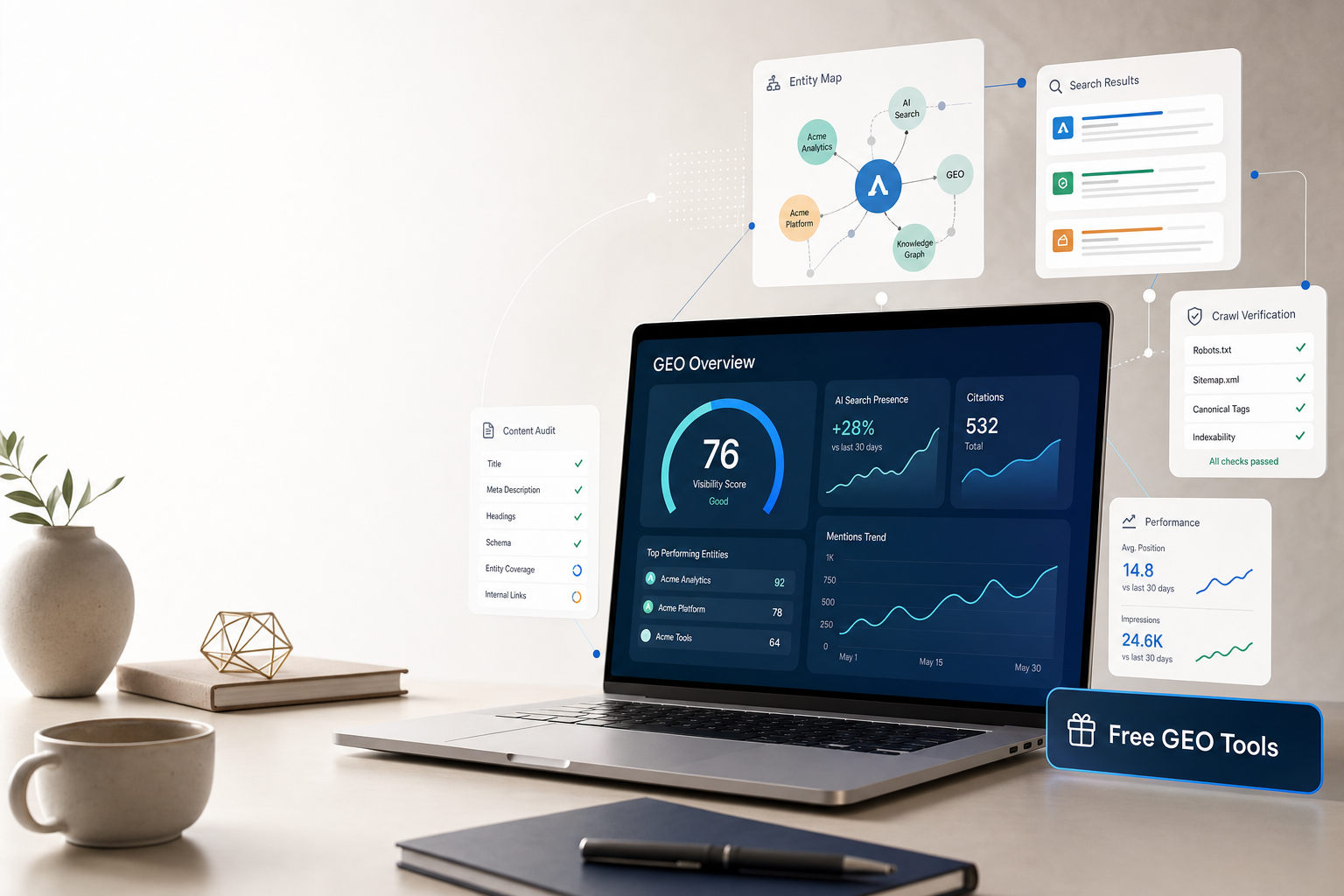
TL;DR: This guide lists 20 free or freemium GEO tools across five jobs: auditing, content optimization, entity management, tracking, and crawl verification. Each entry shows the free-tier limits, the AI engines covered, and whether sign-up is required, so you can build a working toolkit without paying for anything.
| Tool | Free-tier type | Engines covered | Signup required |
|---|---|---|---|
| Geoptie GEO Audit | Free | ChatGPT, Perplexity, Gemini, Claude | N |
| Geoptie Rank Tracker | Freemium (limited keywords) | ChatGPT, Perplexity, Gemini, Claude | Y |
| Geoptie Keyword Finder | Freemium (limited queries) | ChatGPT, Perplexity | Y |
| Geoptie Cannibalization Checker | Freemium (limited pages) | ChatGPT | Y |
| Geoptie Backlink Finder | Freemium (limited domains) | ChatGPT, Google AI Overviews | Y |
| HubSpot AI Search Grader | Freemium (snapshot) | ChatGPT, Perplexity, Gemini | Y |
| Mangools AI Search Grader | Freemium (snapshot) | ChatGPT, Perplexity, DeepSeek, Claude, Grok | Y |
| Frase GEO Score Checker | Freemium (single page) | ChatGPT, Perplexity, Claude | Y |
| Frase AI Visibility Checker | Freemium (single domain) | ChatGPT, Perplexity, Gemini | Y |
| genrank | Freemium (limited prompts) | ChatGPT, Perplexity | Y |
| Geordy.ai | Freemium (schema & content) | ChatGPT, Gemini | Y |
| Google Rich Results Test | Free | All engines (schema validation) | N |
| Wikidata | Free | All engines (community graph) | N |
| Google Knowledge Panel Claim | Free | All engines | N |
| Wikipedia Notability Checker | Free | All engines | N |
| OtterlyAI | Freemium (limited prompts & tracking) | ChatGPT, Perplexity, Gemini, Claude | Y |
| Authority Radar (free trial) | Free trial, 14 days, up to 1,000 citation checks | ChatGPT, Perplexity, Gemini, Claude, Google AI Overviews | Y |
| Google Search Console robots.txt Tester | Free | All engines | N |
| Google Search Console URL Inspection | Free | All engines | N |
| Google Search Console Coverage Report | Free | All engines | N |
The best free GEO tools in 2026 include Geoptie's audit and rank-tracker suite, the HubSpot and Mangools graders, Frase's GEO and visibility checkers, Google's schema validators, Wikidata for entity data, and Authority Radar's free trial for multi-engine citation tracking.
What Counts as a "Free GEO Tool" (And What Doesn't)
Free GEO tools fall into three categories. The first is completely free with no sign-up, such as Geoptie's GEO Audit. The second is freemium with a capped first result: Frase's GEO Score Checker gives you one free page check before asking for an email. The third is freemium with limited prompt volume, like genrank's small set of free prompts.
It's easy to confuse a one-time free scan with a free tracking tier, but they do different jobs. A snapshot tool like HubSpot's AI Search Grader gives you a single visibility score, while a rank tracker follows trends over weeks. Knowing which one you're using saves wasted effort.
For a side-by-side comparison of Authority Radar and a leading competitor, see our Authority Radar vs Otterly.ai comparison.
Discovery and Audit Tools: Checking Your Current AI Visibility
Geoptie's GEO Audit scans six dimensions (citation readiness, content authority, technical optimization, structured data, content depth, and AI-friendliness) and returns a score within seconds. It flags missing schema types, such as an absent Product JSON-LD block, that would otherwise hurt your chances of being cited.
HubSpot's AI Search Grader evaluates how ChatGPT, Perplexity, and Gemini perceive a brand, returning a visibility score, sentiment breakdown, and competitive benchmark. It is a snapshot only, with no historical tracking.
Mangools' AI Search Grader widens engine coverage to include DeepSeek, Claude, and Grok, with a comparable visibility score and basic competitive context. Frase's AI Visibility Checker shows whether ChatGPT, Perplexity, and Gemini currently link back to your domain. The first result is free; additional engine views require an email.
genrank offers a freemium rank checker for a limited set of prompts. It reports which AI engines return a citation for the query you enter, which helps you verify visibility for high-value prompts.
Content Optimization Tools: Schema, JSON-LD, and Citation Readiness
Frase's GEO Score Checker grades a page on citation readiness for ChatGPT, Perplexity, and Claude. The free check surfaces issues such as main answers buried under introductory paragraphs, which you can move higher to improve your citation odds.
Geoptie's Content Checker focuses on AI-friendly structure, evaluating heading hierarchy, bullet usage, and scannability. Geordy.ai adds schema validation and content analysis, though its exact free-tier limits are not independently confirmed.
Google's Rich Results Test and Schema Markup Validator remain essential for confirming JSON-LD syntax. A page missing required properties for Product, Article, or Organization is harder for AI engines to cite.
Entity Tools: Wikidata, Knowledge Panels, and Brand Recognition
Wikidata is a free, community-editable knowledge graph that Gemini, Google AI Overviews, and other engines draw on. Check that your brand's Wikidata item includes accurate statements for industry, headquarters, and founding date, or create a new item if none exists.
Google's Knowledge Panel can be claimed for free through Google Search Console. Claiming it lets you suggest edits and keep the panel accurate, though eligibility depends on your web presence and authoritative mentions.
Wikipedia notability works as an indirect entity signal. A well-sourced Wikipedia article feeds structured data into the broader knowledge graph, strengthening how AI engines understand your brand.
Tracking and Monitoring Tools: Watching AI Visibility Over Time
Geoptie's Rank Tracker moves past the one-time audit by monitoring your domain's presence in AI answers across selected engines and dates. The free tier supports a limited set of keywords.
OtterlyAI provides lightweight monitoring with capped prompt and tracking volume, which suits small campaigns.
Authority Radar's free trial delivers daily citation tracking, competitive benchmarking, and sentiment analysis across ChatGPT, Perplexity, Gemini, Claude, and Google AI Overviews. The trial runs 14 days and includes up to 1,000 citation checks per month, giving you a full view of multi-engine visibility without commitment. Start a free trial to see daily citation changes across all five engines.
Crawl and Technical Tools: Making Sure AI Bots Can Reach Your Content
AI crawlers such as GPTBot, PerplexityBot, Google-Extended (used by Gemini and Google AI Overviews), ClaudeBot, and Amazonbot must be allowed in robots.txt. Block any of them and you lose citations no matter how good your content is.
Google Search Console's robots.txt Tester (reached through the URL Inspection tool) lets you verify access for Google-Extended. For the other bots, inspect /robots.txt manually for User-agent entries. If a bot is blocked, add an Allow: / directive before any broader Disallow rule, or remove the specific Disallow line that blocks it.
For a step-by-step guide to checking AI bot access, see our GEO vs SEO complete guide.
Key Takeaways
- Geoptie's GEO Audit gives you a rapid, six-dimension baseline without signup.
- Snapshot graders like HubSpot and Mangools give a single visibility score but no historical data.
- AI crawlers must be allowed in
robots.txtbefore any citations can appear. - Wikidata is the free, open entity source most AI engines rely on.
- Free audit tools set your baseline; free tracking tools show whether visibility improves over time.
Frequently Asked Questions
What are the best free GEO tools for AI search optimization?
The most complete free toolkit covers auditing (Geoptie GEO Audit), visibility grading (HubSpot and Mangools AI Search Graders), content optimization (Frase GEO Score Checker, Geoptie Content Checker, Geordy.ai), schema validation (Google Rich Results Test), entity management (Wikidata, Google Knowledge Panel), rank tracking (Geoptie Rank Tracker, OtterlyAI), citation tracking (Authority Radar free trial), and crawl verification (Search Console robots.txt Tester).
How can I audit my website for AI search readiness for free?
Start with Geoptie's GEO Audit for a six-dimension snapshot. Follow with HubSpot's AI Search Grader to add sentiment and competitive context, then use genrank to test a few high-value prompts for citation presence.
Are there free tools to track my AI rankings in ChatGPT, Perplexity, and Gemini?
Yes. Geoptie's Rank Tracker monitors selected engines with a limited keyword set. OtterlyAI offers a capped free tier for prompt research and referral-traffic tracking. Authority Radar's free trial provides daily multi-engine citation tracking for the trial period.
What is a GEO score checker and how does it work?
A GEO score checker estimates how likely a page is to be cited by AI engines. Frase's GEO Score Checker grades a URL for ChatGPT, Perplexity, and Claude, then lists the structural and content improvements needed to raise your citation chances.
Can I use regular SEO tools for GEO, or do I need AI-specific ones?
Traditional SEO tools such as Google's Rich Results Test and robots.txt testers validate signals that AI engines also use. But AI-specific tools measure citation presence, sentiment, and engine-level visibility, which standard SEO tools do not capture. Combining both gives you the best results.
What are the biggest limitations of free GEO tools?
Most free tools provide only snapshot data, cap the number of pages or prompts, and often require an email to unlock multi-engine views. Crawl verification stays manual, and entity management leans on community-driven sources like Wikidata, which may not cover every brand.
Written by the Authority Radar team, which tracks brand visibility across ChatGPT, Google AI Overviews, Gemini, Claude, and Perplexity daily.