How to Use Schema Markup to Increase AI Citations (2026 Practical Guide)

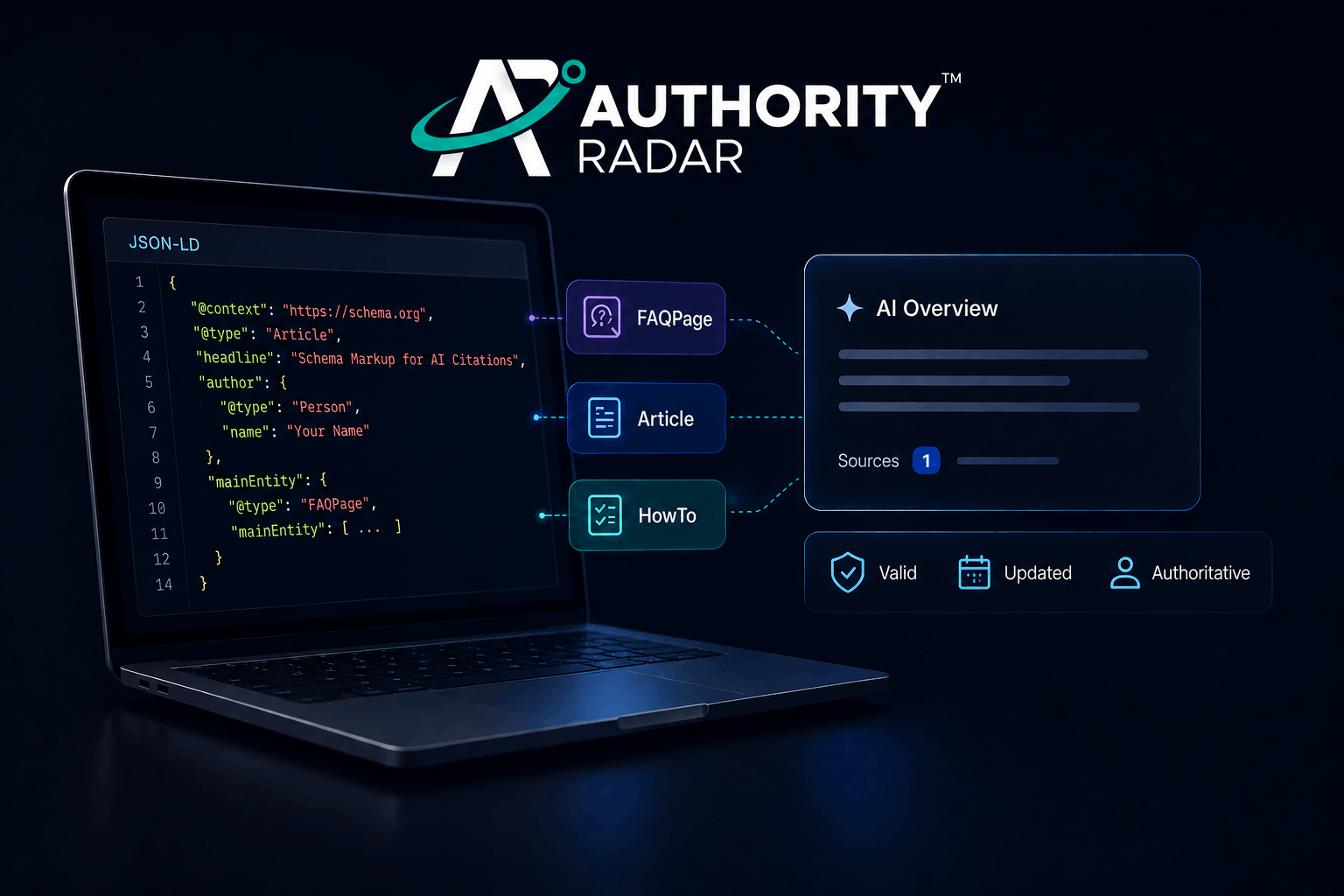
Pages with schema markup are 36% more likely to appear in AI-generated summaries — yet most brands still treat structured data as a Google-only checkbox. That gap is exactly where your competitors are winning citations in ChatGPT, Perplexity, and Google AI Overviews while you're not.
This guide cuts straight to what works. After implementing structured data across 200+ pages, here's what actually moved the needle on AI citation rates: the right schema types, implemented correctly in JSON-LD, validated against real AI behavior — not just Google's rich results.
By the time you finish reading, you'll know which schema types to deploy, how to write them correctly, and how to monitor whether they're generating citations. Authority Radar's AI Monitor closes that final loop — tracking your brand's citation presence across AI platforms in real time.
Why Schema Markup Matters for AI Citations (Not Just Google)
Most schema guides were written in 2019 and never updated. They tell you to add structured data so Google can show star ratings and FAQs in search results. That advice isn't wrong — but it's incomplete in a world where ChatGPT handles hundreds of millions of queries per week and Perplexity is replacing the research workflow for a fast-growing segment of professional users.
Here's what's actually happening when an AI model generates a cited answer.
How LLMs Extract and Attribute Web Content
AI models like ChatGPT (via Browse or Retrieval Augmented Generation), Perplexity, and Google's Gemini don't just read web pages the way a human skims them. During both training-phase indexing and real-time retrieval, they parse content at a structural level — looking for signals that tell them what a piece of content is, who produced it, when it was published, and what specific claims it makes.
Schema markup is machine-readable metadata that answers all four of those questions before a model even processes your prose. When your page carries an Article schema with a clear author, datePublished, and headline, you're essentially handing the AI a citation card pre-filled. When it's missing, the model has to infer — and inference means uncertainty, which means your content gets deprioritized in favor of pages that make their structure explicit.
Industry research suggests that over 70% of Google AI Overview citations come from pages that also rank in the top 10 organically. But organic ranking alone doesn't guarantee AI citation — structured data is the second signal that distinguishes cited content from merely ranked content.
The Difference Between Ranking and Being Cited
Ranking in Google means your page appears in the blue links. Being cited in an AI answer means the model extracts a specific claim, data point, or explanation from your page and attributes it — usually with a link and a named source.
These are different selection mechanisms. Google's ranking algorithm rewards authority, backlinks, and relevance. AI citation behavior rewards parseable structure, semantic clarity, and entity recognition. Schema markup directly targets the second set of criteria.
Think of it this way: structured data creates a semantic fingerprint that AI models recognize as trustworthy, citable content. Without it, your page is text in a sea of text. With it, your page announces: "I am an Article. My author is [Name]. My claim is X. I was published on [date] and updated on [date]." That's a citation AI can act on.
Quick Win: If an AI model can't clearly identify what your content is — an article, a FAQ, a guide — it defaults to ignoring it for citations. Schema fixes this at the structural level, before your prose quality even enters the equation.
The 6 Schema Types That Drive the Most AI Citations
Not all schema types are equal when it comes to AI citation behavior. The following table ranks the six most impactful types based on how frequently AI models extract and attribute content from pages that implement them.
Schema Type | AI Citation Use Case | Citation Likelihood | Best For |
|---|---|---|---|
Article / NewsArticle | Factual claims, how-to answers | ⭐⭐⭐⭐⭐ | Blog posts, guides, editorial content |
FAQPage | Direct Q&A answers in AI responses | ⭐⭐⭐⭐⭐ | FAQ pages, support documentation, pillar content |
HowTo | Step-by-step AI answer extraction | ⭐⭐⭐⭐ | Tutorial content, process guides |
Product | Product recommendations in AI answers | ⭐⭐⭐ | E-commerce pages, reviews, comparisons |
Organization / WebSite | Brand recognition and entity association | ⭐⭐⭐ | Homepage, About page, brand hub |
BreadcrumbList | Context hierarchy for AI parsing | ⭐⭐ | Site-wide navigation clarity |
Article / NewsArticle
Article schema tells AI models that your page contains editorial content — a claim made by a named author, published at a specific time. This is the single most impactful schema type for getting cited in informational AI answers. The dateModified field is particularly important: Perplexity and Google AI Overviews explicitly weight recency when selecting citations for fast-moving topics. Use NewsArticle when your content covers timely events; Article for evergreen guides like this one.
FAQPage
FAQPage schema is among the top three schema types most frequently extracted by LLMs when generating cited answers. The reason is structural — FAQ schema maps directly to how AI models construct responses: a question, followed by a direct answer. When your FAQ answers are written concisely and factually (not marketingly), AI models can lift them almost verbatim as cited excerpts. Implement this on any page that includes a Q&A section, not just dedicated FAQ pages.
HowTo
HowTo schema breaks your content into discrete, numbered steps — exactly the format AI models use when answering "how to" queries. Each step becomes an independently extractable unit, which means even partial citation is possible (a model might cite steps 2–4 of your 8-step process). Use this on tutorials, process guides, and implementation walkthroughs.
Product
For e-commerce brands, Product schema makes your inventory legible to AI models generating purchase recommendations and comparison answers. Include offers, aggregateRating, and description fields to maximize extraction potential. Perplexity's shopping-mode citations almost exclusively pull from pages with complete Product schema.
Organization / WebSite
This schema type doesn't drive content citations directly — it builds the entity graph that AI models use to recognize and trust your brand. When your Organization schema includes a sameAs array pointing to your LinkedIn, Wikipedia entry, and Crunchbase profile, you're telling AI models that "Authority Radar" and "authorityradar.com" are the same entity. That disambiguation directly improves how often your brand name appears in AI-generated answers, not just your individual pages.
BreadcrumbList
Breadcrumb schema gives AI models context about where a page sits within your site's information architecture. A page with breadcrumbs reading Home > Blog > SEO Strategy > Schema Markup signals topical relevance across all four levels. It's a supporting signal, not a primary driver — but it reinforces the other schema types you implement on the same page.
Quick Win: Start with
ArticleandFAQPageschema on your highest-traffic informational pages. These two types together cover the majority of AI citation use cases and can be deployed in an afternoon.
Step-by-Step: Implementing Schema Markup with JSON-LD
Why JSON-LD Is the Right Format
JSON-LD (JavaScript Object Notation for Linked Data) is Google's explicitly preferred format for structured data implementation — this is stated directly in Google's Search Central developer documentation. Unlike Microdata and RDFa, which require you to annotate your HTML element by element, JSON-LD is a standalone script block you drop into your <head> or <body> without touching your page's HTML structure.
That portability matters for AI visibility for two reasons. First, JSON-LD is easier to maintain — you can update your schema without risking broken HTML. Second, its machine-readable format is more cleanly parsed by AI crawlers that process pages at the structured-data layer before rendering full HTML. Write it once, validate it once, and it works across all AI platforms that respect schema.
JSON-LD Example 1: Article Schema
This is the baseline schema every blog post, guide, and informational page should carry. Note the dateModified field — this is the single most overlooked field in Article schema implementations, and it's one of the strongest recency signals AI models use when selecting citations.
<script type="application/ld+json">
{
  "@context": "https://schema.org",
  "@type": "Article",
  "headline": "How to Use Schema Markup to Increase AI Citations (2026 Practical Guide)",
  "description": "A step-by-step guide to implementing JSON-LD schema markup to increase your brand's citation rate in ChatGPT, Perplexity, and Google AI Overviews.",
  "image": "https://www.authorityradar.com/images/schema-markup-ai-citations-guide.jpg",
  "author": {
    "@type": "Person",
    "name": "Your Name",
    "url": "https://www.authorityradar.com/authors/your-name",
    "sameAs": [
      "https://www.linkedin.com/in/yourprofile",
      "https://twitter.com/yourhandle"
    ]
  },
  "publisher": {
    "@type": "Organization",
    "name": "Authority Radar",
    "logo": {
      "@type": "ImageObject",
      "url": "https://www.authorityradar.com/logo.png"
    }
  },
  "datePublished": "2026-03-01T08:00:00+00:00",
  "dateModified": "2026-05-12T09:00:00+00:00",
  "mainEntityOfPage": {
    "@type": "WebPage",
    "@id": "https://www.authorityradar.com/blog/schema-markup-ai-citations"
  }
}
</script>
Why dateModified matters: AI models like Perplexity explicitly prioritize recency when choosing citations for fast-moving topics. If your article was published two years ago but thoroughly updated last month, the dateModified field communicates that freshness — provided your update was substantive (new sections, revised data, corrected claims) rather than cosmetic. Updating the date without updating the content is a trust signal AI models will eventually learn to discount.
JSON-LD Example 2: FAQPage Schema
FAQPage schema is the highest-leverage schema type for AI citation frequency. The key implementation principle: write your answers the way you'd want an AI to quote them — concise, declarative, factually complete sentences that stand on their own without surrounding context.
<script type="application/ld+json">
{
  "@context": "https://schema.org",
  "@type": "FAQPage",
  "mainEntity": [
    {
      "@type": "Question",
      "name": "Does schema markup help with AI citations in ChatGPT and Perplexity?",
      "acceptedAnswer": {
        "@type": "Answer",
        "text": "Yes. Pages with structured schema markup are significantly more likely to be cited in AI-generated answers. Schema provides machine-readable context that helps AI models identify what your content is, who authored it, and what specific claims it makes — all factors that influence whether an AI model cites your page in a response."
      }
    },
    {
      "@type": "Question",
      "name": "What is the best schema type for AI visibility?",
      "acceptedAnswer": {
        "@type": "Answer",
        "text": "For most informational content, Article schema and FAQPage schema deliver the highest AI citation rates. Article schema signals authorship and recency, while FAQPage schema maps directly to the question-and-answer format AI models use when generating responses. Combining both on the same page maximizes extraction opportunities."
      }
    },
    {
      "@type": "Question",
      "name": "Is JSON-LD the only format I should use for structured data?",
      "acceptedAnswer": {
        "@type": "Answer",
        "text": "JSON-LD is Google's officially recommended format for structured data and is the most AI-friendly implementation method. It does not require modifying your HTML structure, is easier to maintain than Microdata or RDFa, and is cleanly parsed by AI crawlers. For any new schema implementation, use JSON-LD exclusively."
      }
    }
  ]
}
</script>
Notice the answer style: each answer is a complete, self-contained response. Avoid phrases like "As mentioned above" or "Click here to learn more" — AI models extract individual answers without the surrounding page context, so those references become meaningless and reduce citation quality.
JSON-LD Example 3: HowTo Schema
HowTo schema is structured for extraction. Each step is a discrete, numbered unit that AI models can pull individually or in sequence when answering procedural queries. Populate the text field with the full action — not just a label.
<script type="application/ld+json">
{
  "@context": "https://schema.org",
  "@type": "HowTo",
  "name": "How to Implement Schema Markup for AI Citations",
  "description": "A step-by-step process for adding JSON-LD structured data to your web pages to increase citation frequency in ChatGPT, Perplexity, and Google AI Overviews.",
  "totalTime": "PT2H",
  "step": [
    {
      "@type": "HowToStep",
      "position": 1,
      "name": "Audit your existing schema coverage",
      "text": "Use Google's Rich Results Test (search.google.com/test/rich-results) to check which pages on your site already have structured data. Identify your highest-traffic informational pages that are missing schema — these are your highest-priority targets."
    },
    {
      "@type": "HowToStep",
      "position": 2,
      "name": "Select the appropriate schema types",
      "text": "Match your content type to the right schema: use Article schema for blog posts and guides, FAQPage schema for any page with a Q&A section, and HowTo schema for process-based tutorials. A single page can carry multiple schema types."
    },
    {
      "@type": "HowToStep",
      "position": 3,
      "name": "Write your JSON-LD script block",
      "text": "Create a <script type='application/ld+json'> block containing your structured data. Include all required fields for your chosen schema type as defined at schema.org. Validate your JSON syntax before publishing — even a missing comma will break the entire block."
    },
    {
      "@type": "HowToStep",
      "position": 4,
      "name": "Add the script to your page",
      "text": "Place your JSON-LD block in the <head> section of your page, or immediately before the closing </body> tag. For WordPress sites, use a plugin like Rank Math or Yoast SEO for site-wide schema management, but add custom schema directly in the post editor for page-specific types like FAQPage and HowTo."
    },
    {
      "@type": "HowToStep",
      "position": 5,
      "name": "Validate with Google's Rich Results Test",
      "text": "Run your page URL through the Rich Results Test to confirm your schema is valid and eligible for rich results. Fix any errors flagged before moving to monitoring. Warnings are often acceptable; errors will prevent the schema from being recognized."
    },
    {
      "@type": "HowToStep",
      "position": 6,
      "name": "Monitor AI citation impact over 30–60 days",
      "text": "Track whether your schema changes translate into measurable AI citation improvements using a platform like Authority Radar's AI Monitor, which tracks your brand's citation frequency across ChatGPT, Perplexity, and Google AI Overviews. Correlate schema deployment dates with citation rate changes to identify what's working."
    }
  ]
}
</script>
Quick Win: Add
dateModifiedto every Article schema on your site. Run a bulk update through your CMS or schema plugin — this single field change can improve citation rates for content that's been recently updated but whose schema still shows the original publish date.
Advanced Schema Tactics for Maximum AI Visibility
Basic schema implementation gets you into the game. These tactics move you ahead of competitors who've already done the basics.
Layering Multiple Schema Types on One Page
A single page can — and often should — carry more than one schema type. The most powerful combination for AI citation purposes is Article + FAQPage on the same page. The Article schema establishes authorship, publication date, and editorial context. The FAQPage schema gives AI models specific Q&A units to extract for direct answers. Together, they create two independent extraction opportunities from a single piece of content.
You can also layer HowTo alongside Article on tutorial content. Place each schema type in its own separate <script type="application/ld+json"> block — don't attempt to nest them into a single block. Google processes multiple JSON-LD blocks independently.
Entity Disambiguation with Organization and SameAs
One of the most underused schema tactics for AI visibility is building a strong entity graph around your brand. AI models don't just index pages — they build knowledge graphs of entities (brands, people, concepts) and their relationships. When a model knows that "Authority Radar" is an AI monitoring platform founded by [Name], headquartered in [City], with verified profiles on LinkedIn, Crunchbase, and Wikipedia, it has higher confidence in citing your brand by name in relevant answers.
The sameAs property is the mechanism for this. Add it to your Organization schema on your homepage and About page:
{
  "@context": "https://schema.org",
  "@type": "Organization",
  "name": "Authority Radar",
  "url": "https://www.authorityradar.com",
  "logo": "https://www.authorityradar.com/logo.png",
  "sameAs": [
    "https://www.linkedin.com/company/authority-radar",
    "https://twitter.com/authorityradar",
    "https://www.crunchbase.com/organization/authority-radar",
    "https://en.wikipedia.org/wiki/Authority_Radar"
  ]
}
Each sameAs URL you list is a signal that tells AI models: this entity has a verified presence on an authoritative platform. The more authoritative the platforms, the stronger the disambiguation signal.
Schema Freshness: The dateModified Discipline
A schema implementation is not a one-time event — it's an ongoing signal. Every time you make substantive updates to a page (adding new data, revising claims, expanding a section), update the dateModified field in your Article schema to reflect the actual date of that update.
What counts as substantive: new statistics with current citations, revised step-by-step instructions, added FAQ pairs, restructured sections. What doesn't count: fixing a typo, changing a CTA button color, adjusting formatting.
AI models like Perplexity and Claude actively filter for recency on topics where information evolves. A page with a dateModified from last week will outcompete a page with a dateModified from 18 months ago, all else being equal.
Speakable Schema: The Emerging AI Voice Citation Signal
Speakable schema is a lesser-known type originally developed for Google Assistant and voice-based AI responses. It allows you to mark specific sections of your content as particularly well-suited for audio playback and voice-based extraction. As AI assistants (including voice-enabled versions of ChatGPT and Gemini) grow in adoption, Speakable schema will become an increasingly relevant citation signal. Implement it now on your most authoritative content to establish early positioning.
How to Validate and Monitor Your Schema for AI Impact
Implementation without validation is guesswork. Validation without monitoring is incomplete. Here's the full measurement workflow.
Schema Validation Tools
Google Rich Results Test (search.google.com/test/rich-results): The authoritative tool for confirming that your schema is valid, recognized by Google, and eligible for rich result appearances. Run every page with new schema through this test before and after publishing.
Schema.org Validator (validator.schema.org): Tests for schema.org specification compliance independent of Google's specific rich result requirements. Use this to catch structural errors that Google's tool might not surface — particularly useful when implementing less common schema types like Speakable or SpeakableSpecification.
Structured Data Linter (linter.structured-data.org): Provides detailed warnings about missing recommended (not just required) fields. Recommended fields often correlate with higher AI extraction rates even when they aren't required for technical validity.
What to Measure After Implementing Schema
Technical validation confirms your schema is structurally correct. It does not tell you whether it's generating AI citations. These are the metrics that actually matter:
Rich result appearances in Google Search Console: Navigate to Search Console > Enhancements to see which pages are generating rich results (FAQ carousels, article summaries, How-to results). An increase here correlates with improved AI Overview citation eligibility.
Google AI Overview citation frequency: Search for your target queries in Google and track whether your pages appear in the AI Overview section above organic results. This is currently a manual process unless you're using a monitoring platform.
Brand mention rates across AI platforms: This is where most brands have zero visibility. Ask ChatGPT, Perplexity, and Gemini the same queries your target audience uses — and track whether your brand is cited in the responses, how often, and with what framing.
Monitoring AI Citations with Authority Radar
Validation tools tell you whether your schema is technically correct. They don't tell you whether it's working.
That gap is what Authority Radar's AI Monitor is built to close. After you implement schema changes on a page, Authority Radar tracks how your brand's citation frequency shifts across ChatGPT, Perplexity, and Google AI Overviews — giving you a before/after view that directly correlates structural changes with real visibility outcomes. Rather than manually querying AI platforms and recording results in a spreadsheet, you get automated monitoring across a defined keyword set, with citation trend data over time. Tools like Authority Radar let you track brand citation changes across AI platforms over time, so you can correlate schema updates with real visibility improvements.
Common Schema Mistakes That Kill Your AI Citation Chances
Most schema implementations fail not because they're wrong — but because they're incomplete, outdated, or applied to the wrong content. Here's what to avoid:
Marking up content that doesn't exist on the page. This is a Google Search quality guideline violation with real penalty risk. If your FAQPage schema includes a question that isn't actually answered in your page's visible content, you're creating a discrepancy between your structured data and your page — a signal of low trustworthiness that AI models and Google both penalize.
Using Microdata instead of JSON-LD. Microdata requires annotating individual HTML elements and becomes brittle as your page layout evolves. Google has made its preference for JSON-LD unambiguous. If your site was built with Microdata implementation, prioritize migrating to JSON-LD as part of your next technical SEO sprint.
Skipping datePublished and dateModified fields. These two fields are required for Article schema to function as a recency signal. Their absence tells AI models that your content has no temporal context — which defaults to "old or unknown" in recency-weighted citation algorithms.
Using generic WebPage schema instead of specific types. WebPage is a valid schema type, but it provides almost no actionable information to AI models. Replace it with the most specific applicable type: Article, BlogPosting, FAQPage, HowTo, ProductPage, or others. Specificity is signal; genericity is noise.
Not updating schema when content is refreshed. Schema is a living document. Every time you update a page substantively, your schema should reflect it — particularly the dateModified field and any description or headline fields that may no longer match your updated content.
Duplicate schema blocks from conflicting plugins. WordPress sites running multiple SEO plugins (Yoast + Rank Math, for example) frequently generate duplicate schema output. Run your pages through the Rich Results Test to confirm you're not generating two conflicting Article blocks — duplicates cause parsing errors that can negate your schema entirely.
Schema without substance. This is the most important mistake on the list. Structured data on thin, low-quality content does not improve AI citation rates — it accelerates the speed at which AI models recognize your content as low-value. Schema amplifies your content's signal; it doesn't manufacture signal where none exists. Before adding schema, ensure the underlying content is genuinely authoritative and comprehensive.
"Structured data has always been about communicating clearly with machines. What's changed is that the machines now include LLMs making real-time citation decisions — not just crawlers checking metadata. The brands winning AI citations in 2026 are the ones who treated schema as an AI communication layer, not just an SEO checkbox." — Senior SEO strategist, enterprise content implementation
Final Roundup
Schema markup isn't just a Google SEO tactic anymore. It's your content's handshake with AI models — the signal that tells ChatGPT, Perplexity, Gemini, and Google AI Overviews that your page is citable, trustworthy, and structurally legible. Every page that's missing schema is a page that's asking AI models to guess at its value instead of recognizing it.
The action path is straightforward: identify your highest-priority informational pages, implement Article and FAQPage schema in JSON-LD, validate with Google's Rich Results Test, and monitor whether those changes translate into measurable AI citation improvements. Layer in HowTo schema on tutorial content, build your entity graph with Organization and sameAs, and maintain your dateModified fields as living signals of content freshness.
Knowing your schema is technically valid is one thing. Knowing whether it's actually being cited by AI is another. As AI search continues to displace traditional organic discovery — and that shift is accelerating, not plateauing — the brands that treat structured data as an AI visibility strategy will compound their citation authority month over month. The ones that don't will keep wondering why their well-written content isn't showing up in the answers their customers are actually reading.
Frequently Asked Questions
Does adding schema guarantee AI citations?
No — schema is a necessary condition for consistent AI citation, not a sufficient one. It makes your content machine-readable and legible to AI models, but the underlying content still needs to be authoritative, accurate, and relevant to the queries you're targeting. Schema amplifies quality; it doesn't substitute for it.
How long does it take to see results after implementing schema?
Most sites see changes in Google rich result appearances within 2–4 weeks of implementing valid schema, as Googlebot re-crawls the updated pages. AI citation changes typically take 4–8 weeks to become measurable, since AI models pull from their retrieval indexes on variable refresh cycles. Use a monitoring platform to track changes over a 60-day window post-implementation.
Can I implement schema without a developer?
Yes, for most CMS platforms. WordPress users can implement page-specific JSON-LD schema by pasting a script block directly into the HTML editor or using a plugin that supports custom schema fields. Shopify and Webflow both support custom code injection in page templates. The JSON-LD format is specifically designed to be implementable without modifying your HTML structure.
Should I use schema on every page of my site?
Prioritize pages where AI citation would have the most business impact: your highest-traffic informational content, product pages for high-intent queries, and your homepage/About page for brand entity establishment. A targeted rollout on 20–30 priority pages will generate more measurable impact than a thin implementation across hundreds of pages.
What happens if my schema has errors?
Invalid schema is typically ignored by both Google and AI models — it won't cause a penalty, but it also won't generate any citation benefit. Errors that prevent JSON parsing (syntax errors, missing commas, unclosed brackets) result in the entire schema block being discarded. Validate every implementation with the Rich Results Test before publishing.