Google I/O 2026 Just Changed Search Forever: What the New AI Search Box Means for Brand Visibility

The Moment That Changed Everything
May 19, 2026 - I'm watching the Google I/O keynote on a second monitor while reviewing a client's GA4 dashboard. The numbers look off; traffic is flat, but conversions are up. I chalk it up to seasonality.
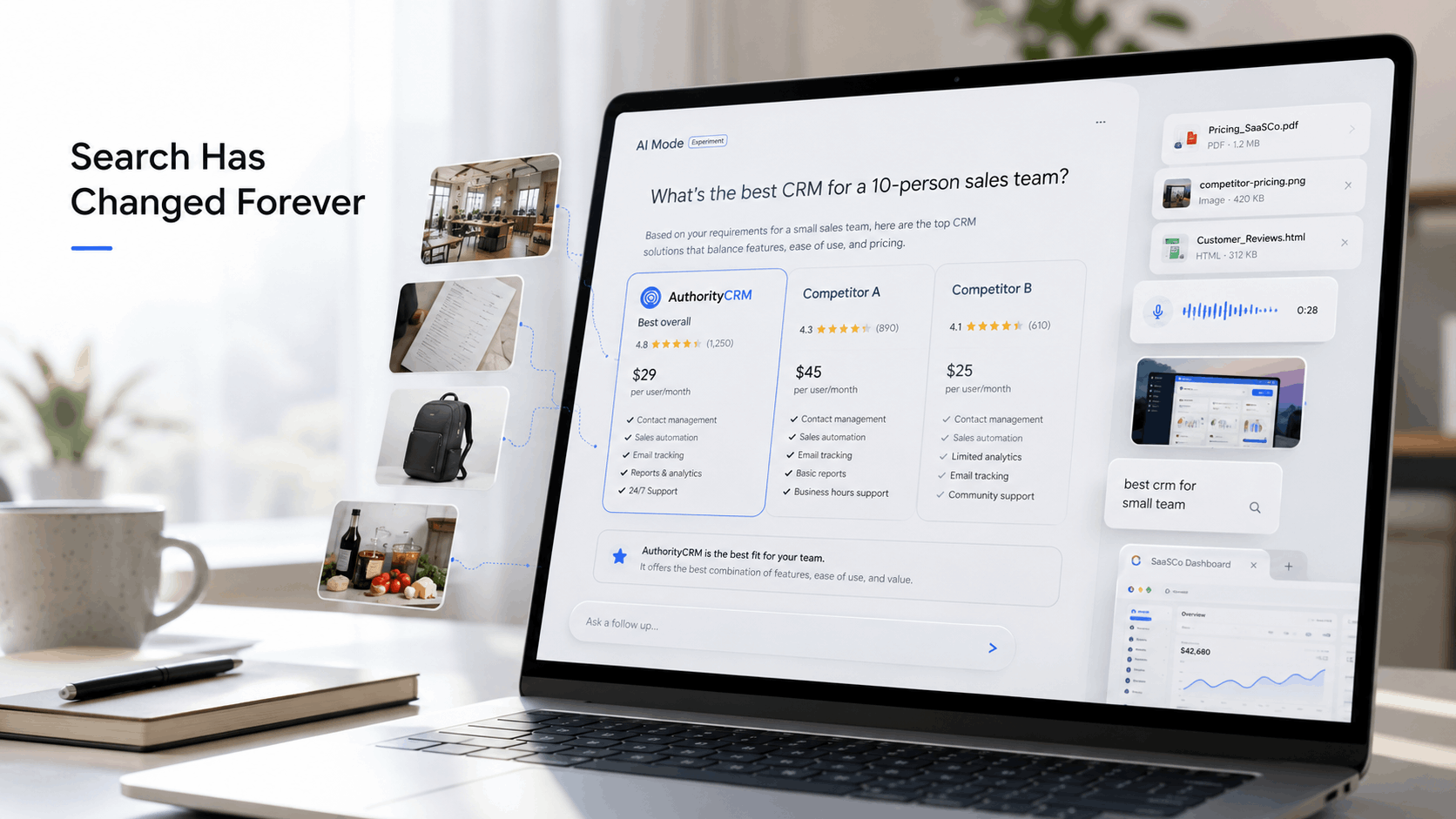
Then Sundar Pichai says it: "The search box has been completely reimagined with AI." I look up. They demo a user uploading a photo of a competitor's SaaS dashboard, asking "what's better for a 10-person team?" and the AI generates a feature comparison table in real time. Not a list of links. A table. With their product, their competitor's product, and a recommendation.
I sat back in my chair. That client whose traffic was flat but conversions were up? Their brand was being cited in AI Mode. Users were seeing their product in AI-generated answers, then searching for them directly. The traffic wasn't coming from the blue links. It was coming from an invisible pipeline that GA4 doesn't track.
That's the story of I/O 2026. Not a feature update. A platform shift. And if you're still measuring success by organic rankings, you're measuring the wrong thing.
The Eight Shifts That Matter - the Implications
Every tech blog covered the announcements. Let's talk about what they actually mean when you sit down on Monday morning to plan your content strategy.
Shift 1: AI Mode Is Now the Default for 1 Billion Users
The headline: "AI Mode reaches 1 billion users." The implication: For a quarter of Google's search base, the default search experience is now conversational, not a list of results. These users are not scrolling. They're reading a synthesized answer and asking follow-ups.
What this means for a B2B SaaS brand: Your buyer is asking ChatGPT or Gemini "what's the best CRM for a 10-person sales team?" If your product isn't mentioned in that answer, you don't exist. The user never sees your #1 ranking for "best CRM." They never scroll. They get an answer, and if you're not in it, you're invisible.
What this means for a local restaurant: A user uploads a photo of their fridge and asks "what can I make with these ingredients?" If your menu isn't structured for AI extraction, you won't be recommended even if you rank #1 for "Italian restaurant near me."
What this means for an ecommerce brand: A user uploads a photo of a dress they like and asks "where can I buy this for under $50?" If your product catalog isn't in Google's visual index, you're not in the conversation.
The budget implication: If you're spending $5,000/month on traditional SEO and $0 on AI visibility, you're optimizing for a shrinking share of attention. AI Mode users are not your future audience. They are your current audience, and they're already here.
Shift 2: Multimodal Search Inputs Kill the Keyword-Only Mindset
Google announced that AI Mode now supports image uploads, file uploads, and Chrome tab context. This means users can:
Upload a screenshot of your competitor's pricing page and ask "is this cheaper somewhere else?"
Upload a PDF of their requirements and ask "which tool fits these needs?"
Have your website open in a tab and ask "what do reviewers say about this product?"
Upload a photo of a product and ask "what's the best alternative?"
The keyword-only mindset is dead. Users are not typing "best CRM 2026." They're uploading their requirements document and asking "what fits this?" They're taking a photo of a product at a store and asking "where is this cheaper online?" They're showing their current tool's interface and asking "what's better?"
What this means for your content: Your product pages, comparison pages, and review pages need to be structured for AI extraction, not just keyword optimization. The AI needs to be able to pull your pricing, features, and reviews from your site and compare them to competitors on the fly.
Niche breakdown:
Ecommerce: Product images with clear backgrounds, pricing in structured data, comparison tables with competitors, review schema with specific pros/cons. The AI will be comparing your product visually and textually.
SaaS: Feature lists in HTML tables, pricing tiers with clear inclusions, comparison pages with competitor names, integration lists. The AI will be matching your features to user requirements.
Local: Photos of your space, menu items, services. The AI will be matching visual inputs to your offerings.
Healthcare: Symptom descriptions, treatment options, provider details. The AI will be matching patient inputs to your services.
Shift 3: Information Agents Are Background AI That Doesn't Wait for You
Information Agents are the shift from "pull" to "push" search. An agent monitors a topic continuously and pushes updates to the user. It doesn't wait for a search query.
Example scenario: A marketing manager sets an agent to monitor "AI search updates for B2B SaaS." When Google launches a new feature, the agent pushes a summary to her dashboard. If your blog post about that feature is structured well, it gets picked up. If it's not, your competitor's post does.
What this means for publishers: You need to publish fast, publish structured, and publish continuously. A blog post that goes live three days after an announcement is too late. The agent has already synthesized your competitor's content and pushed it to the user.
What this means for brands: Your product updates, pricing changes, and feature launches need to be announced on your site with structured data so agents can detect them. A press release in a PDF is invisible. A press release as an HTML page with Article schema is detectable.
Authority Radar note: This is exactly what tools like Authority Radar monitor - when your brand is mentioned in AI responses, by which models, and with what context. If an agent is pushing your competitor's content to users, you need to know that.
Shift 4: The Search Box Is Now a Conversation Interface
Google showed the "new AI search box" a conversational interface where users ask questions, get answers, and follow up. This is not a search engine with AI features. It is an AI assistant with search capabilities.
The user journey change:
Old: User searches "best CRM" → scans 10 blue links → clicks 3 → reads → decides.
New: User asks "what's the best CRM for a 10-person sales team?" → gets a synthesized answer with 3 recommendations → asks "what's the cheapest?" → gets a pricing comparison → asks "does HubSpot have email automation?" → gets a feature breakdown. The user never leaves the AI interface. They never visit your site.
The visibility shift: Your goal is no longer to get the user to click your link. Your goal is to get the AI to mention your brand accurately and positively. If the AI says "HubSpot CRM offers email automation, pipeline tracking, and reporting for $45/user/month," that's your visibility. The user may never visit your site, but they now know your brand, your price, and your features.
The conversion path: Users who see your brand in AI answers may not click immediately. But they may search for you directly later ("HubSpot CRM"), or tell a colleague, or add you to a shortlist. This is indirect conversion, and it is invisible in traditional analytics. (We cover this in Article 10.)
Shift 5: Generative UI (Antigravity) Means Google Builds Your Brand Page for You
Google announced Antigravity, a system that generates custom UI layouts for each query. This means Google will literally build a comparison page, dashboard, or product page using your data, without your design input.
The scary part: If your data is thin or inconsistent, Google will build a page that makes you look bad. If your competitor has richer structured data, their generated page will look more complete and trustworthy.
What this means for your data:
Your product schema must be complete: name, description, image, offers, reviews, availability, brand, SKU, color, size, material, weight, dimensions.
Your pricing must be in structured data, not just text on the page.
Your feature lists must be in HTML tables or structured lists, not images.
Your reviews must be in aggregateRating schema, not just a text block.
Your FAQ must be in FAQPage schema, not just a list.
Niche implication: A local restaurant with incomplete menu data will see a generated page with missing items, wrong prices, or no photos. A SaaS brand with no comparison data will see a generated page that only shows their competitor's features. A retailer with no inventory feed will see a generated page showing out-of-stock products.
Shift 6: Ask YouTube Makes Video a Primary Answer Source
YouTube overtook Reddit as the most-cited source across LLMs in 2026. Ask YouTube lets users ask questions about video content and get synthesized answers with citations to specific timestamps.
The video content gap: Most brands have text-only content strategies. They have blogs, landing pages, and whitepapers. But they have no video content optimized for AI extraction. This means they are invisible in a channel that is now the #1 citation source.
What you need:
Comparison videos with clear spoken feature lists and on-screen tables.
Tutorial videos with step-by-step narration and chapter markers.
Review videos with specific pros, cons, and pricing.
Product demos with clear visual demonstrations and annotated interfaces.
Transcripts that are corrected, structured, and published on your site.
Niche example: A SaaS brand that creates a 10-minute video comparing their tool to 3 competitors, with a clear spoken pricing breakdown and an on-screen comparison table, will be cited in AI answers. A competitor with only a text blog post will be cited less often, because the AI model can extract the video transcript, the visual table, and the comments for a richer synthesis.
Shift 7: Ads in AI Overviews Create a Two-Lane System
Google confirmed ads will appear inside AI Overviews. This creates a "paid lane" alongside the "organic lane" in AI answers.
The strategic implication: If you have strong organic AI citations, you have a trust advantage. If you don't, your competitors will pay to appear in the AI answer, and you will be invisible.
The budget question: Should you bid for AI ad placement or invest in organic AI visibility? The answer depends on your timeline and your margins. Paid AI placement gives you immediate visibility. Organic AI visibility takes months to build but compounds over time. Most brands should do both, but not equally. If you're a startup with no organic presence, lean into paid. If you're an established brand with strong content, lean into organic.
Shift 8: Google Is Not Just Showing AI Answers - It Is Building a New Platform
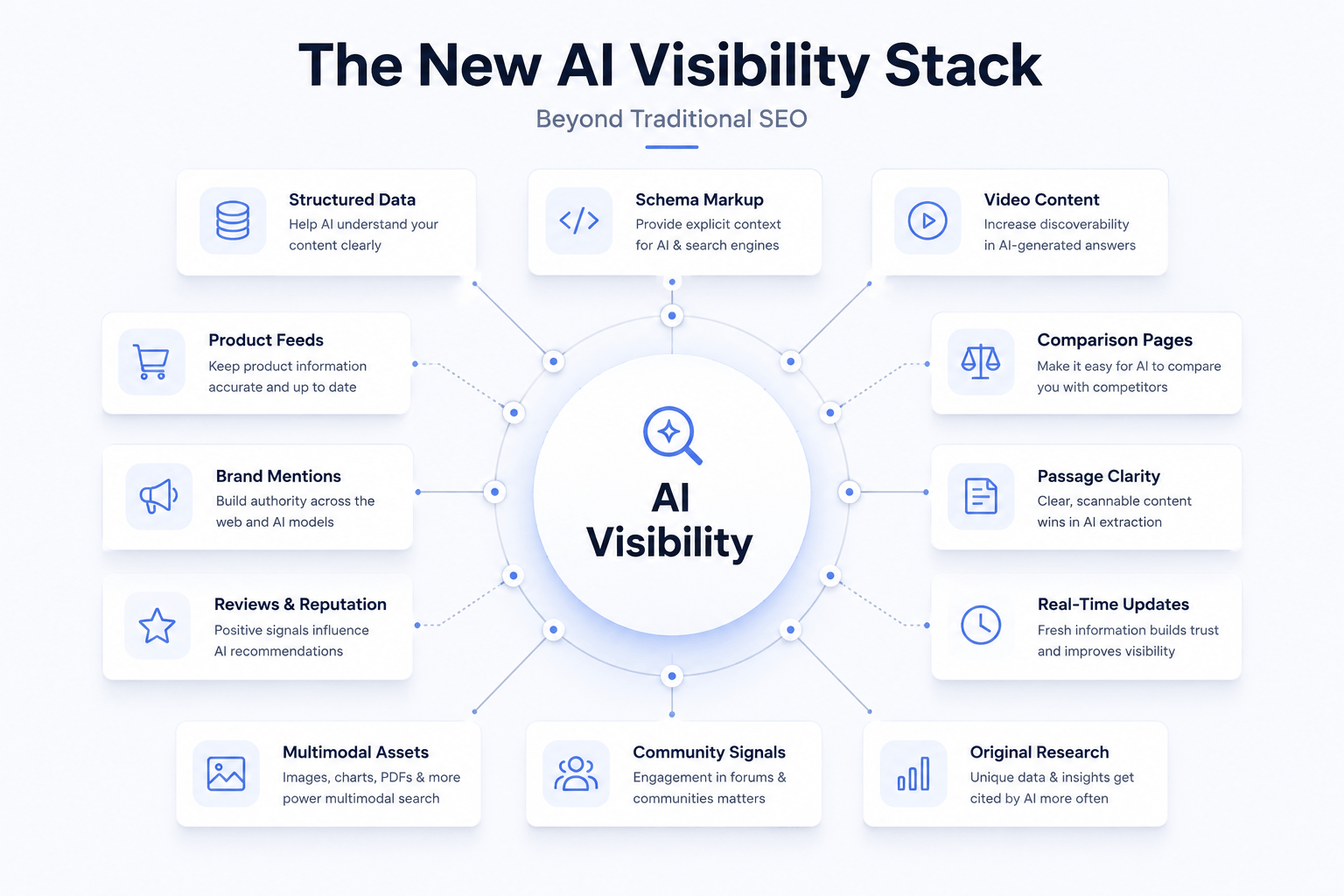
I/O 2026 was not a search update. It was a platform launch. Google is building an AI-native search platform that replaces the link-based results page with a conversational, multimodal, generative interface.
The platform shift:
Old platform: 10 blue links, page rank, keyword matching, click-through rates.
New platform: Conversational answers, passage retrieval, multimodal inputs, generative UI, background agents, video citations, ads inside answers.
What you need to unlearn:
Ranking #1 does not guarantee AI visibility. (See Article 4.)
Keyword density does not matter. Answer clarity matters.
Backlinks are still important for traditional SEO, but they are not the primary signal for AI citations.
Page authority is less important than passage authority.
Click-through rate is not the only metric. AI impressions (even without clicks) build brand awareness.
What you need to learn:
Passage retrieval optimization (structural clarity, answer format, schema markup).
Multimodal content strategy (video, images, structured data, real-time feeds).
AI citation monitoring (tracking which models mention you, with what context, and how often).
Self-reported attribution (asking users how they heard about you, because analytics won't tell you).
Continuous publishing (Information Agents pick up fresh, structured content. Not old blog posts).
What This Means for Your Specific Niche
If You're a B2B SaaS Brand
Your buyer is asking AI assistants for recommendations. They are not reading 10 blog posts. They are asking "what's the best [category] for [use case]?" and getting a synthesized answer with 2-4 recommendations.
What you need to do:
Build comparison pages that mention your competitors by name. The AI needs to see you in the same conversation as your competitors.
Create video demos with clear feature lists and pricing spoken aloud.
Get reviewed on G2, Capterra, and TrustRadius. AI models cite these heavily.
Publish original research and data. AI models cite original data more than opinion.
Structure your FAQ with schema markup. "What is [your product]?" "How much does [your product] cost?" "How does [your product] compare to [competitor]?"
Use Authority Radar to track when AI models mention your brand and with what context. If the AI is misrepresenting your pricing or features, you need to fix the source data.
The budget: If you're spending $10K/month on traditional SEO, shift 30% to AI optimization. That means schema markup, video content, comparison pages, and structured data. Not more blog posts about "the future of AI."
If You're an Ecommerce Brand
Your shopper is uploading photos, comparing prices, and asking "where is this cheapest?" The AI is building comparison tables in real time. If your product feed is incomplete, you're not in the table.
What you need to do:
Complete your Google Merchant Center feed with every attribute: color, size, material, weight, dimensions, availability, price, sale price, image, GTIN, MPN, brand.
Add product schema to every product page with all available properties.
Create comparison content on your site: "[Your product] vs. [competitor]" with structured tables.
Encourage reviews with specific details: "This dress fits true to size, the fabric is heavy cotton, and it arrived in 3 days." AI models extract specific details.
Use real-time inventory feeds. If the AI says you're in stock and you're not, you lose trust.
Upload high-quality product images with clean backgrounds. The AI is comparing visually now.
The margin impact: If the AI is showing your competitor's price in a comparison table and not yours, you are losing sales before the user even visits your site. This is not a future problem. It is happening now.
If You're a Media Publisher or Content Site
Your content is being summarized in AI Overviews. Users read the summary and never click. Your ad revenue is directly threatened.
What you need to do:
Decide whether to opt out of AI Overviews (see Article 3). If you rely on ad impressions from page views, opt out may protect your short-term revenue. But it may hurt your long-term brand awareness.
Build subscription offerings. If users can't get your analysis from the AI summary, they may pay for depth.
Create video content. AI models cite video less than text for news, but video is harder to summarize in a way that replaces the full experience.
Publish original research. AI summaries of original data still drive clicks because users want the full dataset.
Build your brand authority. If users see your brand as the source of truth, they will search for you directly even if the AI summarizes your content.
The existential question: If AI summaries replace page views, what is your business model? The publishers that survive will be the ones that build brand loyalty, subscription revenue, and unique content that AI cannot fully replace.
If You're a Local Business
Local search is becoming multimodal. Users are uploading photos of their location, asking for nearby recommendations, and getting AI-generated maps with business cards.
What you need to do:
Complete your Google Business Profile with photos, hours, services, menu, products, and posts.
Add LocalBusiness schema to your website with all properties: address, phone, geo coordinates, opening hours, price range, accepts reservations, payment accepted.
Upload photos of your interior, exterior, products, team, and work. The AI is matching visual queries to visual content.
Get reviews on Google, Yelp, and industry-specific sites. AI models synthesize reviews for local recommendations.
Create content about your neighborhood and local context. "Best [service] in [neighborhood]" content is still relevant for local AI queries.
If You're an Affiliate or Review Site
AI models are already summarizing your reviews. If a user asks "what's the best [product]?" the AI may synthesize your review without sending the user to your site. Your affiliate clicks are at risk.
What you need to do:
Build comparison tools and calculators that AI cannot replicate in a summary. Interactive tools keep users on your site.
Create video reviews. Video is harder to summarize textually and drives more direct engagement.
Build an email list. If AI summaries replace your search traffic, you need direct access to your audience.
Get mentioned in AI answers as a source. Even if users don't click, they may remember your brand and visit later.
Use Authority Radar to track which AI models are citing your reviews and with what context.
The Strategic Framework: What to Do This Week
Monday: Audit your current AI citations. Search for your brand in ChatGPT, Gemini, Perplexity, and Google AI Mode. What does the AI say about you? Is it accurate? Is it positive? Are you mentioned at all?
Tuesday: Check your structured data. Run Google's Rich Results Test on your homepage, product pages, and comparison pages. Is your schema complete? Are there errors?
Wednesday: Review your content for extractability. Are your FAQ sections structured with schema? Are your comparison pages in HTML tables? Are your product features in lists or tables? Are your video transcripts available?
Thursday: Plan your content calendar for AI. What topics are your users asking AI assistants about? Create content that answers those questions directly, with structured data, in a format that AI models can extract.
Friday: Set up self-reported attribution. Add "How did you hear about us?" to your demo request form, contact form, or purchase checkout. Start measuring AI-driven traffic that analytics misses. (See Article 10 for the full framework.)
This weekend: Watch one of your competitor's AI citations. What are they doing that you're not? What content do they have that gets them cited? What schema do they use? What video content do they have?
Key Takeaway
I/O 2026 was not a feature drop. It was a platform declaration. Google is building an AI-native search experience where the answer replaces the link, the conversation replaces the query, and the generated page replaces the search results.
The brands that win will not be the ones with the best traditional SEO. They will be the ones with the most complete, structured, and extractable data across every format: text, video, images, feeds, and real-time APIs.
Your organic ranking is still important, but it is no longer sufficient. If you are not optimizing for AI visibility passage retrieval, schema markup, video content, multimodal inputs, and continuous monitoring you are optimizing for a shrinking share of attention.
The search box has been reimagined. The question is whether your brand has been reimagined with it.
Last Updated: June 2026; What's New in 2026: This analysis was written following Google I/O 2026 (May 19-20) and includes the latest data on AI Mode, multimodal search, Information Agents, and Antigravity.