Best LLM Rank Tracker Tools for 2026

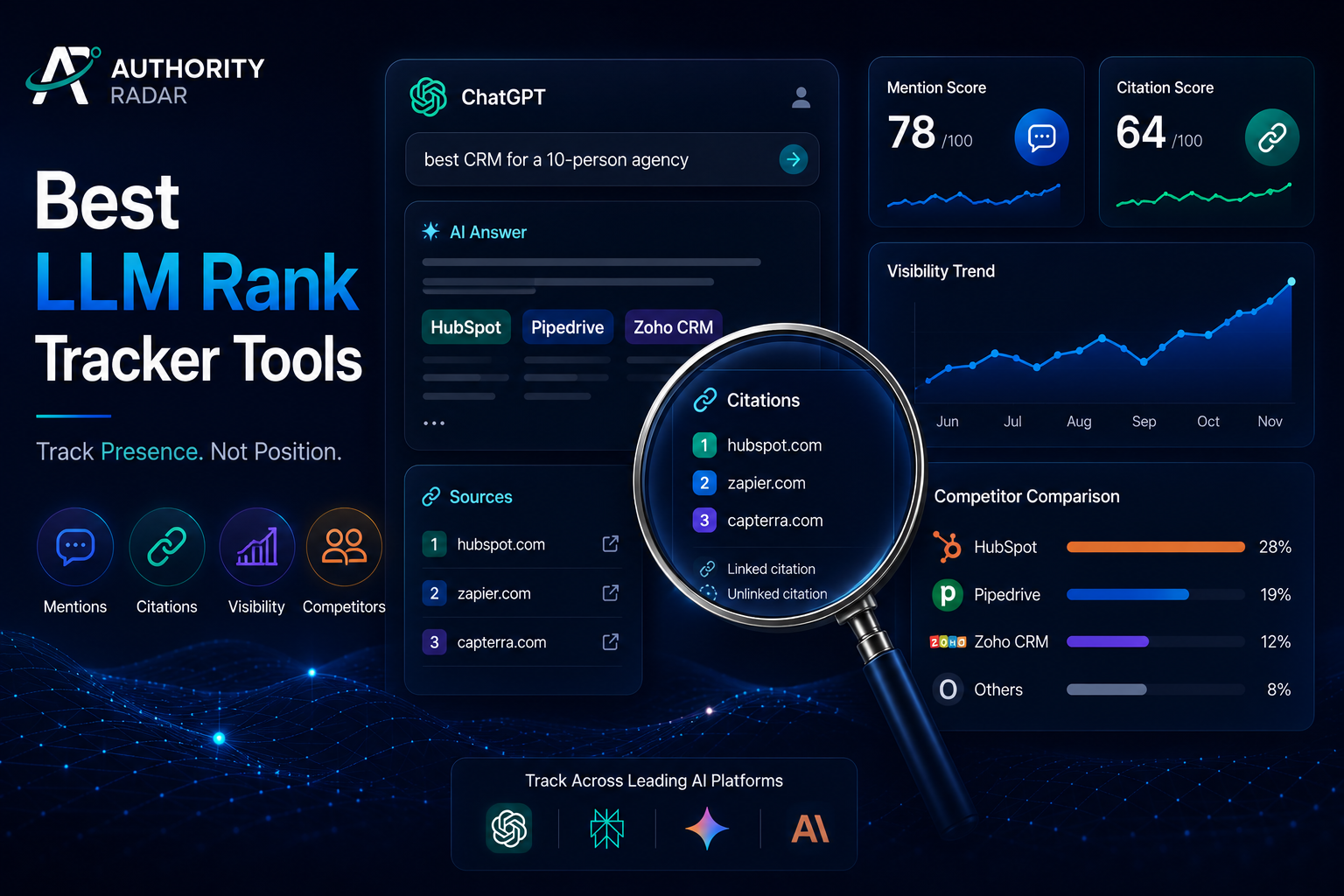
Type "best CRM for a 10-person agency" into ChatGPT and you get a paragraph, maybe a short list, and a couple of source links if you're lucky. There's no number 1, no number 2, no page of ten results to scroll past. So before comparing tools, it's worth saying plainly that "rank" here doesn't mean what it means in classic SEO. These tools track mention frequency, citation status, and relative prominence across a set of prompts, not a fixed position on a results page.
Most comparisons in this category compare headline prices and stop there. That's misleading, because the headline price and the price you actually pay for usable coverage are frequently two different numbers once add-on fees get factored in. So instead of just listing prices, we calculated the real cost per AI engine tracked for six tools, using each vendor's own published pricing. The gap turned out to be larger than expected.
The Real Cost Per Engine, Calculated
Tool | Entry Price | Engines at That Price | Cost Per Engine/Month |
|---|---|---|---|
Authority Radar | $39/mo | 10+ | $3.90 |
Otterly | $29/mo | 4 (Gemini and AI Mode are paid add-ons) | $7.25 entry, $35-45+ for full 6-engine coverage |
Peec AI | $89-95/mo | 3 (capped on every self-serve tier, Claude is Enterprise-only) | ~$31, with no path to more engines without an Enterprise call |
SE Ranking (SE Visible) | $89-189/mo | 2 live (Perplexity, Gemini, Claude still "coming soon") | ~$70+ for the 2 engines actually shipped |
Profound | $499/mo | 9 | ~$55 |
Authority Radar's $39/month plan includes all 10-plus tracked engines with no add-on fees, the entire model set ships at every tier. That works out to roughly $3.90 per engine per month, the lowest figure in this comparison by a wide margin, and it's true using nothing but each vendor's own published pricing page. Otterly's headline price is lower in isolation, but the entry tier covers four engines, and reaching genuine multi-engine coverage there means paying $9 to $149 a month per additional engine on top.
That's the short version. Here's the full breakdown of what each tool actually does, because cost per engine isn't the only thing that matters, and some of these tools are built for jobs Authority Radar isn't trying to do.
What to Check Beyond the Cost-Per-Engine Number
Citation detail, meaning whether the tool shows the specific cited URL and whether it was a linked or unlinked reference, not just a raw mention count.
Refresh frequency, since a tool that updates weekly will miss volatility that a daily tool catches.
Whether the tool stops at the dashboard or connects the finding to a next step, since a citation gap is only useful information if something happens after you see it.
Who it's actually built for, since a tool built for enterprise procurement and a tool built for a solo marketer solve overlapping but different problems, and price-per-engine isn't the only axis that matters if your need is genuinely enterprise-scale data depth.
1. Authority Radar
Authority Radar tracks 10 or more AI platforms, including ChatGPT, Gemini, Claude, Perplexity, Grok, and DeepSeek, starting at $39 a month with the complete engine set included at every tier, no add-on fees for additional platforms. As the table above shows, that's the lowest cost per engine of any tool in this comparison.
The architecture behind the tracking matters too. Authority Radar uses citation-first detection rather than domain-rollup detection: it tracks the individual citation event itself, including its exact position and whether it's a linked or unlinked reference, rather than just flagging that a domain appeared somewhere in a response. That distinction is what the simpler rollup approach used by some competitors tends to lose, position and link-type data don't survive a basic domain check the way they do here.
Authority Radar also connects this tracking to Google Search Console data and a content brief and draft pipeline, so a citation gap a prompt surfaces can move toward a content fix without switching to a separate tool for that step. Refresh is daily.
Best for: teams that want full engine coverage without per-engine add-on pricing, and who want a citation gap connected to a content workflow rather than left as a dashboard finding to chase down elsewhere.
2. Otterly
Otterly's $29/month Lite plan is the lowest headline price among the dedicated tools here, and it includes 15 tracked prompts across four core engines: ChatGPT, Google AI Overviews, Perplexity, and Microsoft Copilot.
The catch is the engine list. Gemini and Google AI Mode aren't included on any tier, they're paid add-ons running roughly $9 to $149 a month each. Once both are added for genuine multi-engine coverage, a $189/month Standard plan can realistically run $300 or more, and even then Claude, Grok, and DeepSeek aren't part of the lineup at all.
Where Otterly is genuinely strong: link citation analysis showing which specific URLs get cited, a GEO audit feature scoring on-page AI-readiness across dozens of factors, and an agency tier with separate client workspaces and white-label reporting. Refresh is weekly on lower tiers.
Best for: teams that only need ChatGPT, Perplexity, AI Overviews, and Copilot, and don't need Gemini, Claude, Grok, or DeepSeek tracked at all.
3. Peec AI
Peec AI starts around $89 to $95 a month for a Starter plan covering 25 prompts and a choice of three engines from a pool of seven. That three-engine cap holds on every self-serve tier, including the most expensive one, paying more buys more prompts and projects, not a longer engine list. Claude is the bigger gap: it isn't available as an add-on at all, only through an Enterprise sales conversation.
What Peec does well is sentiment depth and language coverage, with support for 100-plus languages, genuinely ahead of most of the category. It also uses UI scraping rather than API sampling, which several independent reviews note produces results closer to what an actual user sees.
Best for: teams whose priority engines fit inside three choices and who value sentiment nuance and multi-language reach more than raw engine count.
4. SE Ranking (SE Visible)
SE Ranking's AI tracking module, SE Visible, runs $89 to $189 a month depending on whether it's bundled or standalone. The appeal is consolidation: if your team already lives in SE Ranking for classic rank tracking and site audits, AI visibility shows up in the same dashboard.
The coverage gap is the thing to know before buying. As of this writing, SE Visible tracks ChatGPT and Google AI Mode live, with Perplexity, Gemini, and Claude still listed as coming soon. For a category where most buyers specifically want Perplexity covered, that's a real limitation. Refresh is weekly.
Best for: teams already paying for SE Ranking's broader SEO suite who want a first look at AI visibility and whose category is reasonably well served by ChatGPT alone for now.
5. Profound
Profound is the enterprise end of the category. The Lite self-serve tier starts at $499 a month for 100 tracked prompts, with Enterprise pricing custom-quoted and commonly running into the thousands for full nine-engine coverage including Grok, Meta AI, and DeepSeek.
What that price buys is real. Profound's Prompt Volumes dataset, built from real user prompts rather than simulated queries, is the largest published dataset of its kind in the category, and Agent Analytics tracks how AI crawlers interact with your site at the infrastructure level. The honest limitation is that Profound diagnoses well and executes less; several independent reviews note that once the dashboard surfaces a gap, turning that into published content still happens in separate tools.
Best for: enterprise teams that need the deepest available prompt-volume data and where $499 a month or more is a reasonable line item regardless of cost-per-engine efficiency.
6. Free and Freemium Entry Tools
A growing set of tools offer no-signup or generous free-tier checks, generally covering two to three major engines with a capped number of prompts. Genuinely useful for a first benchmark question (am I visible at all in this category), but they fall short on prompt volume, model coverage, and citation depth once tracking needs to become an ongoing process.
Best for: a first look before committing budget anywhere, not a substitute for ongoing tracking.
The Honest Limitation Every Tool in This Category Shares
No tool, regardless of price or sophistication, can give you a stable, permanent score the way classic rank tracking gives you a SERP position. AI answers are probabilistic. The same prompt asked twice, minutes apart, can return a different set of cited sources, because the underlying models aren't producing a deterministic lookup the way a search index does.
This isn't a flaw to wait out. It's the actual shape of the problem, true of every tool on this list regardless of price or engine count. The value of a good LLM rank tracker isn't a fixed, certain number, it's a consistent enough measurement process that you can tell real movement from normal noise, which requires checking the same prompt set on a regular schedule. Our guide on monitoring brand mentions in Perplexity walks through how to build that kind of repeatable process if you want to understand the mechanics before automating it with any tool above.
If the cost-per-engine math here matters to you, Authority Radar's AI Visibility Tracking covers all 10-plus engines on a recurring schedule with the linked-versus-unlinked citation distinction built in from the start, and no per-engine add-on fees waiting in the fine print.
Frequently Asked Questions
What does "rank" mean for an LLM rank tracker if there's no search results page?
It's a borrowed term from classic SEO that the market has kept because people search for it, but the actual mechanics are different. These tools track mention frequency, citation status, and relative prominence across a set of prompts rather than a fixed position on a results page.
Which LLM rank tracker has the lowest real cost for full engine coverage?
By cost per engine, Authority Radar at roughly $3.90 per engine per month with all 10-plus engines included at $39/month and no add-ons. Otterly's headline price is lower at $29/month, but it only covers four engines before add-ons, and reaching comparable multi-engine coverage there costs significantly more once Gemini and AI Mode are added.
Does Claude get tracked by these tools?
Coverage varies more than most buyers expect. Authority Radar and Profound include Claude. Peec AI gates Claude behind an Enterprise sales conversation on a self-serve plan. SE Visible does not currently track Claude at all. Check this specifically if Claude matters for your category.
Is a suite add-on like SE Ranking's AI tracker as good as a dedicated tool?
It depends on your priorities. The consolidation benefit is real if your team already lives in that suite daily. The tradeoff, at least currently, is narrower engine coverage and slower refresh compared to tools built specifically for this category from the start.
How is a citation different from a mention in these tools?
A mention is your brand name appearing in the AI's answer text. A citation is your brand or domain appearing in the response's source references, meaning the AI treated your content as something to point to, not just something to name. Tools vary in whether they track this distinction clearly or collapse both into one undifferentiated number.
How often should I check my LLM visibility?
Daily refresh catches more volatility than weekly, which matters if you're actively testing whether new content moved a specific prompt. For a stable baseline checked periodically, monthly review of a consistent prompt set is a reasonable cadence regardless of how often the underlying tool refreshes.